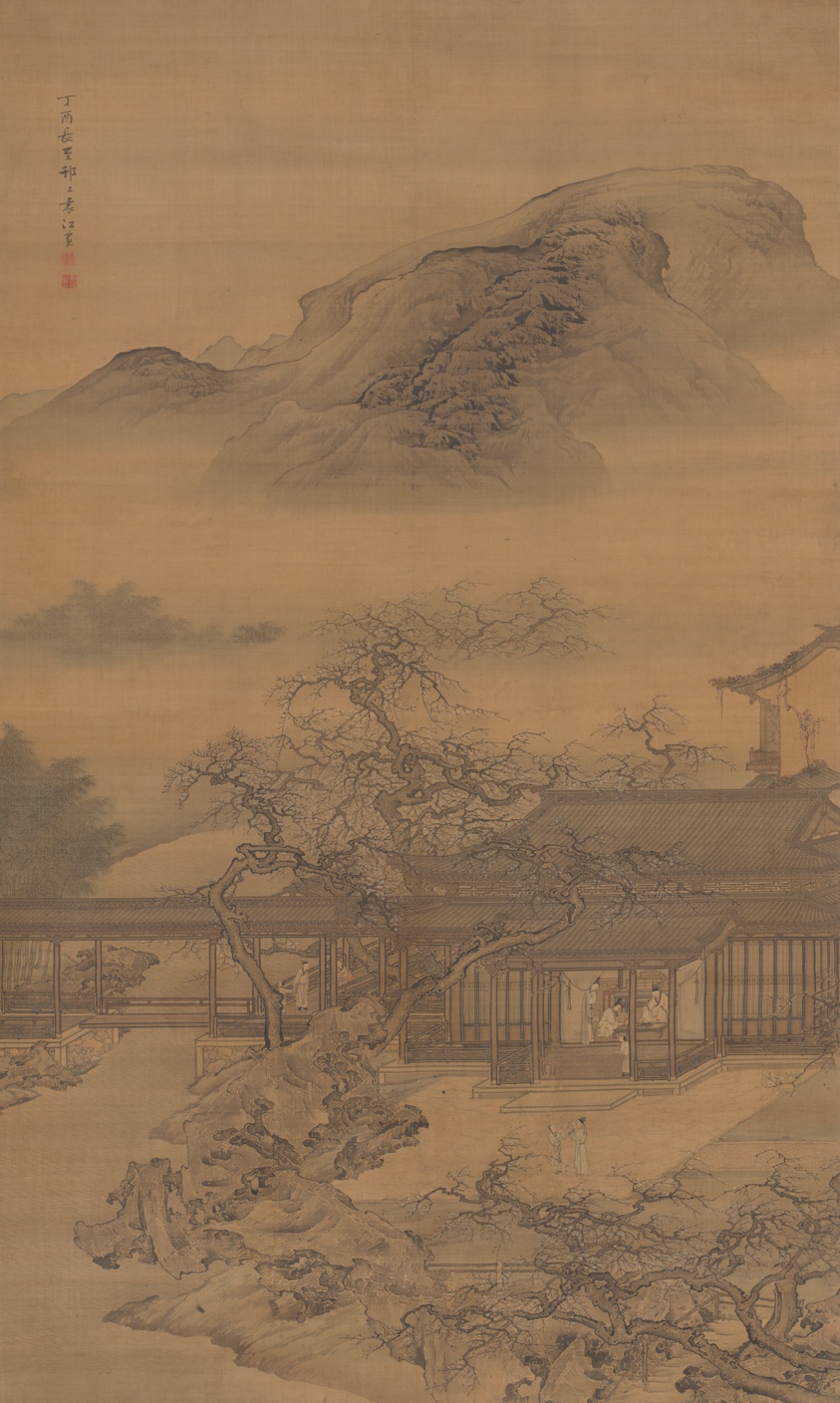
The Materiality of Memory: Deconstructing “Viewing Plum Blossoms with Warm Wine” as a Heritage Artifact
Introduction: The Silk as a Conduit of Cultural Continuity
In the rarefied world of heritage artifacts, where provenance and materiality converge to narrate histories beyond the visual, “Viewing Plum Blossoms with Warm Wine” (溫酒賞梅圖) stands as a masterclass in understated opulence. As a Senior Heritage Specialist at the Lauren Fashion Heritage Lab, I approach this hanging scroll not merely as a painting but as a textile artifact of profound significance—a document of craftsmanship, philosophy, and the enduring dialogue between nature and human refinement. The work, executed in ink and slight color on silk, embodies the quintessence of Chinese literati culture, yet its materiality speaks a universal language of luxury that resonates with the disciplined elegance of London’s Savile Row. Here, silk is not a passive support; it is an active participant in the narrative, a testament to the artisan’s hand and the patron’s discerning eye.
The Silk Substrate: A Study in Craftsmanship and Patina
The scroll’s foundation—a finely woven silk—demands immediate attention. Unlike the robust linen or cotton canvases of Western painting, this silk is a gossamer-thin, almost translucent membrane, its warp and weft so meticulously aligned that the surface appears to breathe. The materiality of this silk is not incidental; it is a deliberate choice that reflects the literati’s reverence for impermanence and elegance. The slight color, likely derived from mineral pigments such as azurite or malachite, is applied with restraint, allowing the silk’s natural luster to filter through. Over centuries, this silk has developed a patina—a subtle yellowing and softening of the weave—that enriches the visual experience. This is not decay but a form of aging akin to the burnished leather of a bespoke shoe or the faded wool of a vintage suit. The patina tells a story of handling, of scrolls unrolled and rerolled in scholarly halls, of incense smoke and candlelight that have gently kissed the surface.
From a conservation perspective, the silk’s condition is paramount. The weave must be stable, the pigments non-flaking, and the mounting—often a complex layering of paper and silk—intact. This scroll’s mounting, with its classic brocade borders in muted gold and celadon, frames the composition without overwhelming it. The choice of mounting silk, likely a damask or satin weave, mirrors the scroll’s own textile heritage, creating a harmonious dialogue between the artwork and its protective casing. This is analogous to the Savile Row tradition of selecting a cloth that complements the cut—the worsted wool that drapes perfectly or the mohair that catches light without glare. In both cases, the material is not merely functional; it is an aesthetic declaration.
Composition and Symbolism: The Literati’s Winter Solace
The painting depicts a solitary scholar, seated by a brazier, warming a flask of wine as he gazes at plum blossoms in the snow. The composition is spare, almost austere, with the figure occupying the lower third of the scroll and the plum branches arching diagonally from the upper left. The ink work is fluid, with swift, calligraphic strokes that define the branches and blossoms. The slight color—a whisper of pink for the petals, a touch of green for the moss—is applied with a lightness that defies the weight of the subject. This restraint is the hallmark of the literati tradition, where emotional depth is conveyed through economy of means. The plum blossom, a symbol of resilience and renewal, blooms in the dead of winter, its fragrance carried by the wind. The warm wine, a metaphor for inner warmth and conviviality, suggests that refinement is not a retreat from the world but a way of engaging with it on one’s own terms.
The scroll’s vertical format, typical of hanging scrolls, invites a slow, contemplative gaze. The viewer’s eye moves from the scholar’s quietude upward to the blossoms, then outward to the implied snow-laden sky. This verticality is a spatial narrative, a journey from the earthly to the ethereal. It mirrors the Savile Row principle of vertical lines in tailoring—the clean, unbroken silhouette that elongates the figure and suggests confidence. Here, the silk’s vertical weave reinforces this upward movement, the threads acting as invisible guides for the eye.
Context and Provenance: The Silk Road of Taste
This scroll likely originated in the Song or early Ming dynasty, a period when silk production reached its apogee in Suzhou and Hangzhou. The silk itself would have been woven in specialized workshops, using silkworms fed on mulberry leaves from specific regions. The dyeing process, often involving natural indigo and madder, would have been a closely guarded secret. The painting’s provenance—its journey from a scholar’s studio to a collector’s cabinet—adds layers of meaning. Each owner, from the Ming literatus to the Qing court official, would have left an imprint: a seal, a colophon, or simply the oils from their hands. These marks are not blemishes but badges of authenticity, akin to the wear on a bespoke suit’s cuffs or the patina on a silver watch case.
In the context of the Lauren Fashion Heritage Lab, this scroll is a case study in how materiality informs heritage. The silk’s fragility demands a controlled environment—low light, stable humidity, and minimal handling. Yet its cultural value is immense. It represents a moment when art and craft were inseparable, when the painter was also a connoisseur of textiles. This holistic approach to luxury is a lesson for modern fashion, where the focus on design often eclipses the material’s story. A Savile Row tailor understands that the cloth’s weave, weight, and finish are as important as the cut. Similarly, this scroll teaches us that the silk’s texture, its response to ink, and its aging over time are integral to the artwork’s meaning.
Conclusion: The Enduring Elegance of the Handmade
“Viewing Plum Blossoms with Warm Wine” is more than a painting; it is a textile artifact that embodies the confluence of materiality, philosophy, and craftsmanship. The silk, with its fluid elegance and subtle patina, is the unsung hero of the composition. It is a reminder that heritage is not static—it is a living dialogue between the past and the present, between the artisan’s hand and the viewer’s eye. For the Lauren Fashion Heritage Lab, this scroll is a touchstone for understanding how luxury is defined not by opulence but by restraint, not by novelty but by continuity. In the quiet contemplation of plum blossoms and warm wine, we find a model for the timeless elegance that Savile Row and the silk weavers of ancient China both strive to achieve: the perfect balance of material, form, and meaning.