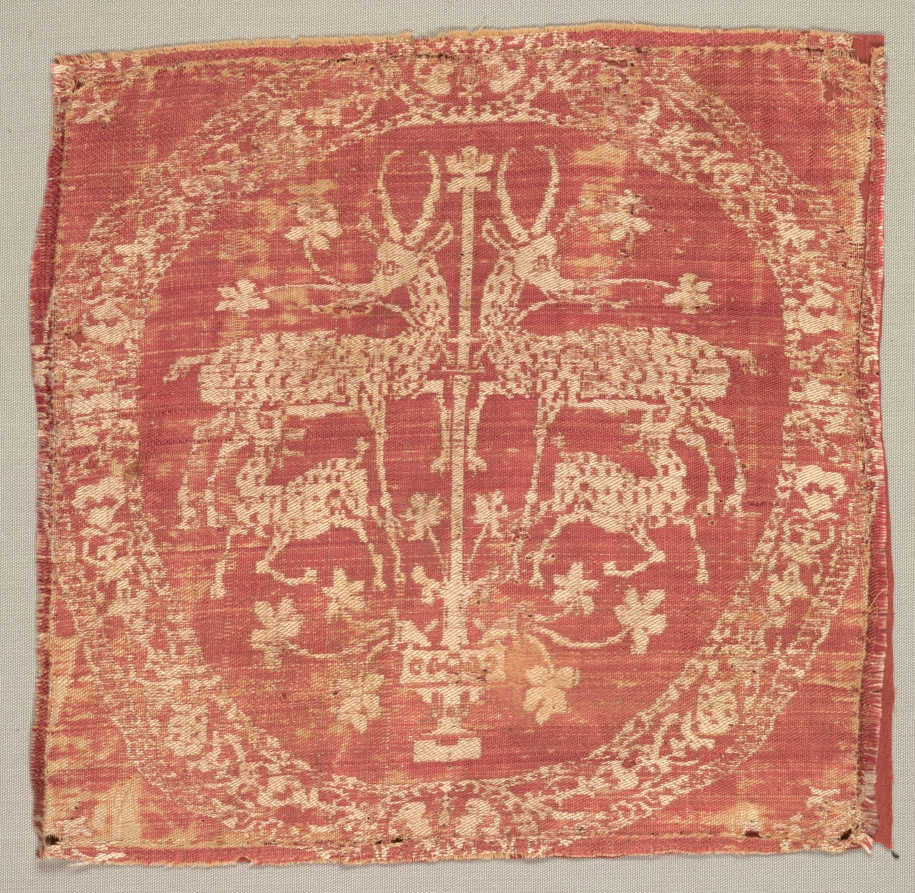
Heritage Research Artifact: Square Ornament from a Tunic
Artifact Identification: Square Ornament, Tunic Fragment
Materiality: Silk, compound weave with supplementary weft patterning
Provenance: Likely Eastern Mediterranean or Central Asian, circa 6th–8th century CE
Contextual Legacy: Imperial Silk Weaving, Byzantine and Sasanian Influence
Introduction: The Square Ornament as a Microcosm of Imperial Craft
In the hushed, wood-paneled ateliers of Savile Row, where the weight of a cloth and the precision of a stitch are matters of near-sacred deliberation, one learns to read materiality as a language. The square ornament from a tunic—a fragment of silk no larger than a gentleman’s pocket square—speaks in a dialect of imperial ambition. It is not merely a decorative device; it is a compressed archive of power, trade, and technical mastery. This artifact, woven from the finest silk threads, embodies the legacy of imperial silk weaving, a tradition that spanned continents and centuries, from the looms of Constantinople to the courts of the Sasanian Empire, and ultimately to the bespoke tailoring houses of London.
The square ornament, likely a tablion or a decorative panel sewn onto a tunic’s shoulder or hem, was a marker of rank and identity. Its geometry—a perfect square—suggests deliberate symmetry, a visual anchor in the flowing drapery of silk tunics worn by elites. The materiality of silk itself is paramount: it was a commodity as precious as gold, controlled by imperial monopolies and traded along the Silk Road. To wear silk was to wear the empire’s reach. This fragment, therefore, is not just a textile; it is a document of geopolitical and economic strategy, rendered in thread.
Materiality: Silk as a Medium of Imperial Narrative
Silk, in its raw state, is a filament of paradox: delicate yet tensile, luminous yet opaque. The square ornament exploits these properties through a compound weave, likely a samite or taqueté structure, where a silk warp and weft create a ground fabric, and a supplementary weft—often of dyed silk or even gilded thread—introduces pattern. The result is a surface that shifts in light, revealing motifs that are both geometric and organic. In this fragment, the square is divided into quadrants, each containing stylized floral or animal forms—perhaps a palmette, a griffin, or a tree of life. These motifs are not arbitrary; they are drawn from a shared visual lexicon of imperial iconography, where the square symbolizes order, the earth, and the four cardinal directions.
The dyeing process further underscores the artifact’s imperial context. The deep crimson, indigo, and gold threads are derived from costly sources: kermes insects for red, indigofera for blue, and metallic threads for gold. These colors were not merely aesthetic; they were regulated. In Byzantium, for instance, only the imperial court could wear certain shades of purple, extracted from the murex mollusk. While this fragment may not contain Tyrian purple, its palette aligns with sumptuary laws that restricted luxury textiles to the ruling class. The square ornament, therefore, is a badge of exclusivity, woven into the very fabric of the tunic.
Contextual Legacy: The Imperial Silk Weaving Tradition
The legacy of imperial silk weaving is a story of theft, innovation, and adaptation. According to Procopius, in the 6th century, Byzantine monks smuggled silkworm eggs from China inside hollow bamboo canes, breaking the Chinese monopoly and establishing sericulture in the Eastern Roman Empire. This act of industrial espionage transformed the Mediterranean economy. Constantinople became the epicenter of silk production, with imperial workshops—the gynaecia—producing textiles for the court, the church, and diplomatic gifts. The square ornament from a tunic is a product of this system, where design was standardized to reflect imperial ideology.
The Sasanian Empire, Byzantium’s great rival, also mastered silk weaving, favoring bold, symmetrical patterns that influenced Islamic art. The square ornament’s geometric precision echoes Sasanian textile design, where repeating motifs—often enclosed in circles or squares—conveyed a sense of cosmic order. When the Arabs conquered Persia in the 7th century, they absorbed these techniques, spreading them across the Islamic world. The square ornament, then, is a node in a network of cultural transmission, linking Roman, Persian, and Islamic aesthetics.
By the medieval period, silk weaving had reached the courts of Europe, where it was prized for liturgical vestments and royal garments. The square ornament’s legacy persists in the pallium of Catholic bishops and the stola of Byzantine emperors. In the Renaissance, Italian city-states like Venice and Lucca became centers of silk production, adapting Eastern motifs into their own designs. The square, as a framing device, appears in Renaissance textiles, where it encloses pomegranates and artichokes—symbols of fertility and abundance.
Savile Row Resonance: The Square Ornament in Bespoke Tailoring
For the Savile Row tailor, the square ornament is not a relic but a reference. The principles of its construction—balance, proportion, and material integrity—are the same that govern a well-cut suit. The square’s geometry mirrors the precision of a jacket’s lapel or the alignment of a stripe. The use of silk, whether in a tie, a pocket square, or a lining, carries the same weight of tradition. A Savile Row client who chooses a silk square for his breast pocket is engaging in a practice that dates back to the imperial courts of Byzantium.
Moreover, the square ornament’s motifs—the palmette, the griffin, the tree of life—have been reinterpreted in modern luxury fabrics. Houses like Holland & Sherry and Scabal produce silk ties and scarves that echo these ancient patterns, often using jacquard looms that are direct descendants of the compound weaves used for the tunic. The legacy of imperial silk weaving is thus alive in the subtle sheen of a silk tie or the intricate pattern of a scarf, worn by a gentleman on Savile Row as a quiet assertion of heritage.
Conclusion: The Square as a Perpetual Ornament
The square ornament from a tunic is a testament to the enduring power of silk as a medium of imperial expression. Its materiality—silk, dye, weave—encodes the economic and political structures of its time. Its context—the legacy of imperial silk weaving—links the looms of Constantinople to the ateliers of London. For the heritage specialist, this fragment is a reminder that fashion is never merely decorative; it is a repository of history, a thread that connects the past to the present. On Savile Row, where every garment is a bespoke artifact, the square ornament continues to inspire, a silent echo of empires woven in silk.