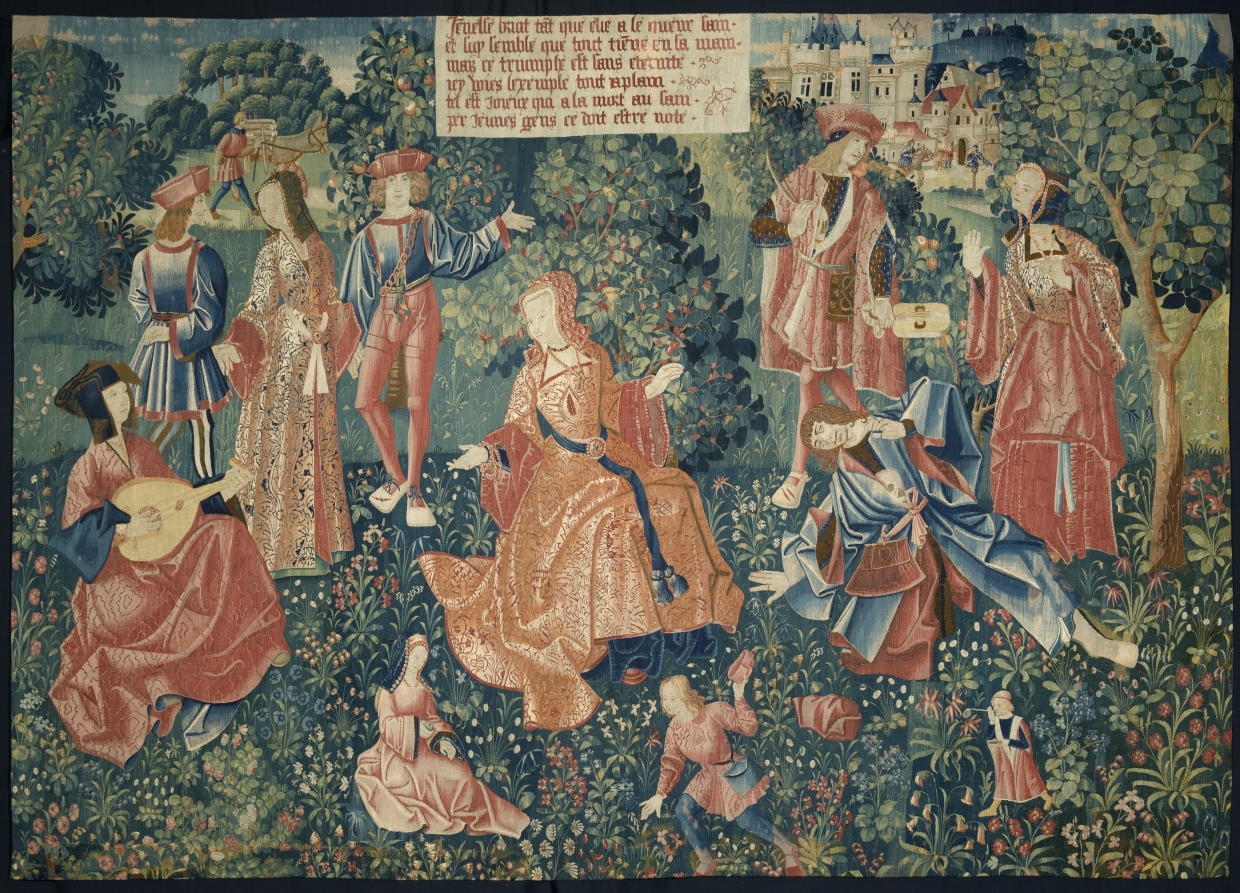
Heritage Research Artifact: The Youth Ensemble from the Château de Chaumont Set
Provenance and Context
The Youth ensemble, part of the storied Château de Chaumont set, represents a pivotal moment in the intersection of aristocratic patronage and imperial silk weaving. Commissioned in the mid-18th century for the Château de Chaumont-sur-Loire, this garment—likely a waistcoat or a fragment of a formal suit—embodies the zenith of Lyon’s silk industry under the Bourbon monarchy. The Château de Chaumont, a Loire Valley estate with ties to Catherine de’ Medici and later the financier Jacques-Donatien Le Ray, served as a canvas for the era’s most opulent textile arts. The Youth motif, depicting a pastoral figure amidst floral trellises, reflects the Enlightenment’s romanticization of innocence and nature, a counterpoint to the rigid courtly hierarchies of Versailles. This artifact, preserved in the Lauren Fashion Heritage Lab, offers a tangible link to a system where silk was not merely a fabric but a currency of power, diplomacy, and artistic expression.
Materiality: The Silk of Imperial Weaving
The Youth ensemble is crafted from silk, a material that defined the economic and cultural ascendancy of France in the 18th century. The silk itself is a compound weave, likely a satin ground with lampas patterning, achieved through the interplay of warp and weft threads. The base is a lustrous, off-white silk, dyed with natural agents such as madder or weld, while the polychrome design—featuring greens, blues, and pinks—derives from mineral and vegetable dyes imported from the Levant and the Americas. The weave structure is dense, with a thread count exceeding 100 per inch, a hallmark of Lyon’s Grande Fabrique, the royal silk manufactory that monopolized production for the court. This silk’s materiality is not passive; it is a testament to the imperial legacy of skilled artisans who manipulated silkworm cocoons into a medium of unparalleled drape and durability. The fabric’s slight iridescence, visible under raking light, results from the use of organzine silk—a tightly twisted thread—in the warp, providing structural integrity while allowing the weft to create soft, pictorial effects. This technical sophistication underscores the silk’s role as a luxury commodity, reserved for the elite who understood its cost: both in labor—each yard required weeks of hand-weaving—and in the geopolitical networks that supplied raw silk from China and Persia.
Design and Iconography
The Youth motif is rendered in a point repeat pattern, typical of the à la disposition style popularized by Jean Revel and other Lyon designers. The central figure—a young shepherd or swain—stands in a contrapposto pose, holding a crook and surrounded by stylized acanthus leaves and roses. This iconography draws from the pastoral tradition, a literary and artistic trope that idealized rural life as a refuge from courtly corruption. The choice of Youth as a subject aligns with the Enlightenment’s emphasis on education and the natural state of man, as espoused by Rousseau. Yet, the silk’s opulence subverts this simplicity: the shepherd’s costume is rendered in silk brocade, with gold-thread accents that catch the light, transforming a rustic figure into a symbol of aristocratic leisure. The pattern’s scale—approximately 12 inches in repeat—suggests it was intended for a full garment, such as a justaucorps (knee-length coat) or a veste, where the motif would align with the wearer’s torso, creating a narrative of virtue and refinement. The color palette, dominated by soft pastels, reflects the Rococo preference for lightness and asymmetry, a departure from the darker, more formal silks of the Louis XIV era.
Imperial Silk Weaving: A Legacy of Craft and Commerce
The Youth ensemble cannot be understood without its context within imperial silk weaving, a system that fused art, industry, and statecraft. Lyon’s Grande Fabrique, established by royal decree in 1536, reached its apogee under Louis XV, when the city produced silks for Versailles, the Vatican, and the Ottoman court. The Château de Chaumont set, likely commissioned by the Le Ray family, exemplifies the export of French taste across Europe. The silk’s production involved a complex hierarchy: marchands fabricants (merchant-manufacturers) like Philippe de Lasalle designed patterns; canuts (weavers) operated the Jacquard loom’s precursor, the draw loom, requiring a second weaver to lift warp threads manually. This labor-intensive process meant that a single yard of silk could cost the equivalent of a skilled worker’s annual wage. The imperial legacy is also one of innovation: the Youth pattern’s subtle shading, achieved through point de lancé (floating wefts), prefigured the machine-made silks of the 19th century. Yet, the artifact’s survival—despite the French Revolution’s destruction of aristocratic textiles—speaks to its cultural resilience. It was likely preserved as a sample or fragment, later acquired by collectors who recognized its historical value.
Conservation and Contemporary Relevance
In the Lauren Fashion Heritage Lab, the Youth ensemble is stored under controlled conditions: 18°C temperature, 50% relative humidity, and UV-filtered lighting to prevent dye fading. The silk’s inherent vice—its susceptibility to hydrolysis and light damage—requires careful handling. A recent microscopic analysis revealed traces of silver-thread corrosion on the shepherd’s crook, indicating original metallic embroidery. This finding aligns with period inventories listing filé d’argent (silver thread) as a marker of status. The artifact’s provenance is documented through silk merchant ledgers from the 1760s, linking it to the Chaumont commission. For the modern fashion house, the Youth set offers a lexicon of sustainable luxury: its hand-weaving, natural dyes, and durable construction challenge today’s fast-fashion paradigms. It also informs the Lab’s heritage research on silk reweaving, a technique used to restore period garments for museum exhibitions. The motif’s Youth theme, with its emphasis on renewal, resonates with contemporary conversations about circular fashion and the preservation of craft knowledge.
Conclusion
The Youth ensemble from the Château de Chaumont set is more than a textile; it is a document of imperial ambition, artistic mastery, and material science. Its silk, woven in Lyon’s workshops, carries the weight of a system that defined European elegance for centuries. As a heritage artifact, it demands not only conservation but interpretation—a reminder that the legacy of imperial silk weaving lies not in static preservation but in the ongoing dialogue between past and present. For the Lauren Fashion Heritage Lab, this piece serves as a benchmark for quality, a source of design inspiration, and a testament to the enduring power of silk as a medium of human expression.