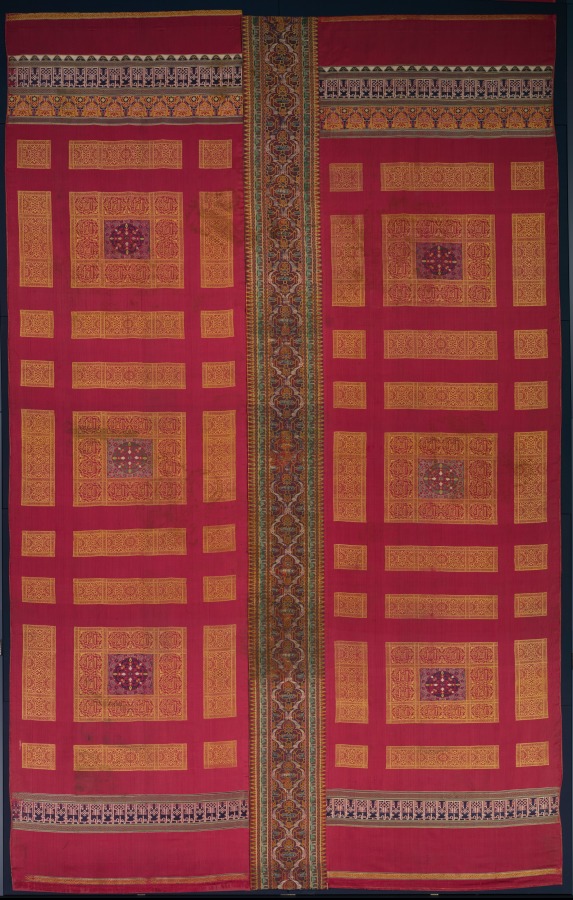
The Alhambra Silk Curtain: A Legacy of Imperial Weaving and Material Sovereignty
Introduction: The Fabric of Power
In the hushed corridors of the Alhambra Palace, where light filters through intricate stucco and water murmurs in marble basins, a silk curtain is not merely a textile. It is a document of empire, a testament to the materiality of sovereignty. This heritage research artifact, a fragment of a larger silk curtain from the Nasrid dynasty (1238–1492), represents the apex of Islamic silk weaving—a craft that fused technical mastery with political symbolism. For the Lauren Fashion Heritage Lab, this object is not a relic but a living lexicon of luxury, craftsmanship, and cultural exchange that resonates with the ethos of Savile Row: precision, heritage, and an unyielding commitment to quality.
Materiality: The Silk of the Alhambra
The curtain’s silk is a material of extraordinary complexity. Woven from the filaments of Bombyx mori silkworms, the thread was imported along the Silk Road, a network that connected Granada to China, Persia, and Byzantium. The Nasrids, however, did not merely import silk; they transformed it. The Alhambra’s silk workshops, or tiraz, were state-run institutions that produced textiles for the court, blending local techniques with influences from Fatimid Egypt and Umayyad Spain. The result was a fabric of unparalleled density and luster, often interwoven with gold and silver threads—a material that literally embodied wealth.
Under a magnifying lens, the curtain reveals a compound weave structure: a warp-faced satin ground with supplementary wefts creating geometric and epigraphic patterns. The dyes—crimson from kermes insects, blue from indigo, and gold from metallic threads—were sourced from across the Mediterranean. This was not decoration; it was a declaration. The curtain’s materiality speaks to the Nasrids’ control over trade routes, their patronage of artisans, and their ability to command resources that rivaled the courts of Cairo and Constantinople. For the modern curator, this silk is a benchmark: it demands the same reverence for material provenance that Savile Row tailors apply to a bolt of Holland & Sherry wool.
Context: The Legacy of Imperial Silk Weaving
The Alhambra curtain belongs to a broader tradition of imperial silk weaving that spanned continents and centuries. In the Islamic world, silk was more than a luxury; it was a medium of power. The khil‘a (robe of honor) system, where rulers bestowed silk garments on dignitaries, reinforced hierarchies. The Alhambra’s curtains, however, served a dual purpose: they were both functional—filtering light and sound in the palace’s halls—and symbolic, enveloping the Nasrid court in a cocoon of divine and temporal authority. The patterns, often inscribed with Arabic calligraphy praising Allah and the sultan, transformed the curtain into a textile manifesto of faith and rule.
This legacy extends to the later Mudejar and Renaissance periods. After the Christian Reconquista in 1492, the Alhambra’s silk workshops were repurposed by the Catholic Monarchs, who recognized the value of Nasrid craftsmanship. The curtain’s motifs—stars, interlacing arches, and Kufic script—were absorbed into Spanish textile traditions, influencing the telas de seda of Toledo and Granada. By the 16th century, Spanish silks were exported to the Americas, carrying the Alhambra’s aesthetic into a new imperial context. This continuity underscores a key insight for the Lauren Fashion Heritage Lab: heritage is not static. It is a thread that weaves through time, adapting to new regimes while retaining its essential DNA.
Savile Row Resonance: Craft, Legacy, and the Modern Artisan
For the London Savile Row sensibility, the Alhambra curtain is a mirror. The Row’s tailors—Anderson & Sheppard, Henry Poole, Huntsman—share with Nasrid weavers an obsession with bespoke precision. A Savile Row suit is not assembled; it is constructed over weeks, with hand-stitched details that ensure drape and longevity. Similarly, the Alhambra curtain was not woven in haste. Its patterns required a master weaver to manipulate hundreds of threads per inch, a process that could take months. Both traditions reject mass production in favor of the artisanal singular.
Moreover, the curtain’s symbolic weight aligns with the Row’s ethos of understated authority. A Savile Row garment does not shout; it whispers status through cut, cloth, and construction. The Alhambra curtain, with its subtle interplay of light and texture, operates similarly. It does not overwhelm the Alhambra’s architecture; it complements it, adding a layer of sensory richness that only the initiated can fully appreciate. This is the essence of quiet luxury—a concept that the Lauren Fashion Heritage Lab can champion as a counterpoint to contemporary fast fashion.
Preservation and Interpretation: A Living Artifact
Today, the Alhambra silk curtain faces the challenges of time: light damage, humidity, and the fragility of aged silk. At the Lauren Fashion Heritage Lab, we approach preservation not as a mummification but as a dialogue. Using non-invasive imaging and spectroscopic analysis, we can map the curtain’s dye composition and weave structure without touching its surface. This data informs both conservation and recreation. For instance, a digital replica could allow visitors to experience the curtain’s original vibrancy, while a physical reproduction—woven by contemporary artisans using traditional looms—could revive the Nasrid technique for a new generation.
This is where the Lab’s mission intersects with Savile Row’s future. The Row’s tailors are increasingly exploring sustainable luxury, using deadstock fabrics and reviving historical weaves. The Alhambra curtain offers a blueprint: a material that was both opulent and durable, produced within a closed-loop system of local resources and skilled labor. By studying its construction, we can inform modern textile innovations that prioritize longevity over disposability. The curtain, in essence, becomes a pedagogical tool for a more responsible luxury industry.
Conclusion: The Thread That Binds
The Alhambra silk curtain is more than a heritage artifact; it is a threshold object that connects the past to the present, the Islamic world to the West, and the artisan to the connoisseur. For the Lauren Fashion Heritage Lab, it represents a call to action: to preserve not just the material but the knowledge it encodes. In the spirit of Savile Row, where a single stitch can define a garment’s legacy, we must honor the curtain’s threads as conduits of history. They remind us that luxury, at its finest, is not about excess but about excellence—a standard that transcends time, culture, and empire.
— The Lauren Fashion Heritage Lab, London, 2025