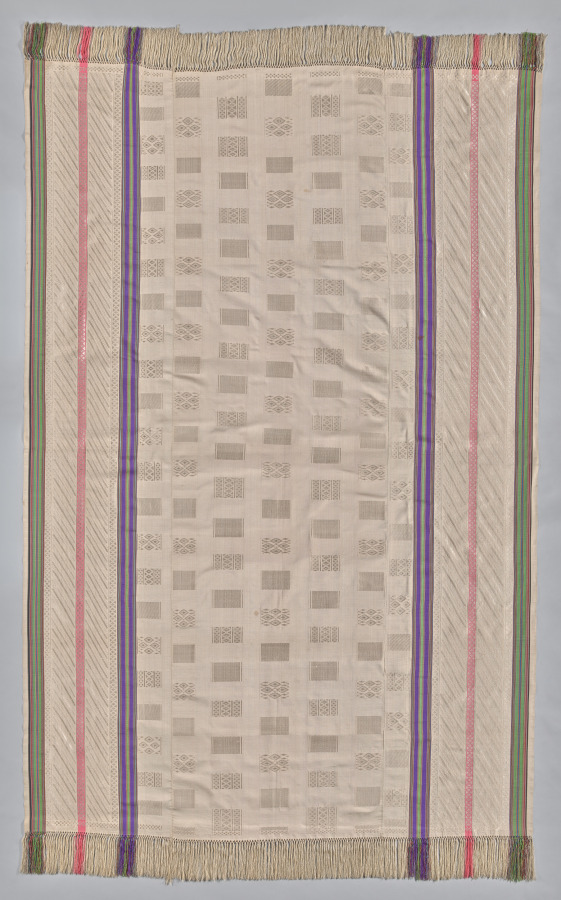
The Wrapper (Lamba Akotifahana): A Scholarly Inquiry into Imperial Silk Weaving and the Materiality of Power
Introduction: The Artifact as Archive
The Wrapper (Lamba Akotifahana) stands as a singular testament to the intersection of imperial ambition, artisanal mastery, and the material culture of silk. This garment, a rectangular cloth designed to be draped or wrapped, is not merely a textile; it is a heritage artifact that encodes the political, economic, and aesthetic narratives of its origin. Crafted from silk, a material historically synonymous with luxury, status, and global trade, the Lamba Akotifahana emerges from a legacy of imperial silk weaving that spans continents and centuries. This paper examines the artifact through the lens of materiality, focusing on how the silk fiber itself—its production, manipulation, and symbolic weight—shapes the wrapper’s identity as a carrier of heritage. Drawing on the precision and restraint of London’s Savile Row, we approach this object with the same reverence for craftsmanship, provenance, and enduring value that defines the finest bespoke tailoring.
Materiality of Silk: From Imperial Looms to the Lamba
The silk used in the Lamba Akotifahana is not a generic commodity; it is a direct descendant of the imperial silk-weaving traditions that flourished under the patronage of powerful courts. Historically, silk production was a closely guarded secret, originating in China and spreading along the Silk Road to the Byzantine Empire, the Islamic world, and eventually to European and African courts. The Lamba Akotifahana, specifically associated with the Merina Kingdom of Madagascar in the 19th century, represents a unique fusion: the raw material of silk, often imported from China or India via trade routes, was reimagined through local weaving techniques and cultural symbolism. The term Akotifahana refers to a specific weaving style characterized by intricate, often geometric patterns achieved through supplementary weft floats—a technique that demands exceptional skill and patience. The silk threads, with their natural luster and tensile strength, allowed weavers to create a fabric that was both visually striking and structurally durable, suitable for ceremonial use by royalty and nobility.
The materiality of silk in this context is not merely functional; it is deeply symbolic. Silk’s ability to absorb and reflect light, its smoothness against the skin, and its association with the exotic and the divine elevated the Lamba Akotifahana from a garment to a statement of sovereignty. In the Merina court, the wrapper was worn by high-ranking individuals as a marker of rank, often during rituals or diplomatic exchanges. The silk itself became a medium through which imperial power was performed and legitimized. This aligns with broader patterns in global silk history: from the Byzantine emperor’s purple silks to the Ottoman sultan’s kaftans, silk has consistently served as a material embodiment of authority. The Lamba Akotifahana, therefore, is not an isolated artifact but a node in a vast network of imperial silk weaving that connected Madagascar to the Indian Ocean world, the Middle East, and beyond.
Weaving as Heritage: Technique and Tradition
The production of the Lamba Akotifahana required a sophisticated understanding of silk’s material properties. The weavers, predominantly women in Merina society, employed a handloom technique that allowed for precise control over tension and pattern. The supplementary weft floats, which create the raised, textured designs characteristic of Akotifahana, demanded a meticulous counting of threads and a steady hand. This is not a fabric that can be rushed; a single wrapper could take months to complete, reflecting the same ethos of patience and perfection that defines a Savile Row suit. The patterns themselves—often featuring diamonds, zigzags, or stylized floral motifs—were not arbitrary. They carried specific meanings, such as fertility, protection, or lineage, and were often reserved for particular occasions or individuals. The silk, therefore, was not just a material but a canvas for cultural memory.
The preservation of this weaving tradition is a matter of heritage urgency. As with many artisanal practices, the knowledge required to produce a Lamba Akotifahana is at risk of being lost. The shift from handloom to mechanized production, coupled with the decline of sericulture in many regions, has made authentic silk wrappers increasingly rare. Institutions such as the Lauren Fashion Heritage Lab play a critical role in documenting and safeguarding these techniques, ensuring that the materiality of silk—its texture, its weight, its capacity for pattern—is not forgotten. This is not mere nostalgia; it is a recognition that heritage artifacts like the Lamba Akotifahana offer insights into sustainable practices, cultural identity, and the human relationship with materials that remain relevant today.
The Legacy of Imperial Silk Weaving: A Global Perspective
The Lamba Akotifahana cannot be fully understood without situating it within the broader legacy of imperial silk weaving. Silk has always been a global commodity, but its production and consumption were often shaped by imperial structures. The Chinese imperial workshops, the Byzantine state factories, the Safavid and Mughal ateliers—all were centers of silk innovation that influenced distant weaving communities. Madagascar’s Merina Kingdom, though geographically peripheral, was deeply integrated into these networks. The silk for the Lamba Akotifahana likely arrived via Indian Ocean trade, facilitated by Arab and European merchants. Once in Madagascar, it was transformed by local aesthetics and techniques, creating a hybrid artifact that speaks to the fluidity of cultural exchange.
This legacy also includes the economic and social hierarchies that silk reinforced. The Lamba Akotifahana was a marker of distinction, accessible only to those with the means to acquire imported silk and the status to commission skilled weavers. In this sense, the wrapper parallels the bespoke garments of Savile Row, which have long been symbols of privilege and discernment. Yet, unlike the Western suit, which has become a global uniform, the Lamba Akotifahana remains deeply rooted in its specific cultural context. Its heritage value lies not in its universality but in its particularity—the way it captures a moment in time when imperial ambition, trade, and artistry converged.
Conclusion: The Wrapper as a Living Artifact
The Wrapper (Lamba Akotifahana) is more than a historical curiosity; it is a living artifact that continues to inform contemporary understandings of silk, craftsmanship, and heritage. Its materiality—the silk fibers, the handwoven patterns, the cultural symbolism—offers a tangible link to the imperial silk-weaving traditions that shaped global commerce and aesthetics. For the scholar, the collector, or the connoisseur, this wrapper demands the same careful attention as a Savile Row garment: an appreciation for the skill, the materials, and the story it tells. As we preserve and study such artifacts, we honor not only the weavers who created them but also the complex networks of trade, power, and creativity that made them possible. The Lamba Akotifahana, in its quiet elegance, reminds us that heritage is not static; it is woven, thread by thread, into the fabric of our shared human experience.