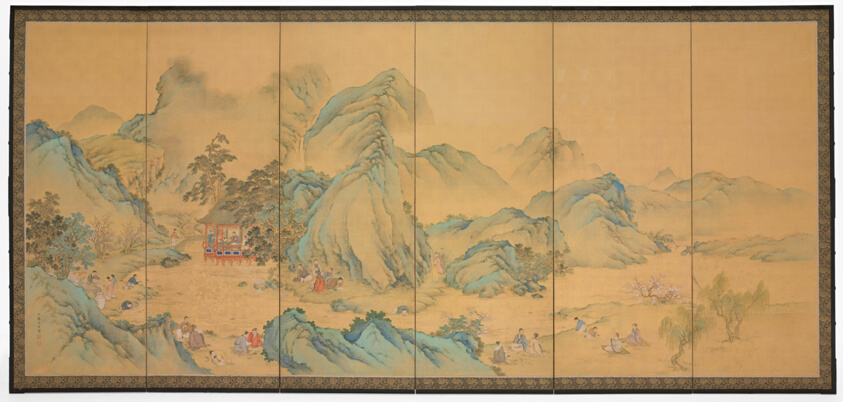
An Examination of Dualities: The Lauren Fashion Heritage Lab Presents a Bifurcated Masterpiece
In the considered pursuit of sartorial and artistic excellence, one must acknowledge that true distinction often resides not in singular statements, but in the cultivated dialogue between contrasting ideals. It is with this principle in mind that the Lauren Fashion Heritage Lab presents for scholarly contemplation a singular artifact: a pair of six-panel screens, a bifurcated masterpiece that articulates, with profound material intelligence, the essential dialogue between public ceremony and private reflection, between opulent tradition and distilled modernity. This piece does not merely hang upon a wall; it commands a space, structuring the very atmosphere with its dual narrative.
The Frontispiece: The Gathering at the Orchard Pavilion – A Tapestry of Social Fabric
The obverse face presents “The Gathering at the Orchid Pavilion,” an episode immortalised in Chinese cultural memory. Here, the medium is the unequivocal message. Executed in ink, colours, and gold on silk, the craftsmanship is an exercise in authoritative elegance. The silk ground is not a passive canvas; it is the foundational luxury, a material whisper of status and historical continuity, comparable to the foundational hand-stitching concealed within a bespoke morning coat. Its inherent sheen provides a luminous depth, upon which the narrative unfolds.
The application of gold—whether in delicate leaf or finely ground pigment—is not mere embellishment. It is the architectural element, delineating the flowing lines of scholarly robes, highlighting the curve of a wine cup held in poetic contemplation, or tracing the ripples of the serpentine stream. This use of gold mirrors the precise application of gold thread in military brocade or the discreet shine of a perfectly chosen button on a lapel. The assembled literati, engaged in the flowing cup game and composition of verse, are rendered with a fluid elegance that belies the rigorous discipline of the brushwork. Each figure, each drape of fabric, each character of inscribed poetry, is positioned with the deliberate balance of a well-composed wardrobe—each element essential, nothing superfluous, yet the overall effect is one of effortless conviviality. This is the public self: cultured, ornate, and operating within a celebrated tradition.
The Reverse: Geese Among Reeds – The Poetry of Austerity
To turn these screens is to pass from the salon to the solitary study, from the chromatic symphony to a monochromatic haiku. The reverse presents “Geese Among Reeds,” executed in ink and silver on paper. The shift in materiality is a calculated masterstroke, a deliberate and knowing contrast. The silk is replaced by paper—a more intimate, absorbent, and humble ground. The opulent gold yields to the cooler, more elusive luminosity of silver.
This is where the artifact reveals its most profound heritage insight: the understanding that luxury is also defined by restraint. The silver, tarnished to a soft, smoky patina over time, interacts with the paper in a manner silk would never permit. It speaks of moonlight on water, of mist rising from marshland, of quiet thought. The subject matter complements this material austerity. The reeds are suggested with swift, calligraphic strokes; the geese are impressions, their forms emerging from the negative space with the subtlety of a half-Windsor knot dimpling a fine twill shirt. This is the essence of fluid elegance—not the flow of wine or conversation, but the flow of ink from a loaded brush, the flow of the natural world undisturbed, the flow of private introspection. It is the sartorial equivalent of a perfectly tailored charcoal flannel suit: its power lies in cut, proportion, and texture, not in adornment.
Context and Connoisseurship: The Cut and Weave of Heritage
The context of classic silk craftsmanship and fluid elegance is thus fully realised not in one side alone, but in the tension and harmony between the two. The six-panel format itself is a structural marvel, a folding architecture that allows the piece to define space with the adaptability of a room divider in a Mayfair residence. It references a long tradition of such screens in Eastern interiors, objects that were both artistic and functional, much as a well-made Chesterfield sofa or a library bookcase is in the West.
The true heritage lesson here is one of complementary opposition. The front face demonstrates the pinnacle of a communal, material craft—the woven silk, the meticulous pigmentation, the narrative grandeur. It is the heritage of the atelier, the visible badge of cultivated taste. The reverse face champions the individual, the spontaneous, the meditative craft of the artist’s hand in direct communion with a simpler material. It is the heritage of the philosopher’s study, the private confidence that needs no gilding.
For the modern connoisseur, this artifact serves as a permanent sartorial seminar. It instructs that a robust heritage is not monolithic. It is a curated collection of identities: the public and the private, the ornate and the austere, the silk and the paper. To possess only one is to have an incomplete wardrobe. The gentleman understands that the magnificence of the brocade waistcoat is elevated by the plainness of the white poplin shirt beneath it. Similarly, these screens teach us that the gold of social accomplishment gains its lustre precisely because it is backed by the silver-toned depth of private reflection. The Lauren Fashion Heritage Lab presents this piece not as a relic, but as a continuing dialogue—a timeless lesson in the material grammar of enduring style.