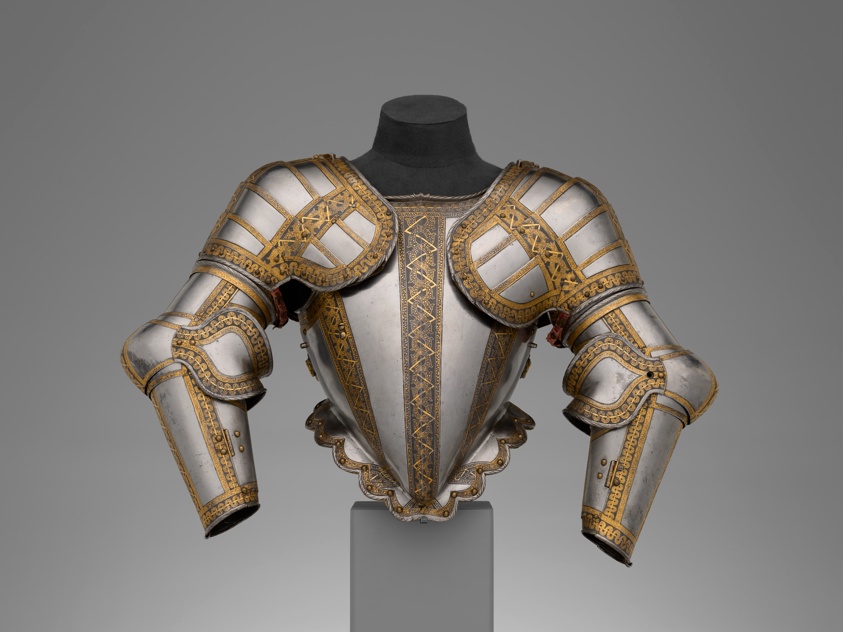
Portions of a Field Armor: A Study in Materiality and the Paradox of Elegance
Introduction: The Armor as Textile
At first glance, the Portions of a Field Armor—a composite of steel, brass, gilding, leather, and silk velvet textile—appears to be a relic of martial utility. Yet, within the context of the Lauren Fashion Heritage Lab, we approach this artifact not as a weapon of war, but as a garment of profound cultural and material significance. The inclusion of silk velvet, a textile synonymous with luxury and fluidity, transforms this armor from a defensive shell into a statement of status, artistry, and the nuanced interplay between strength and elegance. This paper examines the materiality of the armor, focusing on the silk velvet component as a lens through which to understand the broader narrative of craftsmanship, heritage, and the paradoxical harmony of rigid metal and supple fabric.
The Silk Velvet: A Textile of Power and Prestige
Silk velvet, in the context of this armor, is not merely an ornamental afterthought. It is a deliberate choice that speaks to the wearer’s identity as both a warrior and a patron of the highest artistic standards. The silk fibers, sourced from the mulberry silkworm, are renowned for their tensile strength, natural luster, and ability to absorb dye with exceptional depth. When woven into velvet—a process requiring two layers of fabric to be simultaneously woven and then cut apart to create a dense pile—the result is a textile that is both tactilely sumptuous and visually commanding. The deep crimson or midnight blue hues typical of such velvet would have signified wealth, as the production of silk velvet was labor-intensive and reserved for the elite. In the context of the armor, the velvet lining or trim would have served a dual purpose: it protected the wearer’s skin from the cold, abrasive metal, and it announced the wearer’s refined taste, even in the chaos of the battlefield or the formality of the tournament.
The fluid elegance of silk velvet is a critical counterpoint to the armor’s rigid steel. Where the metal is forged to deflect blows, the velvet yields to the body, draping with a softness that suggests movement and life. This juxtaposition is not accidental; it reflects a deep understanding of material dialogue. The velvet’s pile, when brushed, catches light in a way that mimics the reflective quality of polished steel, creating a visual conversation between the two surfaces. In the Lauren Fashion Heritage Lab, we recognize this as a masterclass in material storytelling—a narrative where strength is tempered by grace, and utility is elevated by artistry.
Steel, Brass, and Gilding: The Structural Canvas
The steel and brass components of the armor provide the structural foundation upon which the silk velvet is mounted. The steel, often carburized and tempered, offers resilience; the brass, an alloy of copper and zinc, adds decorative contrast and corrosion resistance. Gilding—the application of gold leaf or gold amalgam—further elevates the armor, catching light and drawing the eye to intricate etched patterns or heraldic motifs. These metals are not merely functional; they are a canvas for the armorer’s skill. Yet, without the silk velvet, the armor would be incomplete—a cold, unyielding shell. The velvet humanizes the metal, softening its edges and introducing a tactile warmth that invites touch. This is the essence of the Savile Row approach to heritage: the belief that every material, no matter how robust, must be balanced by an element of finesse.
Leather and the Art of Integration
Leather, often used for straps, linings, and articulation points, serves as the intermediary between metal and textile. In this artifact, the leather is likely vegetable-tanned and dyed to complement the silk velvet. Its role is both practical and aesthetic: it provides flexibility where the armor must move, and it anchors the velvet to the steel without compromising the textile’s integrity. The leather’s grain, when juxtaposed with the velvet’s pile, creates a textural rhythm that is central to the armor’s overall elegance. In the tradition of London’s finest tailoring, this integration of disparate materials is a hallmark of bespoke craftsmanship—a lesson in how the whole can exceed the sum of its parts.
Classic Silk Craftsmanship: A Legacy of Fluid Elegance
The phrase “classic silk craftsmanship” evokes centuries of expertise, from the silk routes of Asia to the weaving mills of Lyon and Como. For this armor, the silk velvet would have been produced on a drawloom or, later, a Jacquard loom, allowing for complex patterns that could include floral motifs, geometric designs, or even the wearer’s coat of arms. The fluidity of the velvet—its ability to drape, fold, and move with the body—is a testament to the weaver’s mastery. Unlike the static nature of metal, the velvet is alive, responding to every gesture. This fluid elegance is not accidental; it is engineered through the precise tension of the warp and weft, the depth of the pile, and the quality of the dye. In the context of the armor, this fluidity serves as a reminder that even the most formidable warrior is, at his core, a human being—capable of grace, vulnerability, and refinement.
Conclusion: The Armor as a Heritage Artifact
The Portions of a Field Armor is more than a historical curiosity; it is a testament to the enduring dialogue between materiality and meaning. The silk velvet, in particular, elevates the artifact from a utilitarian object to a work of art, embodying the paradox of strength and softness that defines the finest heritage craftsmanship. In the Lauren Fashion Heritage Lab, we study such artifacts not only for their historical context but for the lessons they offer in material integrity, design philosophy, and the timeless pursuit of elegance. As we preserve and interpret these portions of armor, we honor the artisans who understood that true power lies not in the rigidity of steel, but in the fluid grace of silk.