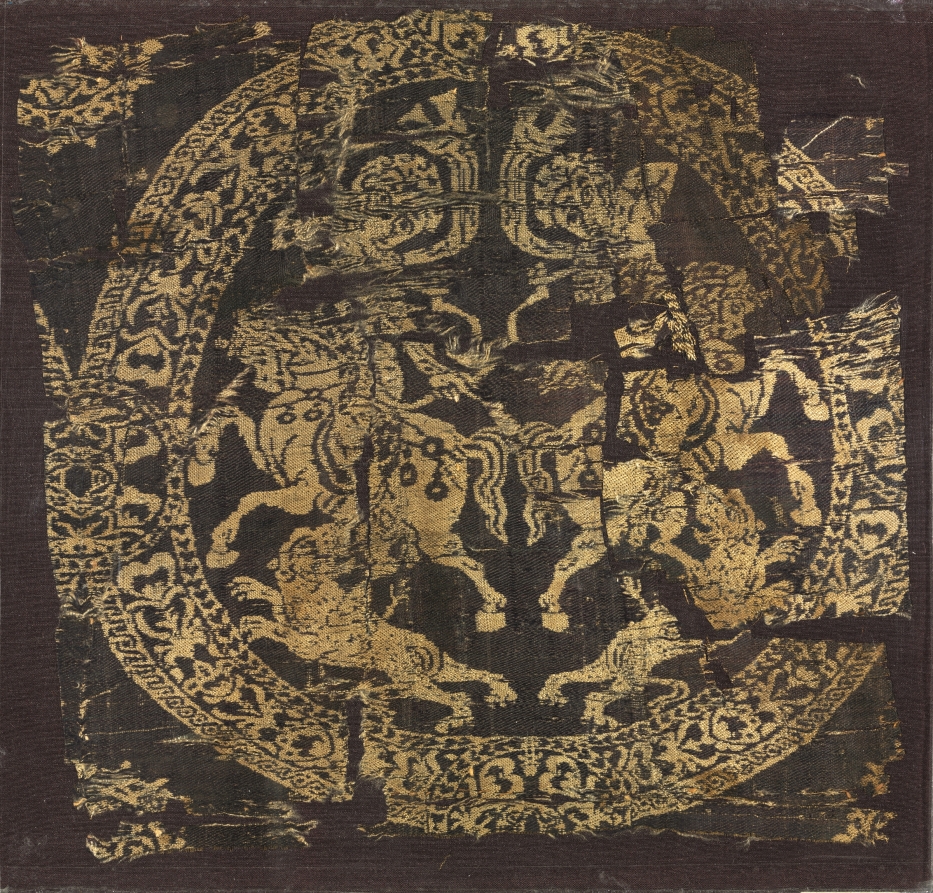
The Roundel with Amazons: A Testament to Imperial Silk Weaving
Introduction: The Artifact in Context
The Roundel with Amazons, a silk fragment from a tunic dating to the late antique period (circa 5th–7th century CE), represents a pinnacle of imperial silk weaving. This artifact, housed in collections such as the Victoria and Albert Museum, is not merely a decorative textile but a profound cultural document. Its materiality—silk—speaks to the complex networks of trade, power, and artistry that defined the Byzantine and Sasanian empires. For the Lauren Fashion Heritage Lab, this roundel offers a critical lens through which to examine the legacy of silk as a medium of imperial identity, gender symbolism, and technical mastery. In the spirit of London’s Savile Row—where precision, heritage, and understated luxury converge—this analysis will dissect the roundel’s material, iconographic, and historical significance, drawing parallels to contemporary fashion’s enduring fascination with silk as a marker of status and storytelling.
Materiality: Silk as Imperial Currency
Silk, in the context of this roundel, was not a commodity but a strategic resource. The Byzantine Empire, inheriting Roman traditions, guarded sericulture as a state secret, with silk weaving concentrated in imperial workshops in Constantinople, Antioch, and Alexandria. The Roundel with Amazons exemplifies the technical sophistication of these ateliers: the weave is a compound twill, likely executed on a drawloom, allowing for intricate polychrome patterns. The silk threads, dyed with madder, indigo, and kermes, retain a luminosity that even centuries of aging cannot diminish. This vibrancy was intentional—silk’s ability to absorb and reflect light made it a symbol of divine and imperial radiance. For the wearer, likely a high-ranking official or aristocrat, this tunic was a declaration of allegiance to the empire’s economic and artistic hegemony. The roundel’s placement on the tunic—often at the shoulder or chest—further emphasized its role as a focal point of authority.
The materiality of silk also underscores the globalized nature of early medieval luxury. Raw silk traveled from China along the Silk Road, was processed in Byzantine or Sasanian workshops, and then re-exported across the Mediterranean and into Northern Europe. This roundel, therefore, is a physical record of cross-cultural exchange. The Amazon motif, however, is distinctly classical, harkening back to Greek and Roman iconography. This fusion of Eastern material and Western imagery is a hallmark of imperial silk weaving, where the medium itself became a canvas for political and cultural narratives.
Iconography: The Amazon as a Symbol of Power and Paradox
The depiction of Amazons on this roundel is both striking and deliberate. In Greek mythology, Amazons were warrior women who challenged patriarchal norms, often depicted in battle scenes with Greek heroes. On a tunic—a garment intimately associated with the male body—this imagery carries layered meanings. The Amazons here are not merely decorative; they are emblems of martial virtue and imperial conquest. For Byzantine elites, the Amazon represented the idealized other: a figure of strength, discipline, and exoticism that mirrored the empire’s own military ambitions. Yet, the paradox lies in the fact that these warrior women are rendered in silk—a fabric synonymous with luxury, sensuality, and the feminine. This tension between martial and material, masculine and feminine, is a recurring theme in imperial textiles.
The roundel’s composition is equally telling. The Amazons are shown in dynamic poses, wielding weapons and shields, their drapery flowing in a manner that recalls classical sculpture. The use of symmetry and circular framing—a hallmark of Sasanian and Byzantine roundels—creates a sense of order and eternity. This geometric precision is not accidental; it reflects the imperial desire to impose structure on chaos, both in art and in governance. The roundel, therefore, functions as a microcosm of the empire’s worldview: a controlled, harmonious universe where even the most rebellious figures are tamed within the confines of silk and thread.
Legacy: Imperial Silk Weaving and Its Modern Echoes
The legacy of imperial silk weaving extends far beyond the fall of Constantinople. The techniques perfected in Byzantine workshops—compound weaves, polychrome dyeing, and narrative roundels—became the foundation for later European silk industries, particularly in Italy and France. The Roundel with Amazons is a direct ancestor of the silk brocades and damasks that adorned Renaissance courts and, later, the ateliers of Savile Row. In fact, the Savile Row tradition of using silk for linings, ties, and bespoke details owes a debt to these early imperial textiles. The emphasis on craftsmanship, material integrity, and symbolic resonance remains unchanged.
For the Lauren Fashion Heritage Lab, this artifact offers a blueprint for understanding how fashion functions as a repository of cultural memory. The Amazon roundel is not just a piece of cloth; it is a narrative device that encodes power, gender, and globalism. In contemporary fashion, designers like John Galliano, Alexander McQueen, and Dries Van Noten have drawn on similar iconography, using silk as a medium to explore themes of war, identity, and mythology. The roundel’s circular form, in particular, has been reinterpreted in modern prints and embroideries, from runway collections to high-street collaborations. This continuity underscores the timelessness of silk as a storytelling tool.
Conclusion: A Thread Through Time
The Roundel with Amazons is more than an artifact; it is a testament to the enduring power of silk as a medium of imperial ambition and artistic expression. Its materiality—silk—connects the Byzantine court to the Silk Road, the classical world to the medieval, and the ancient to the contemporary. For the Lauren Fashion Heritage Lab, this roundel serves as a reminder that fashion is never merely superficial. It is a language of power, a record of exchange, and a canvas for the human imagination. As we continue to study and preserve such artifacts, we honor the legacy of those who wove not just threads, but histories. In the quiet precision of a Savile Row tailor’s stitch, or the bold pattern of a silk scarf, the spirit of the Amazon roundel lives on—a testament to the fact that the finest fabrics are those that carry the weight of the world.