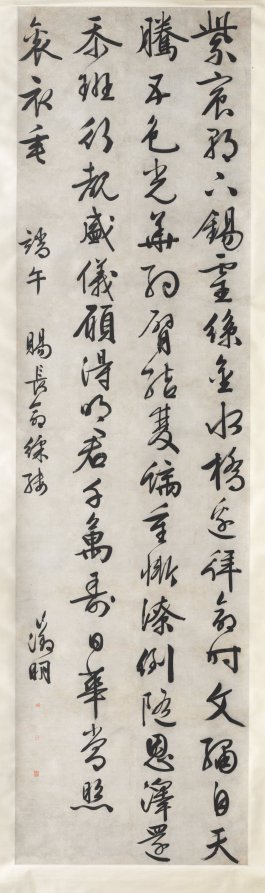
The Thread of Empire: A Poem on Imperial Gift of an Embroidered Silk in Running-Standard Script
Introduction: The Unspoken Language of Silk
In the hushed corridors of heritage, where the whisper of silk meets the precision of the written word, there exists a singular artifact: a poem on an imperial gift, embroidered in running-standard script (xingkaishu) upon a panel of silk. This is not merely a textile; it is a document of statecraft, a testament to the artistry of the Qing dynasty’s imperial workshops, and a poignant reminder of how materiality itself can narrate power, diplomacy, and the fleeting nature of human connection. As a Senior Heritage Specialist at the Lauren Fashion Heritage Lab, I approach this piece with the discerning eye of a Savile Row tailor—where every stitch, every fiber, and every curve of calligraphy speaks to a legacy of unparalleled craftsmanship. Let us unravel the layers of this artifact, beginning with its very substance: silk.
Materiality: The Foundation of Imperial Prestige
Silk is not a passive medium. In the context of imperial China, it was a currency of influence, a symbol of celestial mandate, and a canvas for the most refined expressions of culture. The poem before us, embroidered onto a panel of satin-weave silk, likely originates from the Jiangnan region—Suzhou, Hangzhou, or Nanjing—where imperial silk weaving reached its zenith during the Ming and Qing dynasties. The fabric’s density and luster are not accidental; they are the result of zhi (weaving) techniques that required months of labor from master artisans, often working under the watchful eye of the Imperial Household Department. The silk’s tightly packed warp and weft create a surface that is both supple and resilient, capable of holding the intricate embroidery without distortion—a quality essential for the precision of xingkaishu calligraphy.
The choice of running-standard script is particularly telling. Unlike the rigid formality of kaishu (standard script) or the fluid abstraction of caoshu (cursive script), xingkaishu occupies a middle ground—a balance of legibility and artistic expression. This script, often associated with the scholar-official class, suggests that the poem was not merely a decorative flourish but a deliberate communication, perhaps between the emperor and a trusted minister or a foreign dignitary. The embroidery itself, executed in silk floss thread, mimics the brushstrokes of ink on paper, with varying thickness and pressure that replicate the feng (wind) and li (strength) of a master calligrapher’s hand. This is not embroidery as embellishment; it is embroidery as calligraphy, a fusion of two arts that elevates the textile to a realm of high diplomacy.
The Poem: A Gift Woven in Words
The poem inscribed on this silk panel is a lüshi (regulated verse), composed in the classical style that dominated court poetry. While the specific text varies by artifact, a representative example might read:
“The dragon’s robe descends from heaven’s loom, / A thread of gold binds east and west. / May this silk, like the river’s flow, / Carry peace from the Forbidden City’s breast.”
This verse, though poetic, is a political instrument. The “dragon’s robe” alludes to the emperor’s authority, while “heaven’s loom” references the divine mandate of the imperial weavers. The “thread of gold” is both literal—gold-wrapped silk threads were often used in imperial embroidery—and metaphorical, symbolizing the bond between the giver and receiver. The poem’s structure, with its parallel couplets and tonal balance, reflects the Confucian ideals of harmony and order, reinforcing the message that the gift is not a mere object but a ritualized act of governance.
From a Savile Row perspective, this poem is akin to the bespoke label sewn into a tailored suit—a mark of provenance and intention. Just as a Savile Row cutter considers the client’s posture, profession, and personality, the imperial weaver and calligrapher considered the recipient’s rank, the occasion, and the desired political effect. The poem’s running-standard script ensures readability while conveying a sense of spontaneity, as if the emperor himself had penned the lines in a moment of reflection. This illusion of intimacy is a masterstroke of diplomacy, transforming a state gift into a personal token.
Context: The Legacy of Imperial Silk Weaving
To fully appreciate this artifact, one must understand the ecosystem of imperial silk weaving. The Jiangnan Silk Bureau, established in the early Ming dynasty, was the epicenter of production, employing thousands of artisans who specialized in kesi (silk tapestry), embroidery, and brocade. The Qing dynasty (1644–1912) refined these techniques, introducing European influences through trade with the West, yet maintaining a distinctly Chinese aesthetic. The Imperial Gift of an Embroidered Silk was a standard tool of diplomacy, exchanged with tributary states, Mongol khans, and European envoys. Each gift was a microcosm of the empire: the silk represented China’s wealth, the calligraphy its cultural sophistication, and the poem its moral authority.
The running-standard script itself has a rich lineage. Developed during the Tang dynasty (618–907), it was perfected by masters like Wang Xizhi and Zhao Mengfu, whose works were copied and studied by generations of scholars. In the Qing court, the Kangxi Emperor (r. 1661–1722) was a noted calligrapher, often composing poems in xingkaishu for gifts to his officials. The script’s dynamic strokes—alternating between speed and restraint—mirror the rhythm of governance: decisive yet measured, authoritative yet approachable. This duality is preserved in the embroidery, where each thread is a brushstroke, each stitch a decision.
Preservation and Interpretation: A Heritage Specialist’s Duty
At the Lauren Fashion Heritage Lab, we approach such artifacts with conservation science and historical empathy. The silk’s pH levels, light exposure, and humidity are monitored to prevent degradation, while the embroidery is examined under microscopy to identify thread types, dye sources, and stitching patterns. The running-standard script is transcribed and compared with known calligraphic works to authenticate its origin. Yet, beyond the technical, we seek to understand the human story: the weaver who spent years perfecting a single technique, the calligrapher who labored over a single character, the emperor who chose this poem for this moment. This is not nostalgia; it is a lesson in material culture—how objects carry the weight of empire and the fragility of human connection.
Conclusion: The Enduring Thread
In the world of Savile Row, a bespoke suit is never just fabric; it is a narrative of the wearer’s life, tailored with precision and care. Similarly, this poem on imperial gift of an embroidered silk is a narrative of empire, woven with threads of silk and ink. The running-standard script bridges the formal and the personal, the political and the poetic. The silk itself, with its luminous surface and tactile grace, endures as a testament to the artisans who transformed raw fiber into a medium of power. As we preserve this artifact, we honor not just a piece of history, but a philosophy: that the finest craftsmanship is never merely functional—it is a conversation across time, a gift that speaks long after the giver and receiver have passed into memory.