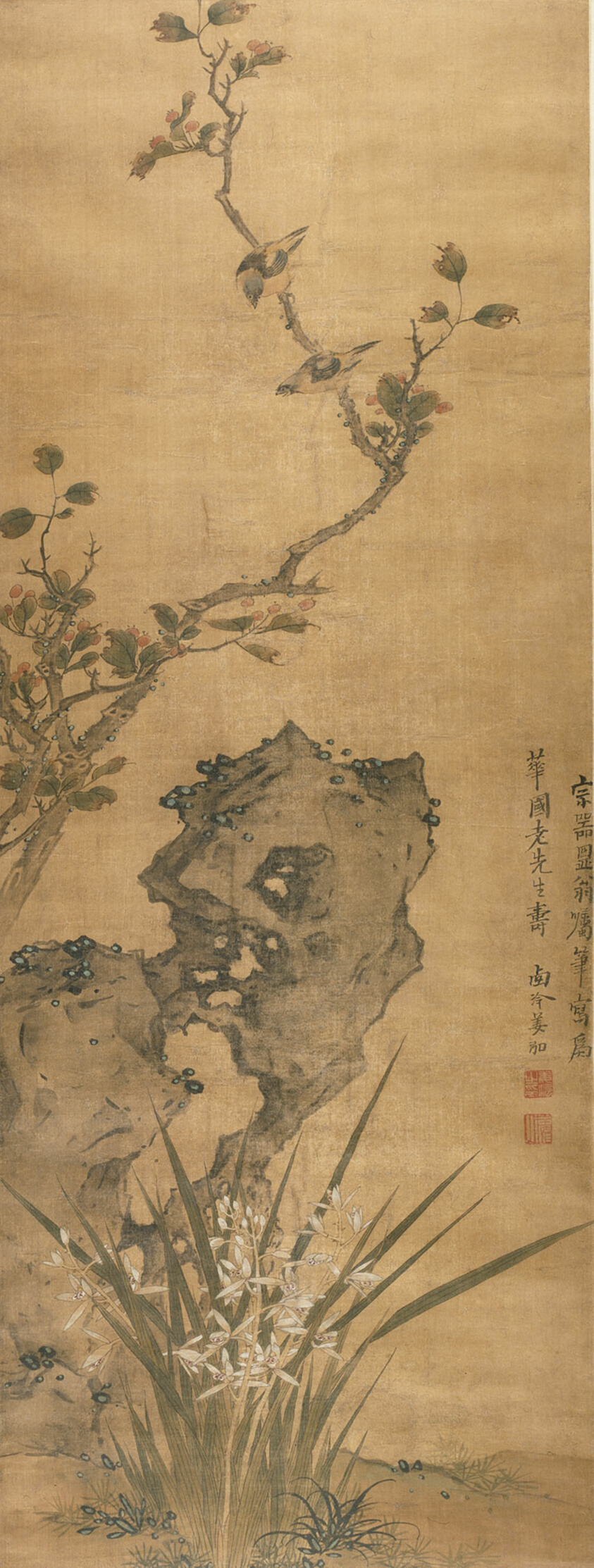
The Enduring Legacy of Silk: A Study of “Birds on a Tree with Fruit and Autumn Foliage”
Introduction: The Artifact as a Testament to Craftsmanship
The heritage artifact under examination—a hanging scroll titled “Birds on a Tree with Fruit and Autumn Foliage”—represents a pinnacle of classical silk craftsmanship. Executed in ink and colors on silk, this scroll embodies the fluid elegance that has defined East Asian artistic traditions for centuries. As a Senior Heritage Specialist at the Lauren Fashion Heritage Lab, I approach this artifact not merely as a decorative object but as a material testament to the symbiotic relationship between natural imagery and luxurious textile heritage. The scroll’s composition—a tree laden with ripe fruit, vibrant autumn leaves, and perched birds—serves as a visual narrative of seasonal transition, abundance, and the meticulous artistry that elevates silk from a fabric to a cultural artifact. This paper will dissect the materiality, context, and enduring relevance of such works within the framework of luxury heritage, drawing parallels to the bespoke ethos of London’s Savile Row.
Materiality: The Silk Canvas as a Medium of Distinction
The choice of silk as the primary support for this hanging scroll is far from arbitrary. Silk, revered for its luminosity, tensile strength, and capacity to absorb pigment with unparalleled subtlety, has been a cornerstone of luxury textiles for millennia. In this artifact, the silk ground is not a passive backdrop but an active participant in the visual experience. The weave’s natural sheen interacts with the ink and mineral pigments, creating a dynamic interplay of light and shadow that mimics the dappled quality of autumn sunlight filtering through foliage. The fluid elegance of the brushwork—evident in the sinuous branches and the delicate rendering of bird feathers—is amplified by the silk’s smooth surface, which allows for precise, unbroken strokes. This is a material that demands mastery; the artist must account for the fabric’s absorbency and translucency, much as a Savile Row tailor must understand the drape and weight of a fine worsted wool. The scroll’s preservation over centuries speaks to the durability of silk when handled with reverence, a quality that aligns with the heritage principle of enduring luxury—objects designed not for ephemeral trends but for generational stewardship.
Composition and Symbolism: The Language of Nature in Luxury
The imagery of “Birds on a Tree with Fruit and Autumn Foliage” operates on multiple symbolic levels, each reinforcing the scroll’s status as a sophisticated cultural artifact. The tree, likely a persimmon or pomegranate, laden with fruit, signifies abundance and prosperity—a motif common in East Asian art but rendered here with a restraint that avoids overt opulence. The autumn foliage, depicted in hues of amber, crimson, and gold, evokes the transient beauty of the season, a theme that resonates with the Japanese concept of mono no aware (the bittersweet awareness of impermanence). The birds, often identified as magpies or thrushes, introduce a dynamic element; their poised stances suggest a moment of stillness before flight, capturing the tension between permanence and change. This interplay of stability and motion is a hallmark of classic silk craftsmanship, where the artist’s hand must balance precision with spontaneity. In the context of luxury heritage, such imagery aligns with the Savile Row principle of understated elegance—where meaning is conveyed through subtlety rather than excess. The scroll does not shout its richness; it invites contemplation, much like a perfectly cut suit that reveals its quality through fit and fabric rather than ostentatious detailing.
Context: The Hanging Scroll as a Bespoke Object
To fully appreciate this artifact, one must consider its original context within the domestic and ceremonial spaces of elite households. Hanging scrolls, or kakemono, were not merely decorative; they were curated objects displayed during specific seasons or occasions, reflecting the owner’s cultural sophistication and connection to nature. The choice of autumn foliage and fruit suggests a seasonal rotation, where the scroll would be hung during harvest festivals or moon-viewing gatherings. This practice mirrors the bespoke ethos of Savile Row, where garments are tailored not only to the client’s physique but also to their lifestyle and occasions. The scroll’s fluid elegance—its ability to harmonize with its surroundings—echoes the way a well-made suit integrates into a gentleman’s wardrobe, enhancing without overwhelming. The silk support, with its inherent luxury, further elevates the object, positioning it as a marker of status and taste. In a heritage context, this scroll is not a mass-produced commodity but a unique creation, much like a commission from a master tailor. The artist’s signature, often discreetly placed, serves as a hallmark of authenticity, akin to a Savile Row label stitched into a jacket’s lining.
Preservation and Interpretation: The Role of the Heritage Specialist
As a Senior Heritage Specialist, my role extends beyond cataloging this artifact to interpreting its relevance for contemporary audiences. The scroll’s materiality—silk, ink, and mineral pigments—requires careful conservation. Silk is sensitive to light, humidity, and handling; its preservation demands a controlled environment that respects its organic nature. This aligns with the heritage principle of responsible stewardship, where the object’s longevity is prioritized over immediate accessibility. In interpreting the scroll, I draw parallels to the fashion industry’s current revival of artisanal techniques. The classic silk craftsmanship evident in this work—the hand-painted details, the precision of the brushwork—offers a counterpoint to fast fashion’s disposability. It reminds us that luxury is not merely about price but about the time, skill, and narrative embedded in an object. For the Lauren Fashion Heritage Lab, this scroll serves as a case study in how heritage can inform modern design. The fluid lines of the birds, the organic asymmetry of the branches, and the restrained color palette could inspire a collection of silk scarves or evening wear, translating tradition into contemporary elegance.
Conclusion: The Scroll as a Living Heritage
“Birds on a Tree with Fruit and Autumn Foliage” is more than a historical artifact; it is a living document of silk’s capacity to convey beauty, meaning, and craftsmanship. Its materiality—ink and colors on silk—speaks to a tradition of excellence that transcends geographical and temporal boundaries. The scroll’s fluid elegance, symbolic depth, and contextual richness position it as a touchstone for understanding luxury heritage. In the spirit of Savile Row, where tradition and innovation coexist, this artifact challenges us to see heritage not as static but as a source of inspiration for future creation. As we preserve and interpret such works, we honor the artisans who transformed silk into poetry, ensuring that their legacy continues to inform and elevate the discourse of luxury. The scroll, like a fine bespoke garment, endures because it embodies the principles of quality, intention, and timelessness—values that remain as relevant today as they were centuries ago.