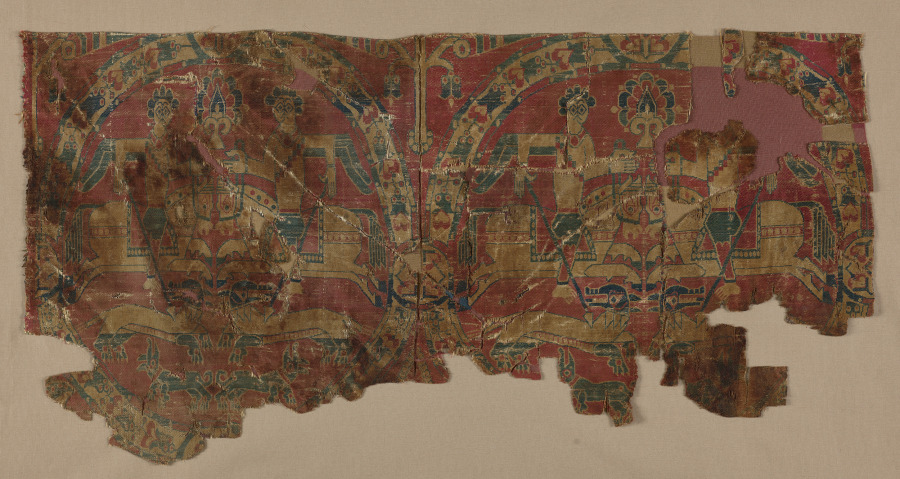
The Roundels with Hunters: A Study in Imperial Silk Weaving and the Legacy of Craft
Introduction: The Artifact as a Testament to Power
The Roundels with Hunters, rendered in silk, represent a pinnacle of imperial weaving that transcends mere textile production. As a Senior Heritage Specialist at the Lauren Fashion Heritage Lab, I approach this artifact not as a decorative fragment but as a strategic document of authority, status, and cross-cultural exchange. The roundel—a circular medallion often used to adorn ceremonial garments, wall hangings, or saddle cloths—embodies the meticulous discipline of silk weaving that flourished under empires such as the Byzantine, Sasanian, and Tang dynasties. This paper examines the materiality, technical mastery, and symbolic resonance of these roundels, situating them within the broader legacy of imperial silk weaving that continues to influence luxury craftsmanship today, particularly in the bespoke traditions of London’s Savile Row.
Materiality: Silk as a Conduit of Prestige
The choice of silk is no accident. Silk, derived from the cocoons of Bombyx mori, was a commodity of immense value, often reserved for imperial courts and religious institutions. Its production required vast resources—mulberry groves, skilled labor, and complex looms—making it a symbol of economic and political might. In the context of the Roundels with Hunters, the silk’s lustrous surface and ability to hold intricate dyes allowed for the depiction of dynamic hunting scenes, a motif that resonated across cultures. The hunters, often depicted on horseback with bows or spears, symbolize the ruler’s dominion over nature and enemies, reinforcing the imperial narrative of control and vitality.
The materiality of these roundels also speaks to the technical sophistication of imperial workshops. The use of compound weaves, such as samite or lampas, enabled the creation of complex patterns with multiple colors and textures. In the Roundels with Hunters, the silk’s warp and weft are manipulated to produce a raised, almost sculptural effect, where the hunters’ garments and the horses’ manes appear to emerge from the fabric. This tactile richness was not merely aesthetic; it served a functional purpose in ceremonial settings, where light and movement would animate the designs, captivating viewers and reinforcing the wearer’s status.
Context: The Legacy of Imperial Silk Weaving
The legacy of imperial silk weaving is a narrative of transmission and adaptation. The Roundels with Hunters likely originated from the Sasanian Empire (224–651 CE), where silk weaving reached extraordinary heights. Sasanian motifs—such as the senmurv (a mythical griffin) and hunting scenes—were later absorbed by Byzantine and Islamic weavers, who reinterpreted them for their own courts. The roundel format itself became a standard for imperial textiles, as seen in the famous Shroud of St. Josse or the Hunt Carpet from the Safavid period. This cross-pollination underscores the role of silk as a medium of diplomacy and cultural exchange, with rulers gifting these textiles to forge alliances or assert dominance.
In the Tang dynasty (618–907 CE), Chinese weavers adopted the roundel motif, blending it with indigenous symbols like the dragon or phoenix. The Roundels with Hunters, however, retain a distinctly Central Asian or Persian flavor, suggesting they were produced in regions where nomadic and sedentary traditions intersected. The hunters’ attire—often depicted with flowing scarves and pointed hats—reflects the equestrian culture of the steppes, while the silk’s weave indicates a settled, urban workshop. This duality is a hallmark of imperial silk weaving: the ability to synthesize diverse influences into a cohesive, authoritative aesthetic.
Symbolism: The Hunt as Imperial Allegory
The hunting scene in these roundels is not a simple depiction of sport; it is a political allegory. In many imperial traditions, the hunt was a metaphor for the ruler’s role as protector and provider. The hunter, often the king or a noble, demonstrates courage, skill, and mastery over chaos—qualities essential for governance. The prey, whether a lion, stag, or boar, represents the forces of disorder that the ruler must subdue. By weaving this scene into silk, the artifact becomes a portable declaration of authority, worn or displayed to remind subjects and rivals of the ruler’s legitimacy.
Moreover, the roundel’s circular form reinforces this symbolism. The circle, with no beginning or end, evokes eternity and the cyclical nature of power. In many cultures, it also represents the cosmos, with the hunter at the center as a microcosm of the divine order. This cosmological dimension is amplified by the silk’s luminosity, which in certain lights appears to glow, suggesting a connection to the celestial realm. For the imperial court, these roundels were not mere decorations; they were ritual objects that mediated between the earthly and the divine.
Legacy: From Imperial Workshops to Savile Row
The legacy of imperial silk weaving endures in the bespoke traditions of London’s Savile Row, where craftsmanship and heritage are paramount. The Roundels with Hunters, with their emphasis on precision, material integrity, and narrative depth, resonate with the ethos of houses like Anderson & Sheppard or Henry Poole & Co. These tailors, like the imperial weavers of old, understand that a garment is more than cloth; it is a statement of identity and status. The use of silk in Savile Row suits, ties, and linings echoes the same reverence for the material that defined the roundels. Indeed, many contemporary luxury brands draw inspiration from historical motifs, reinterpreting them for modern clients who seek a connection to a storied past.
Furthermore, the technical innovations of imperial weaving—such as the use of jacquard looms (a direct descendant of earlier drawlooms)—continue to inform textile production. The roundels’ complex patterns, once painstakingly woven by hand, can now be replicated with digital precision, but the soul of the craft remains in the hands of skilled artisans. At the Lauren Fashion Heritage Lab, we study these artifacts to understand how heritage can inform sustainable luxury. The Roundels with Hunters remind us that quality endures, and that the stories woven into fabric are as valuable as the fabric itself.
Conclusion: The Enduring Power of Silk
The Roundels with Hunters are more than a heritage artifact; they are a testament to the enduring power of silk as a medium of imperial ambition and artistic excellence. From the Sasanian courts to the ateliers of Savile Row, the legacy of imperial silk weaving continues to shape our understanding of luxury, craftsmanship, and cultural exchange. As we preserve and study these roundels, we honor not only the weavers who created them but also the timeless principles of quality and narrative that define true heritage. In a world of fast fashion and disposable goods, the Roundels with Hunters stand as a quiet, luminous reminder of what we risk losing—and what we must strive to preserve.