← BACK TO ARCHIVES
Silk
Heritage Synthesis: Roundel from a Tunic with Palmette Tree
Curated on Jun 17, 2026 // Node: LDN-01
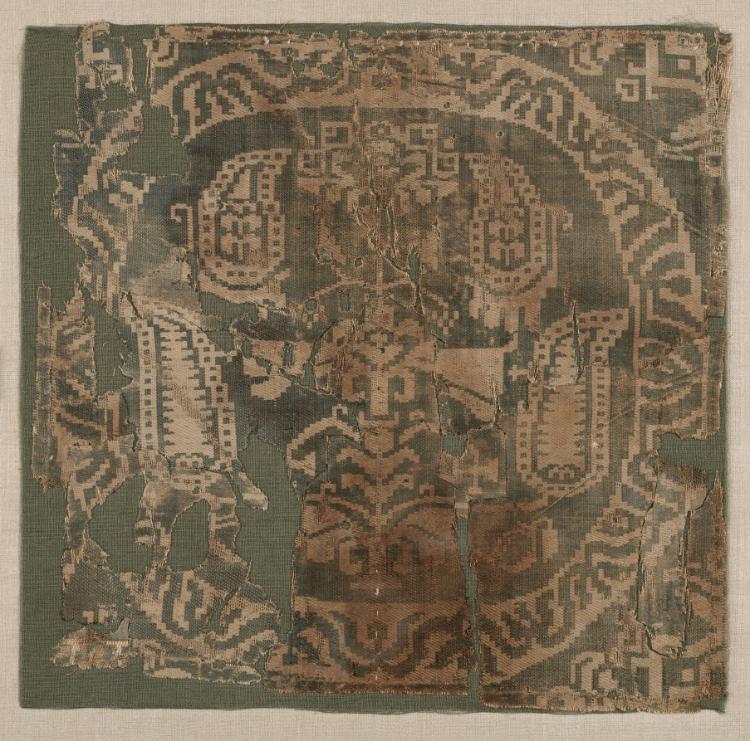
The Roundel from a Tunic with Palmette Tree: A Study in Imperial Silk Weaving and the Enduring Legacy of Craft
As a Senior Heritage Specialist at Lauren Fashion Heritage Lab, I am frequently tasked with examining artifacts that bridge the chasm between ancient technique and modern luxury. The subject of this analysis—a silk roundel from a tunic, featuring a palmette tree motif—is not merely a fragment of textile history; it is a testament to the unbroken lineage of imperial silk weaving, a discipline whose principles of precision, material reverence, and narrative design continue to inform the highest echelons of tailoring, including the hallowed streets of Savile Row. This artifact, likely originating from the Sassanid or early Islamic period (circa 6th–9th century CE), embodies a sophisticated dialogue between power, artistry, and the natural world, rendered in a medium that has long been synonymous with status and refinement.
Materiality and the Silk Imperative
The choice of silk as the foundational material is not incidental. In the context of imperial weaving, silk was a currency of influence, a commodity as valuable as gold, and a medium through which rulers projected authority across vast territories. This roundel, woven from a tightly twisted, high-twist silk thread, demonstrates a mastery of sericulture that was closely guarded by the empires of Persia, Byzantium, and later, the Islamic caliphates. The silk’s lustrous surface, even in its current aged state, retains a subtle sheen that speaks to the original weaver’s ability to manipulate light and shadow. The weave structure, likely a compound twill or a samite variant, allowed for the creation of intricate, multi-coloured patterns without compromising the fabric’s drape or durability—a technical feat that parallels the structural integrity demanded by a Savile Row tailor when constructing a bespoke suit.
The materiality of this silk roundel also underscores a critical lesson for contemporary heritage practitioners: the fabric is not a passive canvas but an active participant in the design. The weaver had to account for the silk’s natural elasticity, its tendency to reflect light differently depending on the angle, and its capacity to hold dye with exceptional vibrancy. The deep indigo and madder red hues that remain visible in the roundel’s palmette tree are evidence of a dyeing process that was both chemically sophisticated and culturally significant. These colours were not merely decorative; they signified royal patronage, religious symbolism, and geographic origin. For instance, the use of true purple, derived from mollusks, was reserved for the highest echelons of Byzantine and Sassanid courts, while the reds and blues here suggest a more accessible but still elite status.
The Palmette Tree: A Motif of Power and Continuity
At the heart of this roundel lies the palmette tree, a motif that transcends cultural boundaries yet remains distinctly imperial in its execution. The palmette, often stylized as a symmetrical, fan-shaped leaf or tree, is a recurring symbol in ancient Near Eastern and Mediterranean art, representing life, fertility, and the cosmic order. In the context of this tunic roundel, the palmette tree is not a naturalistic rendering but a highly controlled, geometric abstraction. The tree’s trunk is composed of interlocking, diamond-shaped forms, while its branches culminate in paired, curling leaves that echo the horns of a ram or the wings of a mythical creature. This fusion of botanical and zoomorphic elements is a hallmark of Sassanid and early Islamic textile design, where the natural world was reimagined as a structured, hierarchical system—much like the imperial court itself.
The roundel’s circular format is equally significant. In imperial silk weaving, the roundel served as a framing device that contained and ordered the design, creating a self-contained universe of meaning. This format was often used on tunics worn by courtiers and military elites, where the roundels would be positioned at the shoulders, chest, or hem, functioning as badges of rank. The repetition of the palmette tree within the roundel—often mirrored or rotated to create a sense of infinite regress—reinforced the idea of an eternal, unchanging order. This is a concept that resonates deeply with the Savile Row ethos, where a well-cut jacket is not a fleeting fashion but a timeless investment in form and function.
Weaving as a Legacy of Imperial Craft
The legacy of imperial silk weaving is not merely a historical curiosity; it is a living tradition that informs the way we understand luxury and craftsmanship today. The weavers who created this roundel were not anonymous artisans but highly trained specialists, often working in state-run workshops under the direct patronage of the emperor or caliph. Their techniques—such as the use of a drawloom to control thousands of individual warp threads—required years of apprenticeship and a deep understanding of both mathematics and aesthetics. This level of specialization is mirrored in the Savile Row tailoring houses, where a master cutter may spend decades perfecting the art of pattern drafting, and a coat maker may dedicate an entire career to the construction of a single garment’s shoulder.
Moreover, the roundel’s design process—from the initial sketch to the final woven cloth—involved a collaborative effort between designers, dyers, and weavers that is strikingly similar to the relationship between a Savile Row designer and their team of artisans. The palmette tree motif, for instance, would have been first rendered on paper or parchment, then translated into a point paper diagram that dictated the exact placement of each thread. This meticulous planning ensured that the final product was not only beautiful but also structurally sound, capable of withstanding the rigours of court life and, eventually, centuries of storage.
Preservation and the Contemporary Relevance
As a heritage specialist, I am acutely aware that the preservation of artifacts like this roundel is not an act of nostalgia but a strategic investment in the future of craft. The silk’s fragility—its tendency to fray, fade, and disintegrate over time—demands a conservation approach that balances scientific rigor with aesthetic sensitivity. At the Lauren Fashion Heritage Lab, we employ climate-controlled storage, low-light display conditions, and non-invasive imaging techniques to document the roundel’s structure without causing further damage. This work is directly analogous to the care a Savile Row tailor takes in preserving a client’s bespoke suit, ensuring that it remains a wearable heirloom for generations.
The palmette tree roundel also offers a powerful lesson in the enduring value of heritage motifs. In an era of fast fashion and disposable design, the deliberate, symbolic nature of this artifact reminds us that true luxury is not about novelty but about depth of meaning. The palmette tree, with its roots in ancient cosmology, continues to appear in contemporary fashion—from the embroidered motifs on a Dior couture gown to the jacquard patterns on a Zegna jacket. By understanding the origins of these motifs, we can create designs that are not merely derivative but genuinely resonant, connecting the wearer to a lineage of power, artistry, and human ingenuity.
Conclusion: The Roundel as a Blueprint for Excellence
In conclusion, this silk roundel from a tunic with a palmette tree is far more than a fragment of textile history. It is a blueprint for excellence—a testament to the imperial silk weaver’s mastery of material, design, and technique. Its legacy is not confined to museum vitrines but lives on in the principles that guide the world’s finest tailoring: a reverence for material, a commitment to precision, and an understanding that true luxury is woven from the threads of heritage. As we continue to study and preserve such artifacts, we honour not only the past but also the future of craft, ensuring that the lessons of imperial silk weaving remain as relevant on Savile Row as they were in the courts of antiquity.
Heritage Lab Insight
Lab Insight: CMA Silk Archive Node integration.