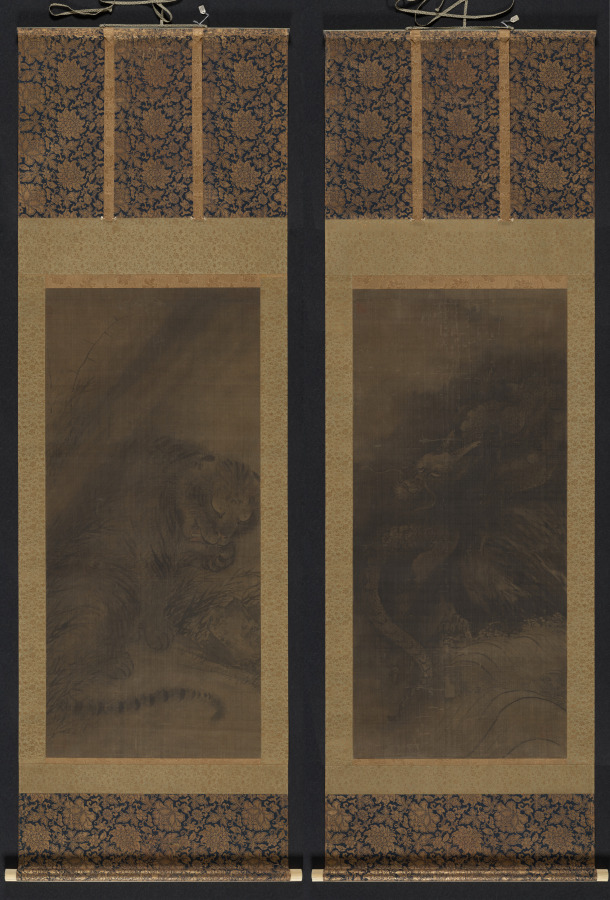
On the Material Dominion of the Dragon and Tiger
To comprehend the legacy of imperial silk weaving, one must first apprehend its fundamental premise: the absolute sovereignty of material. This is not a mere matter of textile production; it is the assertion of dominion over nature’s most elusive filament, transforming it into a language of power. The medium, in this rarefied context, is the entire message. We speak, of course, of silk: a substance whose very procurement was, for centuries, a state secret guarded on pain of death. Its cultivation, its reel, its weave—these were not crafts but acts of alchemy, performed within the walled precincts of imperial workshops. The resultant cloth was less a fabric than a field of honour, a prescribed arena upon which the most potent symbols of cosmic and temporal authority could be rendered. And upon this sovereign ground, two preeminent motifs have ever vied for primacy: the Dragon and the Tiger.
The Loom as Throne Room: Hierarchies Woven in Warp and Weft
Consider the apparatus: the monumental drawloom, a machine of formidable complexity, operated by a master weaver and his assistant in precise, silent synchrony. Each pass of the shuttle was an act of deliberation. This was not manufacturing; it was legislation by thread. The imperial silk loom was, in effect, a throne room in miniature, where the order of the universe was codified in coloured silk. Upon this stage, the Dragon and Tiger were not merely decorative elements. They were the principal actors in a heraldic drama, their positions, scales, claws, and countenances dictated by sumptuary laws as precise as any legal code.
The Five-Clawed Dragon, or long, was the exclusive prerogative of the Son of Heaven. Its sinuous, serpentine form, weaving through clouds or pursuing flaming pearls across the silk ground, represented the emperor’s omnipresent, benevolent, and celestial authority. The dragon was the yang principle incarnate: ascending, celestial, commanding the rains and the waters. To drape oneself in its image was to cloak one’s person in the very fabric of the cosmos. The technical execution matched the symbolic weight: the dragon’s scales were often rendered in supplementary wefts of gold-wrapped thread, a technique known as kesi or slit tapestry, allowing for curvilinear freedom and breathtaking tonal gradation. The effect was one of luminous, detached majesty, a creature not of this earth but of the empyrean.
The Tiger’s Terrestrial Majesty: A Study in Contrast
In deliberate counterpoint stands the Tiger, or hu. Where the dragon undulates, the tiger is poised, muscular, grounded. Its domain is the terrestrial, the mountainous, the realm of raw, authoritative power. In the imperial iconography, the tiger frequently symbolised the military mandarin, the generalissimo, the yang energy made manifest in protective, martial force. It was the emblem of the western quadrant, the white guardian. On the silks destined for a senior military official, the tiger would be depicted with a palpable physicality—its pelt suggested through meticulous shading of amber, ochre, and black threads, its gaze one of fierce alertness.
The material distinction here is critical. While the dragon shimmered with metallic thread, the tiger’s authority was often conveyed through the supreme mastery of satin weave. This technique, producing an unbroken, lustrous plane, was the perfect ground to render the creature’s sleek coat. The weaver’s genius lay in using the silk’s own light-catching properties to suggest the ripple of muscle beneath fur, achieved through subtle shifts in the direction of the float threads. This was not the celestial radiance of the dragon, but the deep, liquid glow of a predator in its prime. It spoke of a power that was immediate, formidable, and essential to the equilibrium of the state.
A Legacy Measured in Threads per Inch
The true heritage of this endeavour, then, resides in its uncompromising philosophy of appropriateness. Every element, from the fineness of the filament (measured in denier) to the density of the weave (threads per inch), from the specificity of the hue (derived from mineral or vegetable dyes reserved for the court) to the complexity of the motif, was a calibrated expression of rank and function. The dragon and tiger, together, represented the dual pillars of imperial rule: the celestial mandate and the terrestrial might required to defend it. Their coexistence on silks—sometimes in opposition, sometimes in complementary balance—was a visual treatise on statecraft.
This legacy transcends the historical workshop. It establishes a paradigm for understanding material heritage not as a collection of artefacts, but as a grammar of power, executed with peerless technical rigour. The imperial weavers of Nanjing, Suzhou, and Hangzhou understood that true luxury is not mere ornamentation; it is the seamless, authoritative integration of symbol, material, and technique to communicate an incontrovertible order. The silk was their page, the loom their pen, and the dragon and tiger their most profound verbs. To study these textiles today is not to look at a pattern. It is to read a constitution, woven in the most exquisite prose the world has ever known.