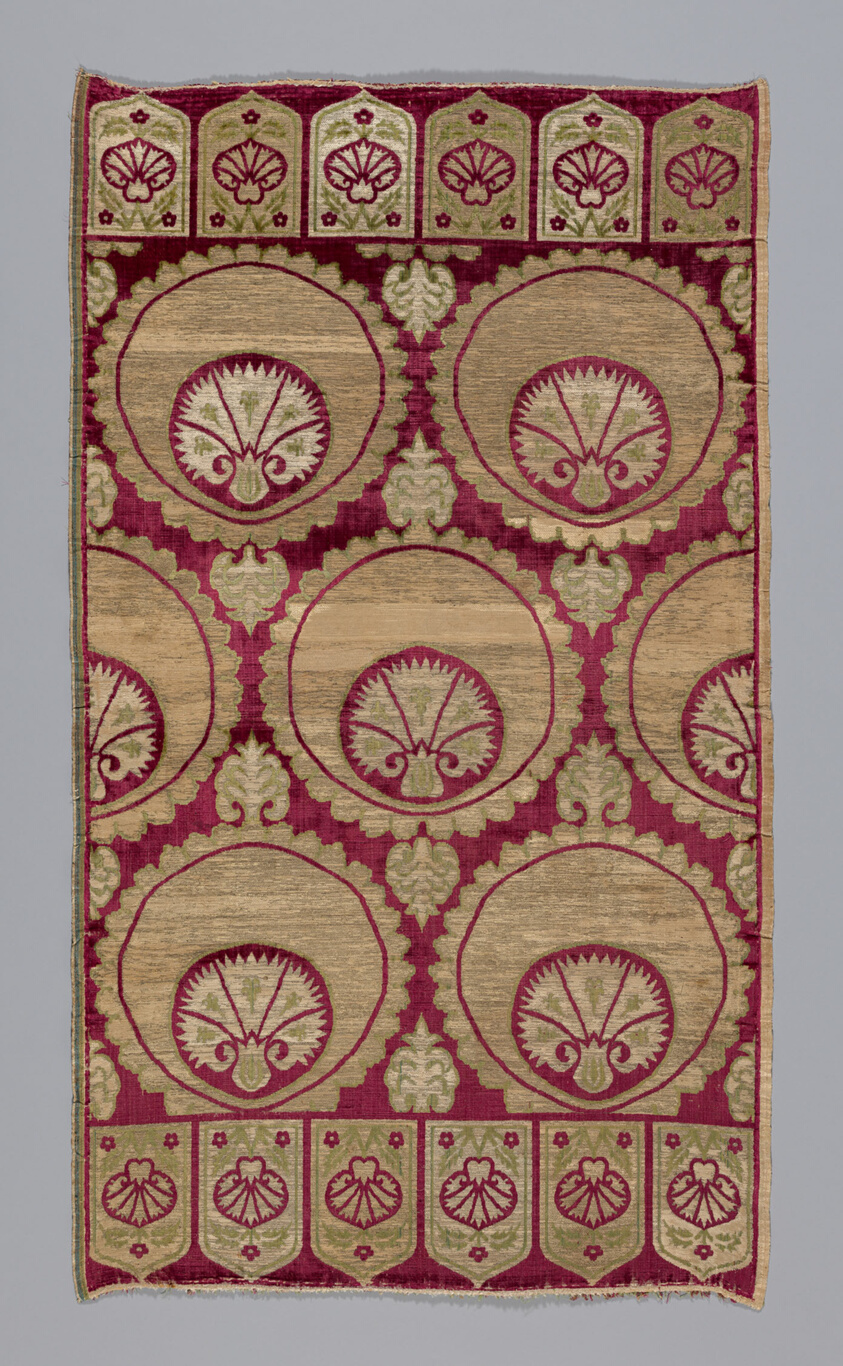
Heritage Research Artifact: The Cushion Cover as a Testament to Textile Mastery
In the hallowed halls of Lauren Fashion Heritage Lab, where the legacy of craftsmanship meets the rigor of scholarly inquiry, the cushion cover emerges not merely as a domestic accessory but as a profound artifact of textile engineering and aesthetic ambition. This object, crafted from a sophisticated interplay of silk, cotton, and “silver” metal strips wrapped around a silk core, embodies the pinnacle of classic silk craftsmanship and fluid elegance. Its construction—a warp-float faced satin weave with supplementary metal-wrapped silk brocading wefts, supplementary binding wefts, and supplementary warps forming cut and voided velvet—demands a forensic examination of materiality and technique, akin to the meticulous standards upheld by London’s Savile Row tailors, where every stitch and weave is a declaration of heritage and precision.
Materiality: The Symphony of Silk and Metal
Silk, the foundational fiber, serves as the canvas and the soul of this artifact. Its natural luster, tensile strength, and capacity for dye absorption render it the quintessential medium for opulent textiles. The warp-float faced satin weave, a structure where long floats of silk warp threads dominate the surface, creates a smooth, reflective finish that captures light with a liquid grace. This weave is not merely decorative; it is a structural choice that prioritizes durability and a tactile sensuality, reminiscent of the finest silk ties and pocket squares from Savile Row’s bespoke houses. The satin’s fluidity is further enhanced by the use of cotton in the supplementary binding wefts, which provides stability without compromising the silk’s inherent drape. Cotton, often overlooked in luxury contexts, here acts as the silent anchor—a practical counterpoint to silk’s ethereal beauty, ensuring the cushion cover withstands the rigors of use while maintaining its elegant form.
The inclusion of “silver” metal strips wrapped around a silk core introduces a dimension of luminosity and weight that elevates this artifact beyond mere fabric. These metal-wrapped threads, historically akin to those used in ecclesiastical vestments and royal regalia, are not pure silver but a simulation—likely a silver-toned alloy or gilt metal—that mimics the precious metal’s reflective properties. The silk core ensures flexibility, preventing the metal from snapping during weaving, while the outer metal strips catch and scatter light, creating a shimmering effect that shifts with movement. This technique, known as brocading, involves supplementary wefts that are interwoven into the satin ground, allowing the metallic threads to float on the surface in controlled patterns. The result is a textile that whispers of opulence without shouting, a hallmark of understated luxury that defines both Lauren’s aesthetic and Savile Row’s philosophy of quiet sophistication.
Technique: Cut and Voided Velvet as a Narrative Device
The cushion cover’s most extraordinary feature lies in its cut and voided velvet, achieved through supplementary warps that rise above the satin ground. Cut velvet, created by shearing loops of warp threads, produces a plush, tactile pile that contrasts with the smooth satin. Voided velvet, where the pile is selectively omitted, leaves areas of bare satin, creating a pattern of raised and recessed surfaces. This interplay of texture is a masterstroke of textile design, akin to the contrast between a worsted wool suiting and a cashmere overcoat on Savile Row—a dialogue between structure and softness, light and shadow.
The supplementary warps for the velvet are woven in silk, ensuring the pile retains the same lustrous quality as the ground. The cut areas, where the loops are severed, produce a dense, velvety surface that invites touch, while the voided sections reveal the satin’s reflective sheen. This technique requires extraordinary skill: the weaver must precisely control the tension and placement of the supplementary warps to avoid distortion. The metal-wrapped brocading wefts, introduced as supplementary elements, further complicate the weave, as their rigidity demands careful handling to prevent breakage. The result is a textile that tells a story of patience and expertise, where every millimeter of fabric is a testament to the weaver’s mastery.
Context: Classic Silk Craftsmanship and Fluid Elegance
This cushion cover belongs to a tradition of classic silk craftsmanship that spans centuries, from the looms of Lyon to the workshops of Como. Yet its execution reflects a distinctly modern sensibility—one that values fluid elegance over rigid formality. The satin weave’s natural drape, combined with the velvet’s tactile depth, creates a sense of movement even when the cushion is at rest. This is not a static object; it is a living artifact that responds to light, touch, and environment, much like a well-tailored jacket that moves with the wearer’s body.
The use of “silver” metal strips, while evocative of historical luxury, is tempered by the cotton binding wefts—a pragmatic choice that grounds the piece in functionality. This balance between opulence and utility is a defining characteristic of Lauren’s design philosophy, where heritage is not a museum piece but a living tradition. On Savile Row, this ethos manifests in the construction of a suit: the finest cloth, hand-stitched details, and a fit that is both timeless and personal. Similarly, this cushion cover is not merely decorative; it is an investment in quality, a piece that will age gracefully, its silk patina deepening with time, its velvet pile softening with use.
Conclusion: A Legacy Woven in Thread
As a heritage research artifact, this cushion cover transcends its function to become a document of human ingenuity. Its materials—silk, cotton, and metal-wrapped threads—are not arbitrary; they are chosen for their interplay of light, texture, and durability. Its techniques—satin weave, brocading, cut and voided velvet—are not mere decoration; they are expressions of a weaver’s skill and a designer’s vision. In the context of Lauren Fashion Heritage Lab, this object stands as a testament to the enduring power of craftsmanship, a reminder that true elegance lies not in excess but in the thoughtful orchestration of materials and methods. For the connoisseur of Savile Row, it is a familiar language—one of precision, restraint, and an unwavering commitment to quality. This cushion cover is, in every sense, a masterpiece of textile art, woven into the fabric of heritage itself.