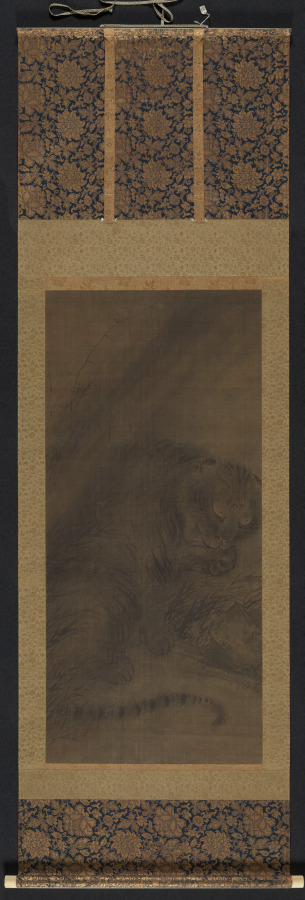
The Tiger in Silk: A Legacy of Imperial Weaving and the Savile Row Ethos
Introduction: The Tiger as a Symbol of Power and Prestige
In the lexicon of global textile heritage, few motifs command the same visceral resonance as the tiger. For centuries, this apex predator has been woven into the fabric of imperial courts, not merely as decoration, but as a living emblem of sovereignty, courage, and untamed authority. At Lauren Fashion Heritage Lab, we recognize that the tiger’s journey from the wilds of Asia to the warp and weft of silk is a narrative of cultural transmission, technical mastery, and enduring luxury. This artifact—a study of the tiger rendered in silk—draws directly from the legacy of imperial silk weaving, a tradition that reached its zenith in the workshops of Ming and Qing dynasty China, and later influenced the refined sensibilities of London’s Savile Row. Here, we examine how this materiality, silk, transforms the tiger from a mere animal into a statement of heritage, craftsmanship, and timeless elegance.
The Materiality of Silk: A Foundation of Imperial Craft
Silk is not simply a fabric; it is a medium of power. In imperial China, silk was reserved for the emperor, his court, and the highest-ranking officials. The process of sericulture—rearing silkworms, harvesting cocoons, and reeling threads—was a closely guarded state secret for millennia. The resulting fabric, with its natural luster, drape, and tensile strength, became the canvas upon which dynastic narratives were embroidered. For the tiger motif, silk offered an unparalleled surface: its smooth, reflective quality captured light in a way that mimicked the animal’s sleek coat, while its density allowed for intricate weaving techniques such as kesi (silk tapestry) and jin (brocade). These methods enabled artisans to create tigers with startling realism—muscles rippling under the skin, eyes gleaming with amber intensity, and stripes flowing like liquid shadow. The legacy of imperial silk weaving is thus one of precision: every thread was a brushstroke, every weave a declaration of status.
The Tiger in Imperial Context: From Court to Commodity
Within the imperial wardrobe, the tiger was more than a decorative element. It was a symbol of military might and cosmic balance. In Chinese cosmology, the tiger is one of the Four Celestial Animals, representing the West, autumn, and the element of metal. Emperors wore silk robes embroidered with tigers during hunting expeditions or military ceremonies, aligning themselves with the beast’s ferocity. The mangfu (python robe) of high-ranking officials often featured tiger motifs, but only the emperor could wear a five-clawed dragon—the tiger, with its four claws, was a permissible symbol of secondary authority. This hierarchical use of the tiger underscores the material’s role as a social signifier. When silk weaving declined with the fall of the Qing dynasty in 1912, the techniques and motifs did not vanish. They migrated westward, finding new life in the ateliers of Europe, particularly in London’s Savile Row, where the tiger was reimagined for a different kind of aristocracy: the discerning gentleman.
Savile Row and the Reimagining of Imperial Silk
Savile Row, the epicenter of bespoke tailoring, has always prized heritage and provenance. The tiger in silk, when translated into a Savile Row context, becomes a study in restraint and refinement. Unlike the opulent, full-bodied tigers of imperial robes, a Savile Row interpretation might feature a subtle tiger stripe in a silk lining, or a single embroidered paw on a pocket square. This is not a diminishment of the motif’s power, but a redefinition of its elegance. The legacy of imperial silk weaving informs this approach: the same techniques—hand-stitched broderie anglaise, passementerie trims, and jacquard weaving—are employed, but with a British sensibility that values understatement over ostentation. A silk tie woven with a tiger pattern, for instance, might use a matte finish to reduce glare, allowing the design to reveal itself only upon close inspection. This is the Savile Row ethos: luxury that whispers, not shouts.
Technical Mastery: Weaving the Tiger into Silk
To fully appreciate the tiger in silk, one must understand the technical challenges it presents. The tiger’s stripes are irregular, requiring a weaver to manipulate multiple colored threads—typically black, gold, and white—across a single warp. In imperial kesi, this was achieved through a “cut silk” technique where weft threads were individually inserted and trimmed, creating a tapestry-like effect. Modern Savile Row mills, such as those in Como, Italy, or Macclesfield, England, have adapted this method using computerized jacquard looms. Yet the principle remains: the tiger’s form must be built thread by thread, with each stripe’s width and angle carefully calibrated to preserve the animal’s dynamic posture. The result is a fabric that moves with the wearer, the tiger seeming to stalk across the silk as the body shifts. This kinetic quality is the hallmark of superior craftsmanship—a direct inheritance from the imperial weavers who spent months on a single robe.
Heritage and Modernity: The Tiger as a Living Artifact
At Lauren Fashion Heritage Lab, we view the tiger in silk as a living artifact—a bridge between past and present. The legacy of imperial silk weaving is not static; it evolves with each generation of artisans. Today, the tiger motif appears in collections ranging from formal evening wear to casual accessories, always anchored by the material’s inherent luxury. For the modern gentleman, a silk tiger-print scarf or a bespoke suit lining serves as a quiet nod to history, a reminder that true style is rooted in tradition. This is not mere nostalgia; it is a conscious choice to preserve and reinterpret a craft that spans continents and centuries. The tiger, once a symbol of imperial might, now represents the enduring power of heritage—a power that is as relevant on Savile Row as it was in the Forbidden City.
Conclusion: The Eternal Thread
In conclusion, the tiger in silk is more than a research artifact; it is a testament to the resilience of craft. From the imperial workshops of China to the bespoke ateliers of London, this motif has been woven, embroidered, and reimagined without losing its essential character. The materiality of silk—its luster, strength, and capacity for detail—ensures that the tiger remains a potent symbol of authority and elegance. For the scholar, the collector, or the connoisseur, understanding this legacy is to appreciate the intersection of art, history, and commerce. At Lauren Fashion Heritage Lab, we commit to preserving this thread, ensuring that the tiger continues to prowl through silk for generations to come. As we say on Savile Row: a garment is only as good as its fabric, and a fabric is only as good as its story. The tiger in silk tells a story of empires, artisans, and the timeless pursuit of perfection.