← BACK TO ARCHIVES
Silk
Heritage Synthesis: Border
Curated on Jun 17, 2026 // Node: LDN-01
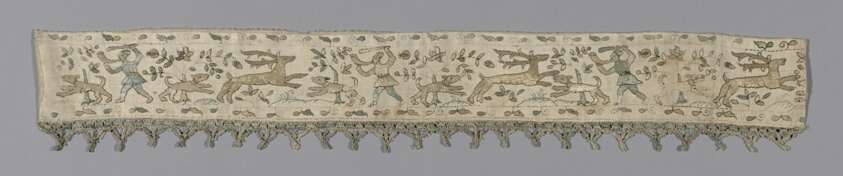
The Border as a Threshold of Craft: A Study in Silk, Linen, and the Language of Edges
In the lexicon of luxury, the border is seldom a mere termination. It is a declaration. Within the hallowed ateliers of London’s Savile Row, where the cut of a jacket is a philosophy and the fall of a trouser is a theorem, the border—whether a hand-rolled hem, a pick-stitched lapel, or a silk-embroidered edge—represents the final, most exacting dialogue between the tailor and the cloth. The artifact under examination, a linen border embroidered with silk and edged with bobbin lace, is not simply a decorative fringe. It is a masterclass in materiality, a testament to the tension between structural integrity and fluid elegance. This paper deconstructs the border as a heritage artifact, arguing that its construction—from the plain weave of its ground to the intricate silk stitches and the delicate lace edging—embodies a philosophy of restraint and opulence that defines classic silk craftsmanship.
Materiality and the Grammar of the Ground
The foundation of this artifact is linen, a fiber of ancient pedigree and rigorous discipline. In a plain weave, the simplest interlacing of warp and weft, linen offers a crisp, unyielding surface. It is a ground that demands precision. On Savile Row, linen is often reserved for summer suiting or as a structural interlining, valued for its ability to hold a crease without surrendering to drape. Here, however, the linen serves as a canvas for silk. The contrast is deliberate and profound. Linen’s matte, slightly irregular texture absorbs light, while silk—a filament of luminous, almost liquid quality—reflects it. The border thus becomes a study in opposites: the earthy, stoic strength of flax versus the ethereal, aristocratic shimmer of the silkworm’s thread. The plain weave of the linen provides a grid, a disciplined architecture upon which the embroiderer can impose a rhythm of stitches.
The Stitch Lexicon: A Vocabulary of Control and Flourish
The embroidery techniques employed—back stitch, double running stitch, overcast stitch, running stitch, and split stitch—are not arbitrary. Each serves a specific function in the border’s narrative. The back stitch and double running stitch create a continuous, unbroken line, ideal for outlining forms with the precision of a draftsman’s pen. On Savile Row, this is akin to the chalk line on a basted garment—a guide that must be exact. The overcast stitch is used to secure edges, preventing fraying while adding a subtle, rolled texture. The running stitch, the simplest of all, offers a sense of movement, a staccato rhythm that can be varied in length to suggest shadow or depth. The split stitch, a technique where the needle pierces the previous stitch, creates a fine, chain-like line that mimics the smoothness of a painted stroke. Together, these stitches form a vocabulary of control. They are the tailor’s seam allowances, the dart tucks, the invisible reinforcements that allow a garment to move with the body while retaining its shape.
Yet, the border does not merely constrain; it also liberates. The inclusion of couching—where a heavier thread is laid on the surface and stitched down with a finer thread—introduces a sculptural element. Couching allows for the use of thicker silk threads, often in metallic or variegated hues, to create raised, dimensional patterns. This is the equivalent of a master tailor’s pad stitching on a lapel, where the thread is not just functional but decorative, creating a subtle topography of light and shadow. The French knots, small, spherical stitches, punctuate the border like pearls on a string. They are the final exclamation points, the tiny bursts of texture that catch the eye and demand closer inspection. In the context of heritage craftsmanship, French knots are a signature of patience; each knot requires a precise twist of the needle and a steady hand, a skill that can take years to perfect.
The Lace Edge: Where Structure Meets Air
Perhaps the most remarkable feature of this artifact is its edging: a combination of silk and linen bobbin lace. Bobbin lace is a technique of twisting and crossing threads, held in place by pins on a pillow, to create an open, web-like structure. It is the antithesis of the dense, embroidered linen. Where the embroidery is solid, the lace is transparent. Where the stitches are grounded, the lace floats. This juxtaposition is not merely aesthetic; it is philosophical. The border, which typically signifies an end, a boundary, is here transformed into a threshold. The lace edge does not close the artifact; it opens it, allowing the eye to pass through to the space beyond. On Savile Row, this would be the equivalent of a vent in a jacket—a cut that allows for movement, for breath, for the garment to live on the body rather than simply encase it.
The use of both silk and linen threads in the lace is a deliberate choice. Linen provides tensile strength, ensuring the lace does not stretch or distort over time. Silk provides luster and softness, allowing the lace to drape with a fluidity that linen alone cannot achieve. This hybridity is a hallmark of classic silk craftsmanship, where materials are not used in isolation but in dialogue. The lace edge, therefore, is not a mere trimming; it is a resolution of the tension between the rigid and the flowing, the structured and the ethereal.
Fluid Elegance and the Savile Row Ethos
The phrase “fluid elegance” is often invoked in fashion discourse, but it is rarely defined. In the context of this border, fluid elegance is the result of a precise balance between weight and movement. The linen ground provides a certain heft, a sense of substance that prevents the piece from being insubstantial. The silk embroidery adds a layer of richness, a tactile and visual luxury that invites touch. The bobbin lace edge, however, introduces a counterpoint of lightness, a whisper of air that allows the entire composition to sway, to breathe, to respond to the slightest current. This is the same principle that governs the drape of a Savile Row jacket: the cloth must be heavy enough to hold its shape, yet supple enough to move with the wearer. The border, in its microcosm, replicates this macrocosmic ideal.
Conclusion: The Border as a Living Artifact
This heritage artifact is not a relic. It is a living document of a craft tradition that values patience, precision, and the interplay of opposites. The border, in its materiality of linen and silk, its lexicon of stitches, and its lace edge, is a testament to the idea that the most profound statements are often made at the edges. On Savile Row, where the cut is king and the finish is the final word, the border is not an afterthought. It is the signature. It is the place where the tailor’s hand is most visible, where the silk meets the skin, and where the garment—or in this case, the artifact—speaks its most eloquent truth. The border is not an end. It is a beginning.
Heritage Lab Insight
Lab Insight: AIC Silk Archive Node #2272.