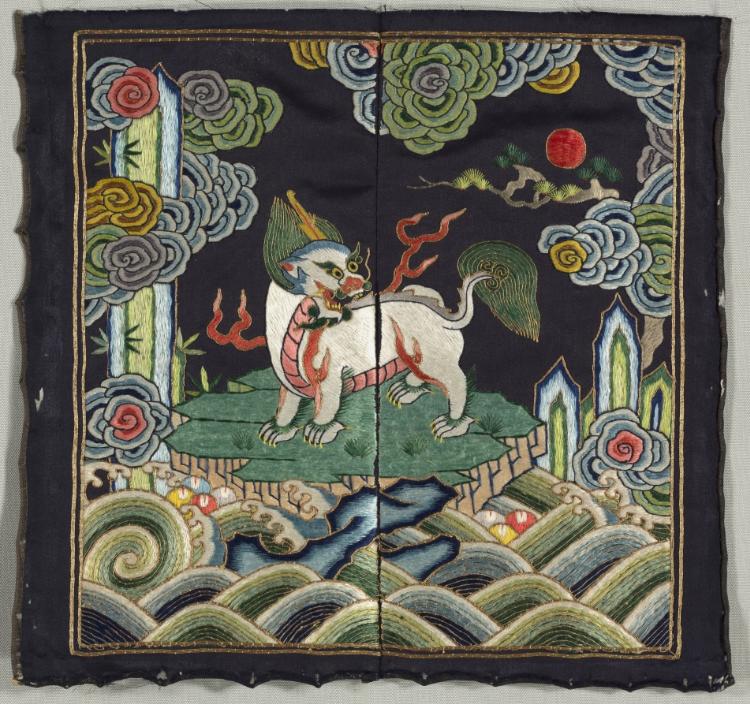
The Rank Badge (Buzi): A Material Testament to Imperial Silk Weaving
In the hushed ateliers of London’s Savile Row, where the cut of a jacket is a matter of legacy, we understand that fabric is not merely cloth—it is a narrative woven into existence. The Rank Badge (buzi), a square or round insignia of silk, represents one of the most sophisticated material artifacts of imperial China. For the connoisseur of heritage textiles, this badge is not a relic but a living document of craftsmanship, power, and the immutable standards of silk weaving that defined an empire. At Lauren Fashion Heritage Lab, we dissect the buzi not as a historical curiosity, but as a benchmark of material excellence—a standard that Savile Row’s finest houses would recognize as the pinnacle of textile integrity.
The Materiality of Silk: A Foundation of Imperial Prestige
Silk, in the context of the buzi, is not a generic material. It is a specific, engineered medium that demanded absolute precision. The imperial silk weaving workshops of the Ming (1368–1644) and Qing (1644–1912) dynasties, particularly those in Suzhou, Nanjing, and Hangzhou, operated under a code of quality that rivals the bespoke standards of any contemporary tailoring house. The silk used for a rank badge was typically a tabby-weave or twill-weave ground, often in a deep, resonant hue—midnight blue, cinnabar red, or stone grey—chosen to contrast with the embroidered or woven motifs. The thread count was exacting; a single square inch might contain hundreds of warp and weft threads, creating a surface so smooth that it could reflect light like still water. This was not a fabric for the casual observer; it was a material that demanded respect through its sheer technical perfection.
For the Savile Row practitioner, the buzi’s silk is a lesson in structural integrity. Unlike modern synthetic blends that sacrifice longevity for cost, imperial silk was spun from the cocoons of Bombyx mori silkworms, fed exclusively on mulberry leaves. The resulting filament was continuous, strong, and lustrous. The dyeing process, using natural pigments from plants and minerals, ensured that the colour would not fade over centuries—a fact borne out by surviving examples in museum collections. This is the same philosophy that underpins a well-made suit: the material must endure, not merely exist.
Weaving the Hierarchy: The Buzi as a System of Codes
The buzi was not a decorative afterthought; it was a regulatory device. Worn on the front and back of the surcoat (the bufu), it signified the wearer’s rank within the civil or military bureaucracy. For civil officials, the motifs were avian: a crane for the highest rank (first), a golden pheasant for the second, a peacock for the third, and so on down to the quail for the ninth. Military ranks were represented by mythical or real beasts—the qilin (a chimeric creature) for the first, a lion for the second, a tiger for the third, and a bear for the fourth. This was a language of power rendered in silk, a code that every courtier and subject could read at a glance.
From a heritage perspective, the buzi’s design is a masterclass in composition and restraint. The central animal is typically depicted in a dynamic pose, often surrounded by clouds, waves, or auspicious symbols such as the sun, the moon, or the “three star” gods of longevity, prosperity, and rank. The embroidery technique—whether kesi (silk tapestry weaving) or xiu (embroidery)—required extraordinary skill. In kesi, the weaver would insert coloured silk threads into the warp to create the design, a process so laborious that a single badge could take months to complete. The result is a surface where the image is not applied but integrated into the fabric itself—a concept that resonates with Savile Row’s insistence on construction that is invisible yet essential.
The Legacy of Imperial Silk Weaving: Standards That Endure
The legacy of imperial silk weaving is not a closed chapter. It is a living tradition that informs how we evaluate textile quality today. The buzi exemplifies three principles that any heritage specialist must uphold:
1. Precision of Execution: The alignment of the motif within the badge’s square or round field was exact. The embroidery or weaving had to be symmetrical, with no loose threads or uneven tension. This is the same standard applied to a Savile Row lapel—the roll must be perfect, the stitching invisible. The buzi’s silk ground was often reinforced with a paper or silk backing to maintain its shape, a technique that mirrors the use of canvas interlinings in tailored jackets.
2. Symbolic Integrity: Every element of the buzi carried meaning. The colours, the animals, the clouds, and even the number of waves at the base of the design were prescribed by sumptuary laws. To wear an incorrect badge was not a fashion faux pas; it was a breach of protocol that could lead to demotion or punishment. This reminds us that heritage textiles are never neutral—they are encoded with social, political, and spiritual significance. For the modern designer, this underscores the importance of understanding the context of a material, not just its aesthetic appeal.
3. Artisanal Transmission: The techniques used to create buzi were passed down through generations of weavers and embroiderers, often within family workshops. This oral and practical tradition is analogous to the apprenticeship system on Savile Row, where a cutter might spend years learning the subtleties of a shoulder seam. The buzi’s survival in museum collections is a testament to the skill of these artisans, who worked without the aid of machines but with a level of control that modern technology struggles to replicate.
Conservation and Contemporary Relevance
At Lauren Fashion Heritage Lab, we approach the buzi as a conservation priority. The silk, while durable, is vulnerable to light, humidity, and handling. Proper storage in acid-free tissue, in a climate-controlled environment, is essential. When displayed, the badge should be mounted on a padded support to avoid creasing or stress on the silk threads. For the collector or curator, the buzi offers a unique opportunity to study the intersection of material science and cultural history. The condition of the silk—its lustre, its colour fastness, its weave density—provides clues about the original workshop, the period of manufacture, and even the social status of the wearer.
For the contemporary fashion house, the buzi is a source of inspiration that transcends mere pattern borrowing. It teaches us about the value of slow craftsmanship, the importance of material provenance, and the power of a garment to communicate identity. A Savile Row suit, like a buzi, is a statement of belonging—to a tradition, a standard, a way of being. The silk of the buzi is not just a fabric; it is a contract between the maker and the wearer, a promise of quality that endures beyond the lifetime of the individual.
Conclusion: The Buzi as a Benchmark
In the lexicon of heritage textiles, the rank badge stands as a benchmark of imperial silk weaving. Its materiality—the precise silk, the exacting weave, the symbolic embroidery—represents a standard that Savile Row would recognise as kin. It is a reminder that true luxury is not about excess but about excellence—the kind that requires patience, skill, and an unyielding commitment to the craft. As we continue to study and preserve these artifacts, we honour not only the artisans who created them but also the enduring legacy of silk as a medium of power, beauty, and meaning.