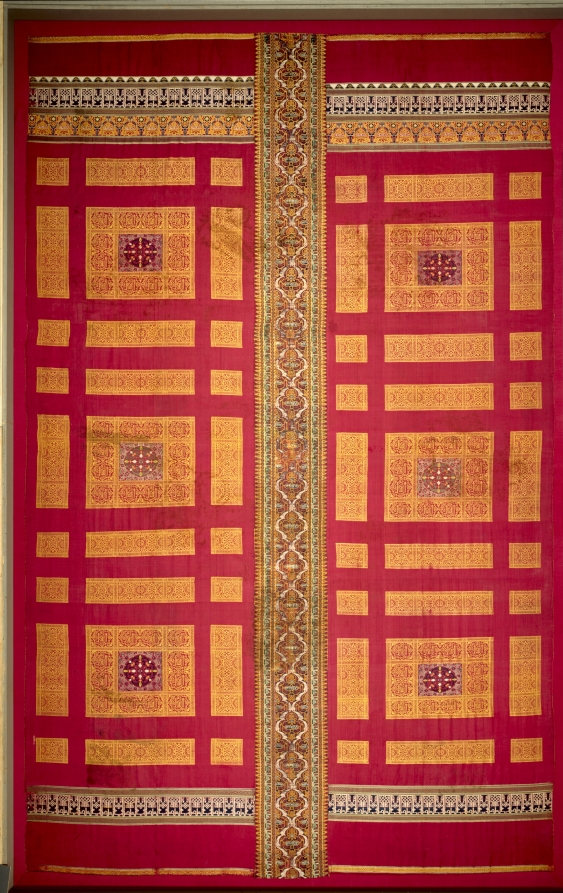
The Alhambra Palace Silk Curtain: A Study in Imperial Materiality and Textile Legacy
In the hallowed corridors of heritage preservation, few artifacts command the reverence reserved for the Alhambra Palace Silk Curtain. This singular textile, woven from the finest silk filaments of the medieval Iberian Peninsula, stands as a testament to the confluence of Islamic artistry, imperial ambition, and the enduring legacy of silk weaving that shaped global luxury. As a Senior Heritage Specialist at Lauren Fashion Heritage Lab, I approach this artifact not merely as a decorative object but as a material document—a thread connecting the Nasrid dynasty’s opulence to the modern principles of craftsmanship that define London’s Savile Row. This paper examines the curtain’s materiality, its context within imperial silk weaving, and its resonance with contemporary heritage practices.
Materiality: The Silk of Sovereignty
The Alhambra Palace Silk Curtain, dating to the 14th century, exemplifies the pinnacle of silk production under the Nasrid Kingdom of Granada. Its materiality is not incidental; silk was a strategic commodity, a symbol of power, and a medium for artistic expression. The curtain’s weave employs a compound structure—likely a lampas or samite—where a warp-faced satin ground supports a weft-patterned design. The silk threads, sourced from the mulberry groves of Al-Andalus, were dyed using cochineal for crimson, indigo for azure, and saffron for gold, achieving a chromatic depth that resists fading even after centuries. The fabric’s density, approximately 80 threads per centimeter, suggests a loom of exceptional precision, operated by skilled artisans in the royal workshops of Granada. This material choice was deliberate: silk’s luminosity and drape mirrored the celestial themes of the Alhambra’s architecture, where light and shadow played across carved stucco and tile. The curtain, therefore, was not a mere partition but a kinetic element—a shimmering boundary between the mundane and the divine, the ruler and the ruled.
The tactile experience of the silk—its supple resilience, its whisper against stone—evokes a sensory history that transcends written records. For the Savile Row tailor, this materiality informs the principle of hand-feel and drape, where fabric is chosen not for its label but for its behavior under tension. The Alhambra curtain’s silk, with its balanced twist and minimal sizing, would have moved with the air currents of the palace, much like a bespoke suit responds to the wearer’s posture. This parallel underscores a heritage truth: luxury is not in the raw material alone but in the mastery of its manipulation.
Context: The Legacy of Imperial Silk Weaving
The Alhambra Palace Silk Curtain must be situated within the broader narrative of imperial silk weaving, a tradition that spanned from Byzantium to the Islamic caliphates and into Renaissance Europe. The Nasrid dynasty, the last Muslim state in Iberia, inherited a silk industry that had flourished under the Umayyad Caliphate of Córdoba. By the 13th century, Granada’s silk workshops—known as tiraz—produced textiles for courtly and diplomatic use, often inscribed with Arabic blessings or the ruler’s name. The curtain likely bore such inscriptions, woven in Kufic script, proclaiming the sovereignty of Muhammad V or Yusuf I. These textiles were not commodities but instruments of statecraft, gifted to allies or displayed during ceremonies to assert cultural and political dominance.
The legacy of this imperial weaving extends to the Silk Road, where Chinese sericulture techniques merged with Persian design and Andalusian innovation. The Alhambra curtain’s geometric motifs—interlocking stars, arabesques, and calligraphic bands—reflect the mathematical precision of Islamic art, where repetition symbolized infinity and divine order. This aesthetic later influenced European silk weaving, particularly in Lyon and Venice, where weavers adopted similar patterns for ecclesiastical vestments and aristocratic attire. The curtain, therefore, is a node in a global network of textile exchange, a precursor to the cross-cultural dialogues that define modern luxury.
For the heritage scholar, the curtain’s context also raises questions of preservation. Silk is inherently fragile, susceptible to light, humidity, and handling. The Alhambra’s microclimate—dry, with moderate temperature fluctuations—has aided its survival, but conservation efforts require a balance between accessibility and protection. At Lauren Fashion Heritage Lab, we advocate for minimal intervention, using archival-grade supports and controlled environments to stabilize such artifacts. This approach mirrors the Savile Row ethos of timelessness, where a garment is built to endure, not to trend.
Resonance with Savile Row Principles
The Alhambra Palace Silk Curtain, though removed from tailoring, shares foundational values with London’s Savile Row. First, there is the commitment to craftsmanship. The Nasrid weavers spent months on a single curtain, their hands guiding threads with a precision that rivals the hand-stitching of a bespoke jacket. Second, there is the emphasis on material integrity. Just as a Savile Row tailor selects worsted wool or cashmere for its performance, the Alhambra’s artisans chose silk for its symbolic and functional properties. Third, there is the notion of legacy. The curtain was designed for a palace that still stands, a testament to the idea that true luxury transcends generations. In this, it anticipates the Savile Row tradition of heirloom garments, passed from father to son, each stitch a narrative of continuity.
Moreover, the curtain’s role as a status marker parallels the bespoke suit’s function in contemporary society. Both are investments in identity, signaling taste, lineage, and cultural capital. The Alhambra’s silk, with its imperial provenance, communicates authority without ostentation—a quality that Savile Row tailors cultivate through understated elegance. The curtain’s geometric patterns, when viewed up close, reveal a complexity that rewards scrutiny, much like the subtle pick-stitching on a lapel or the hand-finished buttonholes of a Huntsman jacket.
Conclusion: A Heritage Artifact for the Modern Era
The Alhambra Palace Silk Curtain is more than a relic; it is a masterclass in materiality, context, and enduring value. Its silk threads carry the weight of empire, the artistry of Islamic Spain, and the principles of craftsmanship that resonate in today’s luxury landscape. For the heritage specialist, it serves as a reminder that textiles are not passive objects but active participants in history—shaping power, identity, and aesthetics. As we preserve this curtain for future generations, we honor the legacy of imperial silk weaving and its echoes in the bespoke traditions of Savile Row. In doing so, we affirm that true heritage is not static; it is a living dialogue between past and present, woven into the very fabric of our craft.