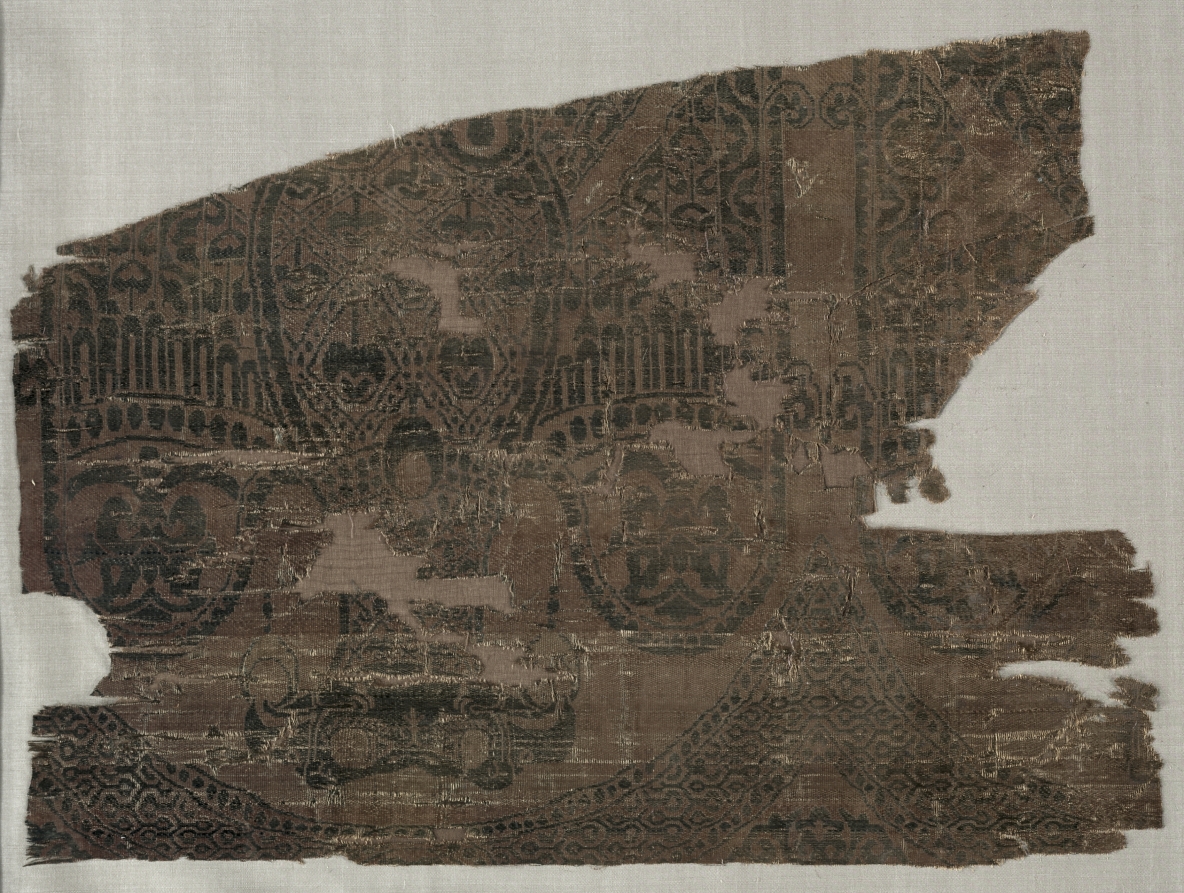
Introduction: The Threads of Power and Piety
In the hushed, scholarly corridors of heritage preservation, few artifacts command the same reverence as the samite fragments recovered from the tomb of Saint Bernard Calvo. These silk remnants, bearing the potent motif of the double-headed eagle, are not merely textile relics; they are a profound testament to the intersection of imperial ambition, ecclesiastical authority, and artisanal mastery. As a Senior Heritage Specialist at the Lauren Fashion Heritage Lab, I approach these fragments with the exacting eye of a Savile Row tailor—where every thread, every weave, and every motif tells a story of provenance, power, and the enduring legacy of silk weaving. This paper dissects the materiality, historical context, and symbolic weight of these fragments, offering a scholarly narrative that bridges the opulence of Byzantine and Holy Roman imperial courts with the sacred silence of a medieval tomb.
Materiality: The Anatomy of Samite Silk
The fragments are composed of samite, a luxurious, heavy silk fabric woven in a twill or compound weave, often incorporating gold or silver threads. The term “samite” derives from the Old French samit, itself rooted in the Greek hexamiton (“six threads”), referencing the complex weave structure that produces a dense, lustrous surface. In these fragments, the silk is of exceptional quality, dyed in deep crimson and gold—colors that speak to both imperial prestige and ecclesiastical sanctity. The crimson likely derives from kermes or cochineal, while the gold threads are gilded silver or gold leaf wrapped around a silk core, a technique perfected in Byzantine and Islamic workshops.
From a Savile Row perspective, the drape and hand of samite are akin to a bespoke double-breasted suit in a heavyweight wool—structured, authoritative, yet fluid in its fall. The weave’s density ensures durability, which explains why these fragments survived centuries in a tomb’s microclimate. However, the silk’s fragility is evident in the frayed edges and faded hues, a reminder that even the most opulent materials are subject to time’s relentless erosion. The double-headed eagle motif, woven with precision, demonstrates a mastery of pattern repetition and symmetry, hallmarks of imperial silk workshops where looms were calibrated to produce flawless, repeatable designs for ceremonial vestments, banners, and shrouds.
Context: The Legacy of Imperial Silk Weaving
The double-headed eagle is one of heraldry’s most enduring symbols, representing dual sovereignty—often interpreted as the union of earthly and spiritual power, or the dominion over East and West. In the context of these fragments, the motif links Saint Bernard Calvo to the broader legacy of imperial silk weaving that flourished in Byzantium, the Holy Roman Empire, and later, in Islamic and Norman courts. Saint Bernard Calvo, a 12th-century bishop of Vic, Spain, was canonized for his piety and political acumen. His tomb, discovered in the Cathedral of Vic, contained these silk fragments, likely part of a funerary pall or liturgical garment. The presence of the double-headed eagle suggests a deliberate assertion of authority—perhaps a gift from a Holy Roman Emperor or a Byzantine envoy, reinforcing the bishop’s role as a bridge between secular and sacred realms.
The legacy of imperial silk weaving is rooted in the Byzantine Empire, where state-controlled workshops in Constantinople produced silks for diplomatic gifts, ecclesiastical use, and imperial regalia. These silks were not mere commodities; they were instruments of soft power, carrying motifs that proclaimed the emperor’s divine mandate. The double-headed eagle, adopted by the Byzantine Palaiologos dynasty, later became emblematic of the Holy Roman Empire and the Russian Tsardom. In Spain, the motif appeared in Visigothic and Mozarabic art, but the samite fragments from Saint Bernard’s tomb represent a direct link to the trans-Mediterranean silk trade, which connected Constantinople, Alexandria, and Al-Andalus. The silk’s weave and dye techniques suggest a provenance from Byzantine or Islamic workshops, possibly passing through the hands of Catalan merchants who dominated Mediterranean trade routes in the 12th century.
Symbolism and Function: The Double-Headed Eagle in Sacred Space
The double-headed eagle on these fragments is more than a decorative device; it is a theological and political statement. In Christian iconography, the eagle symbolizes resurrection and divine vision, while the two heads represent the dual nature of Christ—human and divine. For Saint Bernard Calvo, a bishop who navigated the turbulent politics of the Reconquista, the motif may have signified his role as a spiritual shepherd and a temporal mediator. The fragments’ placement in his tomb suggests they were part of a funerary ensemble designed to convey his sanctity and his connection to imperial authority. This aligns with the practice of wrapping bishops in silks that mirrored imperial regalia, a tradition that blurred the lines between ecclesiastical humility and earthly power.
From a functional perspective, the samite fragments likely belonged to a pall (a cloth covering the coffin) or a chasuble (a liturgical vestment). The double-headed eagle would have been prominently displayed, ensuring that even in death, the bishop’s allegiance to both Church and Empire was visible. The silk’s weight and texture would have made it suitable for ceremonial use, where the fabric’s sheen and the gold thread’s glint caught candlelight, creating an aura of divine presence. In the tomb, the fragments served as a tactile link between the living and the dead, a material prayer for the bishop’s soul.
Preservation and Scholarly Significance
The survival of these fragments is a testament to the tomb’s sealed environment and the silk’s inherent durability. However, conservation efforts must balance the need for study with the imperative to preserve. At the Lauren Fashion Heritage Lab, we employ non-invasive techniques such as multispectral imaging and micro-Raman spectroscopy to analyze dye composition and weave structure without damaging the fibers. The fragments are stored in climate-controlled conditions, with minimal light exposure to prevent fading. Their scholarly significance lies in their ability to illuminate the networks of trade, power, and faith that defined the medieval Mediterranean. They are not static artifacts but dynamic documents, speaking to the mobility of materials, motifs, and meanings across borders.
Conclusion: A Legacy Woven in Silk
The samite fragments from the tomb of Saint Bernard Calvo are a masterclass in the interplay of materiality and meaning. They remind us that silk, in its imperial form, was never merely a fabric—it was a language of authority, a medium of devotion, and a marker of identity. For the modern scholar, these fragments offer a rare glimpse into the world of medieval luxury, where the double-headed eagle soared not only on banners but also on the very garments that clothed the dead for eternity. As we continue to study and preserve these fragments, we honor the legacy of imperial silk weaving—a legacy that, like the eagle itself, looks both to the past and to the future, its threads forever binding the earthly to the divine.