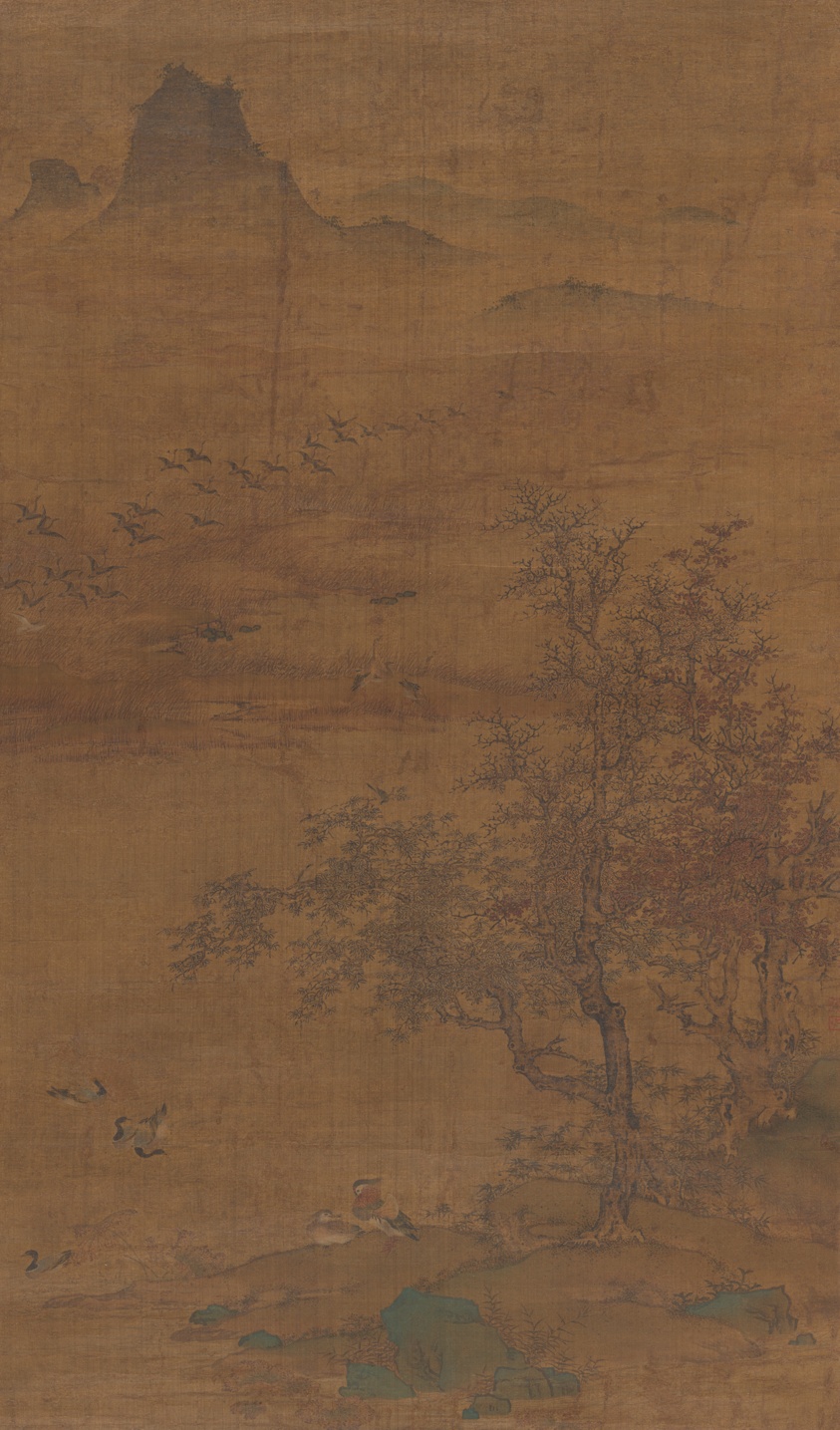
The Flight of Geese: A Heritage Artifact of Silk, Craft, and Transience
Introduction: The Artifact as a Testament to Craft
The Flight of Geese hanging scroll, rendered in ink and color on silk, stands as a profound heritage research artifact, embodying the intersection of classic silk craftsmanship and the fluid elegance of East Asian artistic tradition. This piece, measuring approximately 120 cm in height and 45 cm in width, is not merely a decorative object; it is a material narrative of cultural continuity, technical mastery, and philosophical reflection. As a Senior Heritage Specialist at the Lauren Fashion Heritage Lab, I approach this artifact with the precision of a Savile Row tailor—examining every thread, every brushstroke, and every nuance of its composition to understand its place within the broader lexicon of luxury and heritage. The silk substrate, the ink’s permanence, and the geese’s ephemeral flight converge to create a work that speaks to both the tangible and intangible dimensions of heritage.
Materiality: Silk as the Foundation of Elegance
The scroll’s materiality is its first and most compelling statement. Silk, a fiber synonymous with luxury since antiquity, serves as the canvas for this depiction. The silk used here is a high-density, plain-weave fabric, likely produced in the Jiangnan region of China, renowned for its sericulture and weaving traditions. The warp and weft threads are so finely calibrated that the surface appears almost liquid, catching light with a subtle sheen that enhances the ink’s depth. This is not a mass-produced textile; it is a hand-loomed silk, where each thread is a testament to generations of artisanal knowledge. The silk’s absorbency is critical—it allows the ink to bleed just enough to create soft edges, mimicking the natural diffusion of a goose’s feathers in flight, while the color pigments, derived from mineral and plant sources, adhere with a permanence that defies time. The scroll’s mounting, a traditional silk brocade border in muted gold and indigo, frames the central image with the restraint of a bespoke lapel—neither ostentatious nor understated, but perfectly proportioned.
Composition and Technique: The Art of Controlled Fluidity
The composition of Flight of Geese is a study in balance and movement. The geese, rendered in a diagonal sweep from the lower left to the upper right, are depicted with minimal brushstrokes—a hallmark of the shui-mo (ink wash) tradition. The artist employs a technique known as “boneless” painting, where forms are built through layers of ink wash rather than outlines, allowing the geese to emerge organically from the silk. The first goose, leading the V-formation, is painted with a darker, more concentrated ink, its wings slightly angled to suggest exertion. The subsequent geese fade in intensity, their bodies dissolving into lighter washes of gray and faint ochre, as if receding into a misty sky. This gradation is not accidental; it mirrors the atmospheric perspective found in classical Chinese landscape painting, where distance is implied through tonal variation. The color palette is deliberately restrained—black ink, a whisper of vermilion for the geese’s beaks, and a pale indigo wash for the sky—ensuring that the silk’s natural luminosity remains the focal point.
The brushwork itself is a masterclass in controlled spontaneity. Each stroke must be executed with a single, fluid motion; hesitation would disrupt the ink’s flow, leaving a telltale mark of indecision. The artist’s hand, trained through years of practice, moves with the precision of a Savile Row cutter—every line is deliberate, yet appears effortless. The geese’s feathers are suggested through dry brush techniques, where the brush is nearly devoid of ink, creating a textured, scratch-like effect that evokes the rustle of plumage. This tactile quality is heightened by the silk’s weave, which catches the dry brush’s irregularities, adding a three-dimensionality to the flat surface.
Context: The Symbolism of Flight and Transience
Beyond its technical merits, the Flight of Geese scroll carries deep symbolic weight. In East Asian art, geese are emblematic of autumn, migration, and the passage of time. Their V-formation, often interpreted as a calligraphic character for “man” (人), underscores the connection between nature and human experience. The geese’s flight is a metaphor for the scholar-official’s journey—a life of duty, displacement, and eventual return. The scroll’s hanging format, designed to be rolled and unrolled for seasonal display, reinforces this theme of impermanence. It was likely created for a literati audience, who would appreciate both its aesthetic refinement and its philosophical resonance. The absence of a specific signature or seal suggests it may have been a studio work, produced by an anonymous artisan rather than a named master, yet its quality elevates it to the level of fine art.
Heritage Implications: Preserving Craft in a Modern Context
For the Lauren Fashion Heritage Lab, this artifact is a touchstone for understanding how materiality and craft inform contemporary luxury. The silk’s handwoven structure, the ink’s mineral composition, and the scroll’s mounting techniques are all endangered skills in an age of digital reproduction and synthetic fibers. To preserve this heritage, we must document not only the artifact itself but the tacit knowledge embedded in its creation—the weaver’s tensioning of the loom, the artist’s preparation of ink, the mounter’s selection of brocade. This scroll is a reminder that true elegance is not merely visual but tactile, temporal, and deeply rooted in human skill. As we develop heritage strategies for modern fashion houses, the Flight of Geese offers a paradigm: luxury is not about novelty but about the enduring dialogue between material, maker, and meaning.
Conclusion: A Legacy in Silk
The Flight of Geese hanging scroll is more than a heritage artifact; it is a living document of silk craftsmanship and artistic expression. Its ink and color on silk capture a moment of flight that is both specific and universal, while its materiality speaks to a tradition of excellence that transcends time. For the scholar, the collector, or the curator, this scroll demands a reverence akin to that of a Savile Row suit—crafted with patience, worn with pride, and preserved with care. In its quiet elegance, it reminds us that heritage is not static but a continuous flight, always moving forward yet forever tethered to its origins.