The Enduring Thread: Silk Fragments as Imperial Legacy in the Modern Sartorial Lexicon
In the hushed ateliers of Savile Row, where the whisper of shears against worsted wool is a sacred sound, the presence of silk is often an afterthought—a lining, a tie, a pocket square. Yet, to the trained eye of the Senior Heritage Specialist, silk fragments are not mere remnants. They are the primary documents of a lost imperial language, a tactile archive of power, trade, and artistry that predates the very concept of the tailored suit. As we examine these delicate, often tattered, pieces of fabric within the Lauren Fashion Heritage Lab, we are not simply preserving cloth; we are decoding the materiality of empire. This paper argues that silk fragments, specifically those from the imperial weaving traditions of China and later Europe, represent a critical nexus of craft, commerce, and cultural hegemony, offering a nuanced understanding of how luxury textiles shaped global fashion systems long before the modern era.
Materiality: The Weight of a Thread
To hold a silk fragment from the Ming or Qing dynasties is to hold a paradox. The material itself—Bombyx mori filament—is impossibly light, yet it carries the gravitational pull of centuries. The materiality of imperial silk is not merely about its tactile softness or its lustrous sheen. It is about the structural integrity of a thread that could be woven so densely that it became a canvas for entire cosmologies. Consider the kesi technique, a tapestry weave of cut silk threads that creates a picture-like effect. A fragment of kesi from the Qianlong era (1735–1796) is not just a piece of fabric; it is a micro-architecture of color and pattern, where each weft thread is a deliberate stroke of a painter’s brush. The dye—derived from madder root, indigo, or the precious cochineal insect—was a chemical signature of imperial reach. The weight of the fabric, often measured in grams per square meter, tells a story of purpose: a heavy, stiff silk for a ceremonial robe, a gossamer-thin gauze for a summer court garment. These fragments, even in their decay, reveal the sensory hierarchy of the court—where touch, sight, and even sound (the rustle of silk) were markers of status.
Imperial Context: The Loom as a Political Instrument
The legacy of imperial silk weaving is inextricably linked to the state apparatus. In China, the imperial silk workshops in Suzhou, Hangzhou, and Nanjing were not merely factories; they were instruments of governance. The pattern on a silk fragment was a coded message. The five-clawed dragon (mang) was reserved for the emperor alone; the four-clawed dragon for princes. The color—bright yellow for the Son of Heaven, blue for the empress, and crimson for high-ranking officials—was a visual taxonomy of power. A fragment bearing a cloud-and-dragon motif is not decorative; it is a legal document of rank. The weave density—often exceeding 100 threads per centimeter—was a feat of engineering that required a master weaver and a team of apprentices. The loom itself, often a massive drawloom requiring two operators, was a pre-industrial computer, programmed by pattern cards and intricate harnesses. To possess such a fragment is to hold a piece of a centralized luxury economy that dictated taste from Beijing to the Silk Road.
Fragmentation as Narrative: The Decay of Empire
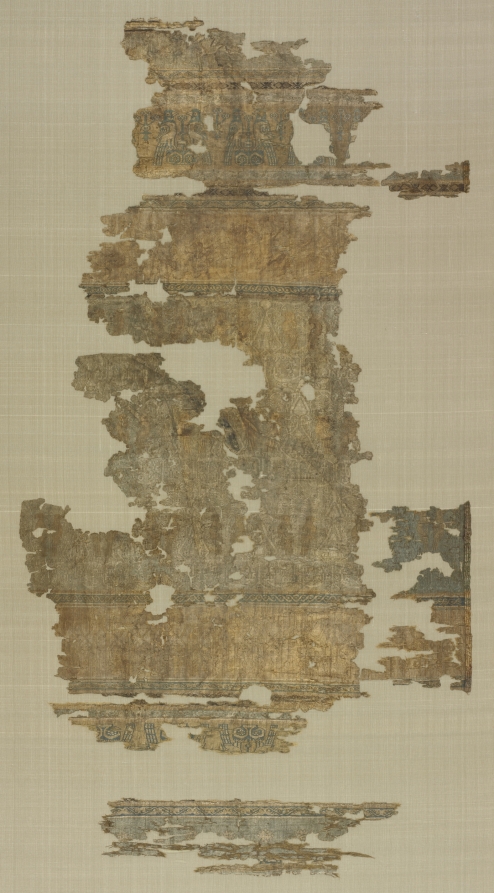
The very condition of these silk fragments—their frayed edges, faded colors, and missing sections—is a narrative device. A fragment from a Ming dynasty dragon robe, now reduced to a palm-sized square, tells a story of dispossession. Perhaps it was cut from a larger garment during the Boxer Rebellion, or perhaps it was a sample taken by a European merchant in the 19th century. The tear in the silk is not a flaw; it is a historical suture connecting the imperial court to the global trade networks of the East India Company. The fading of the indigo dye is a chemical record of exposure to light and air, a timeline of its journey from the Forbidden City to a London auction house. As a heritage specialist, I argue that the incomplete nature of these fragments is their greatest asset. They force us to imagine the whole, to reconstruct the material context of a garment that was once a living artifact of ritual and ceremony. The fragment is a synecdoche—a part that stands for a lost whole, a whisper of a world that was systematically dismantled by colonialism and modernization.
Savile Row and the Imperial Echo
How does this relate to the bespoke tailoring of Savile Row? The connection is more direct than one might assume. The silk linings of a Huntsman or Anderson & Sheppard jacket are not merely functional; they are a direct lineage from the imperial looms. The jacquard weave, invented by Joseph Marie Jacquard in 1804, was a direct descendant of the Chinese drawloom. The pattern books of Savile Row, with their intricate damasks and brocades, owe a debt to the silk fragments that arrived in London via the East India Company. When a client selects a silk lining with a subtle geometric pattern, they are participating in a tradition that began with the imperial dragon. The craftsmanship of a Savile Row tailor—the precise cutting, the hand-stitching, the attention to material integrity—is a direct echo of the master weavers of Suzhou. The fragment, in this context, becomes a pedagogical tool. It reminds us that luxury is not about novelty; it is about continuity. The heritage of silk is not a museum piece; it is a living thread that runs through the very fabric of modern tailoring.
Conclusion: The Fragment as Future
In the Lauren Fashion Heritage Lab, we do not treat silk fragments as relics to be preserved in amber. We treat them as active agents in a conversation about material culture. They are primary sources for understanding the global history of luxury. They challenge us to think about sustainability—the idea that a single fragment, properly cared for, can outlast entire fast-fashion cycles. They remind us that craft is not a nostalgic concept but a rigorous discipline that requires material intelligence. For the modern designer, a silk fragment from the Qianlong era is not a reference; it is a blueprint for how to make something that is both beautiful and meaningful. The legacy of imperial silk weaving is not a closed chapter; it is a continuous thread that we, as heritage specialists, are responsible for re-weaving into the present. And on Savile Row, where the cut is king, the fragment is the quiet, enduring queen.