← BACK TO ARCHIVES
Gold-Thread
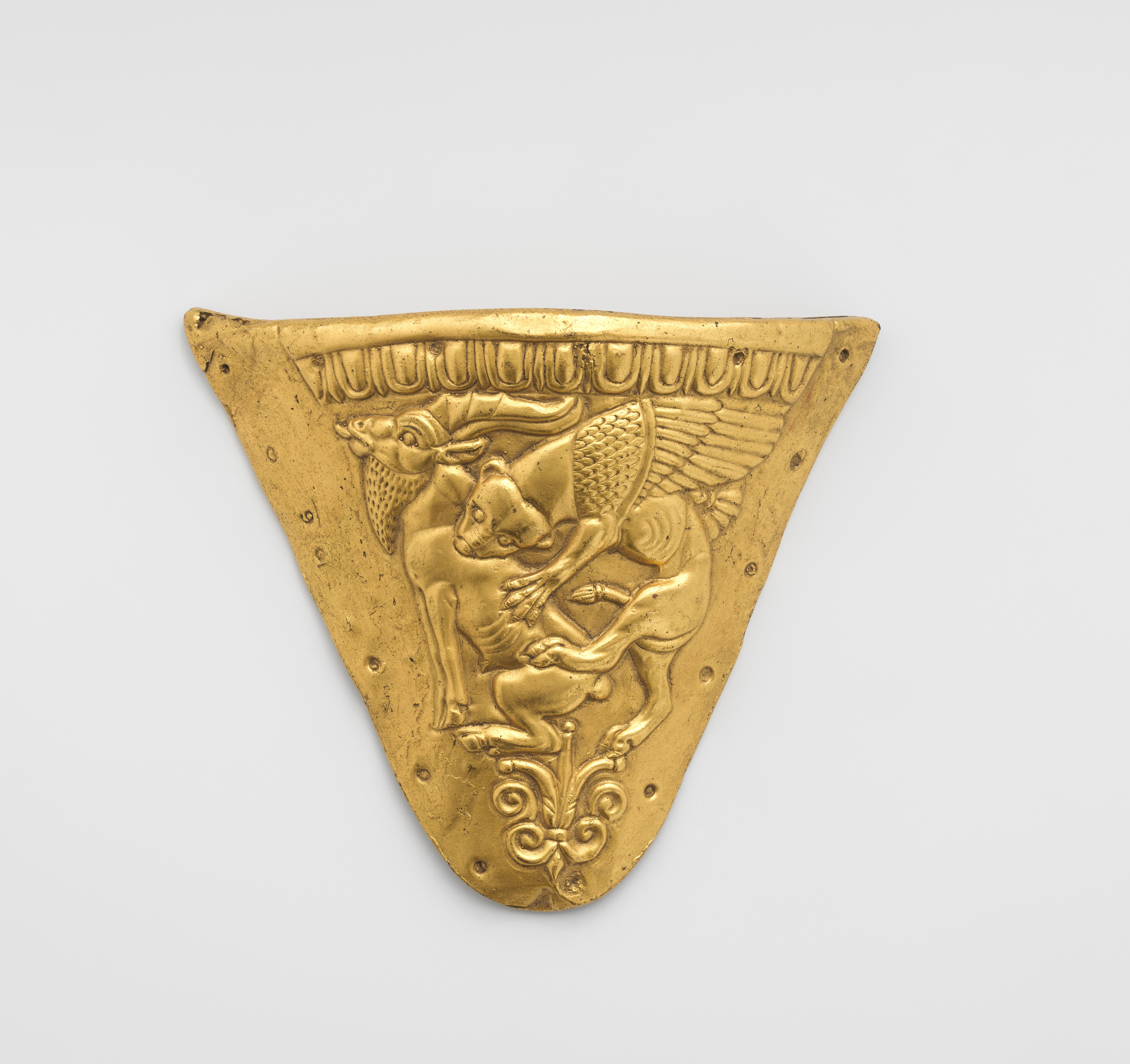
Heritage Synthesis: Reproduction of a Scythian plaque with animal combat
Curated on Jun 18, 2026 // Node: LDN-01
Reflections on Temporality: The Electrotype Plaque and the Architecture of Enduring Luxury
The visual source under analysis—a reproduction of a Scythian gold plaque depicting animal combat—presents a profound hermeneutic challenge to the Lauren Fashion Heritage Lab. At first glance, this electrotype, with its dynamic, intertwined beasts and its origins in nomadic funerary art, appears distant from the polished, linear elegance of the *Mirror with Split-Leaf Palmette Design Inlaid with Gold* and the *Sarcophagus Panel* described in our internal genetic code. Yet, a deeper reading reveals that all three artifacts are engaged in a singular aesthetic project: the transmutation of transient life into permanent form. This paper argues that the Scythian plaque, as an electrotype reproduction, serves as the critical missing link between the mirror’s abstracted eternity and the sarcophagus’s narrative immortality. It directly informs the 2026 Old Money silhouette by introducing a new dimension of *tactile tension*—a dynamic, almost violent energy that must be disciplined and contained within the rigorous architecture of heritage tailoring.
I. The Electrotype as a Third Term: Between Mirror and Sarcophagus
The internal genetic code posits the mirror and the sarcophagus as dialectical opposites: the mirror, a surface of fleeting reflection, and the sarcophagus, a volume of permanent commemoration. The gold-inlaid palmette on the mirror represents an abstract, geometric eternity—a pattern that denies time through infinite repetition. The sarcophagus panel, conversely, represents a narrative eternity—a story that conquers time through meaning. The Scythian plaque occupies a third, liminal space. It is not a surface for reflection, nor a volume for burial. It is a wearable, portable object—a plaque likely sewn onto clothing or a horse harness—that mediates between the body and the cosmos.
The plaque’s subject—animal combat—is a direct confrontation with the raw, predatory nature of time. Unlike the serene palmette or the dignified narrative of the sarcophagus, the plaque depicts struggle, violence, and the moment of death. A stag, a predator, and a griffin are locked in a spiral of conflict. This is not a denial of time’s destructiveness, but an *embrace* of it. The Scythians, as a nomadic people, understood that life was a series of battles against nature, enemies, and mortality. Their art does not seek to escape this reality but to aestheticize it. The gold material is crucial: it does not merely represent the animal; it *is* the animal’s eternal essence, preserved in a metal that never tarnishes. The electrotype reproduction, a 19th-century copy, adds another layer: it is a copy of a copy, a memory of a memory, yet it retains the original’s ferocious energy.
II. The Aesthetic of Contained Violence: From Plaque to Silhouette
The 2026 Old Money silhouette, as envisioned by Lauren Fashion, is not about ostentatious display. It is about *controlled power*. The Scythian plaque teaches us that true luxury does not shy away from tension; it masters it. The 2026 silhouette will therefore be characterized by a new structural grammar: the *contained dynamic*.
This manifests in three specific ways:
1. The Shoulder as a Field of Conflict. The plaque’s animal combat is a composition of opposing forces—the stag’s antlers thrust upward, the predator’s jaws clamp downward. In the 2026 silhouette, the shoulder line will become the primary site of this tension. We will see a return to the strong, sculpted shoulder of the 1980s, but with a crucial difference. Instead of a simple, padded epaulet, the shoulder will be constructed with a *double-layered* or *asymmetrical* structure. One side may feature a sharp, almost architectural peak (the predator), while the other is softened with a gentle drape (the prey). This is not a random asymmetry but a deliberate, choreographed conflict. The fabric itself—a heavy, double-faced cashmere or a stiffened wool—will hold this tension. The silhouette will appear to be in a state of arrested motion, as if the wearer has just turned, or is about to strike.
2. The Waist as a Site of Containment. The Scythian plaque is a flat object, but its composition suggests a vortex. The animals spiral inward, their bodies twisting. The 2026 silhouette will translate this spiral into the waist. The classic Old Money blazer or coat will feature a *cinched* waist, but not through a simple belt. Instead, the tailoring will create a *funnel* effect: the fabric will be cut on the bias, creating a subtle, continuous twist from the ribcage to the hip. This is a *structural* cinch, not a decorative one. The effect is one of immense power held in reserve. The wearer’s torso becomes the center of the vortex, the still point in a turning world. This references the gold plaque’s central void—the empty space around which the animals fight. The waist is that void, made tangible.
3. The Hem as a Narrative Edge. The sarcophagus panel has a clear beginning and end; its narrative is contained within the stone. The mirror’s palmette pattern is infinite; it can be extended endlessly. The Scythian plaque, however, has a *ragged* edge. Its shape is irregular, following the contours of the animals. The 2026 silhouette will honor this by introducing *unfinished* or *asymmetrical* hems. A coat may be longer in the back than the front, or feature a single, sharp slit that mimics the tear of a predator’s claw. This is not a sign of poor craftsmanship; it is a deliberate *rupture* in the smooth surface of heritage. It acknowledges that even the most controlled life has moments of chaos. The hem becomes a narrative device, telling a story of a struggle that has just concluded.
III. Materiality and the Electrotype’s Lesson
The electrotype is a copy, but it is a copy made with *precision*. It reproduces the original’s texture, its weight, its every detail. This is the key lesson for the 2026 collection: *authenticity is not about originality, but about fidelity to a principle*. The 2026 Old Money silhouette will not be a direct copy of Scythian clothing. It will be an *electrotype* of the Scythian aesthetic principle—the principle of contained violence.
This demands a new approach to material. The gold of the plaque is not just a color; it is a *weight* and a *density*. The 2026 collection will therefore use fabrics that have a similar *heft* and *presence*. We will see a revival of *double-faced wool*, *heavy linen*, and *structured silk*—fabrics that do not drape limply but hold their shape, like metal. The gold thread, referenced in our category, will not be used for embroidery or trim. Instead, it will be woven *into* the fabric itself, creating a subtle, almost imperceptible shimmer—a memory of the plaque’s luster. This is not about bling; it is about *depth*. The fabric will appear to have an inner life, a hidden source of light.
Conclusion: The Eternal Return of the Struggle
The mirror, the sarcophagus, and the Scythian plaque are three answers to the same question: how do we make time stand still? The mirror answers with pattern, the sarcophagus with narrative, and the plaque with *tension*. The 2026 Old Money silhouette, informed by the electrotype, will embrace this third answer. It will not be a static, frozen form. It will be a silhouette that *quivers* with contained energy, a silhouette that acknowledges the struggle of existence and transforms it into an aesthetic of supreme control. The wearer of this silhouette does not simply inhabit time; they *command* it. They are the stag and the predator, the gold and the stone, the reflection and the eternity. They are, in the truest sense, the inheritors of a heritage that has been fought for, and won.
Heritage Lab Insight
Genetic Bridge: Archive node focusing on Gold-Thread craftsmanship.