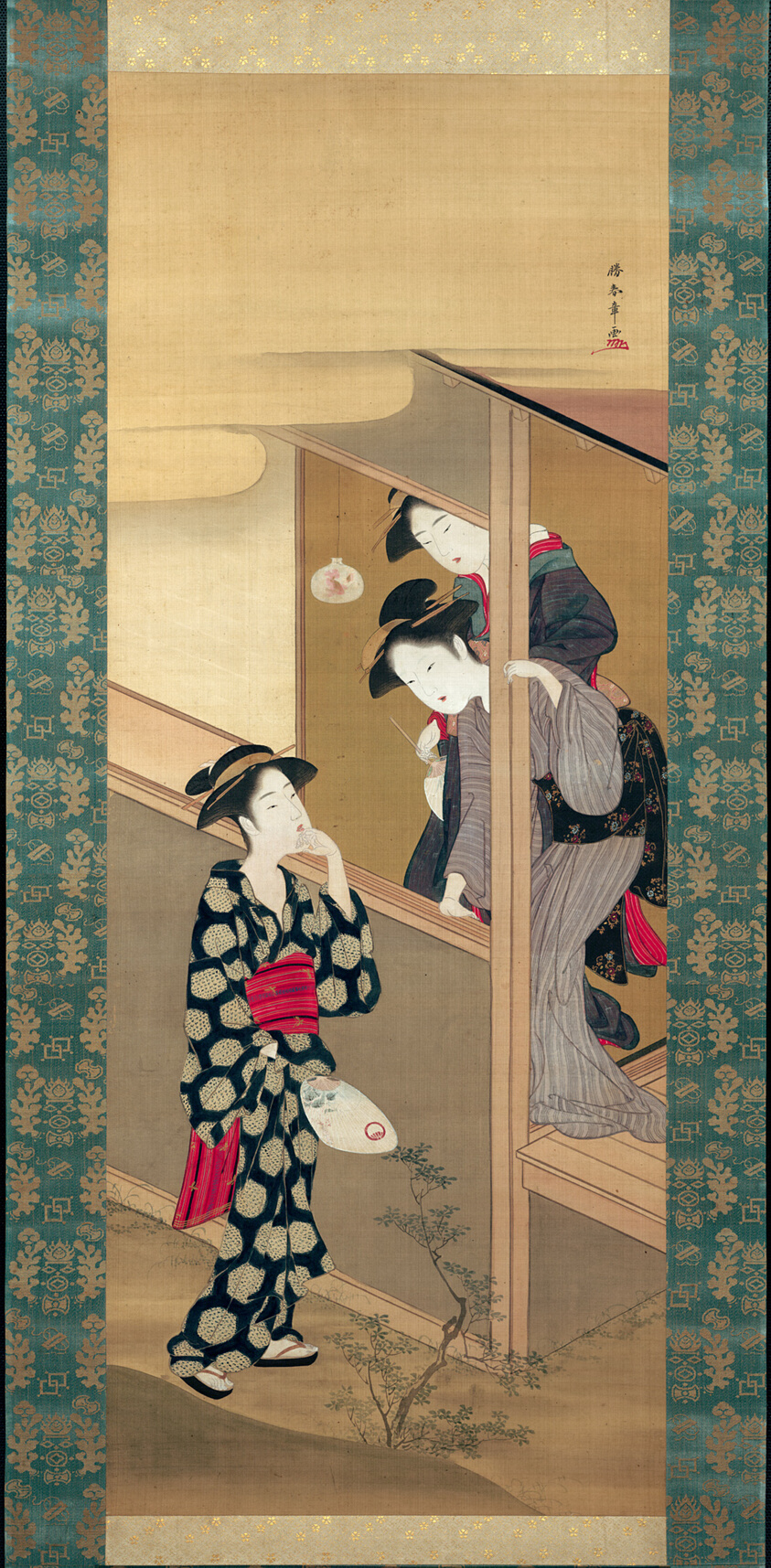
An Examination of Materiality and Line: The Heritage of "Three Beauties Chatting by a Veranda"
To engage with a hanging scroll such as Three Beauties Chatting by a Veranda is to enter into a dialogue with a legacy of material intelligence. The work presents itself not merely as an image, but as an articulated object, where the substance of its creation—the silk ground, the mineral pigments, the fluid ink—is inseparable from its narrative intent. In the manner of a Savile Row garment, where the integrity of the cloth dictates the drape of the lapel and the fall of the trouser, here the very character of the silk prescribes the behaviour of the medium and, by extension, the aesthetic outcome. This artifact, therefore, demands an appraisal that begins not with iconography, but with the foundational principles of its construction.
The Ground: A Foundation of Unspoken Refinement
The selection of silk as the substrate is the first and most consequential act of craftsmanship. This is not a passive canvas, but an active participant. The fine, tightly woven threads provide a surface of exceptional smoothness and minimal absorption, a quality that necessitates a particular discipline from the artist’s hand. Ink and colour do not sink in; they rest upon the surface, allowing for a clarity and brilliance of hue that paper cannot sustain. This creates a visual effect akin to the luminous sheen of a finely woven twill or a Venetian silk—a depth of colour that appears to emanate from within the material itself. The silk’s slight lustre catches the light, granting the painted scene a subtle vitality, a soft glow that shifts with the viewer’s perspective, much as the finish on a bespoke shoe evolves under different illumination.
Furthermore, the vertical, hanging format of the scroll leverages the inherent strength and drape of the silk. It is a format designed for contemplation, to be unfurled and engaged with in a moment of deliberate ceremony, then carefully rolled for preservation. This ritual of display underscores the object’s value and temporality, a considered practice not unlike the maintenance of a heritage garment in a cedar-lined wardrobe.
The Execution: Fluidity as a Technical Imperative
The descriptor fluid elegance is not merely poetic; it is a technical report. On silk, hesitation or correction is perilous. The brushwork must be confident, precise, and economical. Each line describing the elegant drape of a robe, the delicate arch of a brow, or the intricate lattice of the veranda must be rendered with a single, purposeful gesture. This results in a purity of line that is the hallmark of masterful control—the sartorial equivalent of a perfectly hand-rolled lapel or a seam stitched with such consistency it becomes invisible.
The application of colour follows this same principle of disciplined fluidity. Mineral pigments, ground and bound, are laid with a transparency that allows the silk’s ground to contribute to the overall tonality. Washes of colour define form through subtle modulation rather than harsh delineation, creating the soft, flowing volumes of the robes. The palette, likely derived from malachite, azurite, and cinnabar, would have been chosen not only for its beauty but for its stability—these are colours intended to endure, much as the dyes used in a regimental tie or a hunting jacket are selected for their permanence and propriety.
The Composition: A Study in Social Geometry
Within this refined material context, the scene of three figures in conversation achieves a particular resonance. The composition is undoubtedly a study in social rapport and restrained poise. The veranda acts as a stage, a defined architectural space that frames the interaction. The arrangement of the figures—their inclinations towards one another, the gestures of their hands, the shared focus—speaks to a narrative of intimate, cultivated discourse. The elegance of their forms is amplified by the knowledge of the technical mastery required to depict them upon such an unforgiving ground.
This is not a snapshot of idle gossip, but a portrait of refined leisure, a visual articulation of a cultivated social ideal. The artistry lies in conveying this depth of character and relationship through the supremely controlled language of line and wash on silk. Every element, from the fall of a sleeve to the turn of a head, contributes to a harmonious whole, achieving a balance that feels effortless precisely because of the immense skill underpinning it.
Conclusion: Heritage as an Accumulation of Choices
In final analysis, Three Beauties Chatting by a Veranda stands as a heritage artifact of the highest order because its significance is cumulative. It represents the confluence of exemplary material selection, technical mastery of a demanding medium, and nuanced artistic expression. The silk is not simply what it is painted on; it is the essential condition that elevates skilled painting into the realm of luxury artifact. The fluid elegance observed is the direct result of an artist working in perfect sympathy with his material, understanding its potentials and its constraints.
To possess such an object—or indeed, to study it—is to acknowledge a standard. It is an embodiment of a heritage where quality is inherent in every decision, from the loom to the final brushstroke. In this, it shares the fundamental ethos of the most revered traditional craftsmanship elsewhere: that true elegance is never an afterthought, but the inevitable result of integrity in materials, respect for technique, and clarity of purpose. The scroll, in its serene beauty, is a silent testament to this enduring principle.