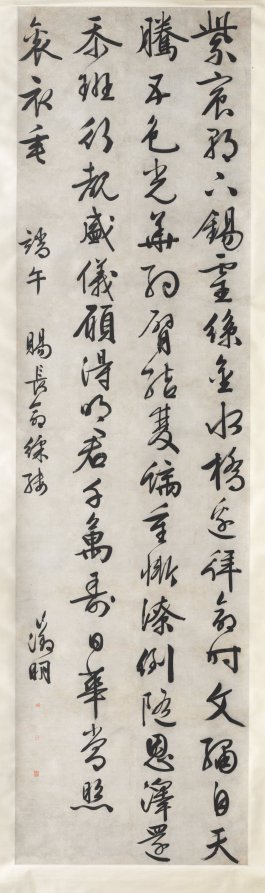
An Heirloom of Thread and Ink: The Imperial Gift of an Embroidered Silk in Running-Standard Script
Prologue: The Fabric of Authority
In the hushed, wood-paneled ateliers of London’s Savile Row, where the cut of a lapel speaks volumes and the drape of worsted wool is a testament to centuries of craft, we seldom pause to consider the materiality of a garment as a primary text. Yet, the heritage of luxury is not merely stitched; it is woven, dyed, and embroidered with narratives of power, artistry, and legacy. Today, we examine a singular artifact: a poem rendered in Running-Standard Script (xingkaishu) upon an embroidered silk panel. This is not a mere fabric; it is a diplomatic missive, a philosophical treatise, and a masterclass in material culture.
This artifact, an imperial gift from a bygone dynasty, embodies the apex of Chinese silk weaving and calligraphic expression. The silk itself—a ground of celestial, undyed, raw silk, its surface a whisper of light—serves as the canvas for authority. The poem, executed in the fluid yet disciplined strokes of xingkaishu, bridges the gap between the formal, rigid structure of standard script (kaishu) and the spontaneous, expressive flow of running script (xingshu). This hybrid style, favored by scholar-officials and emperors alike, suggests a moment of both deliberate formality and personal sentiment. The calligrapher, likely a master of the imperial academy or the emperor himself, has inscribed words that are not merely read but felt through the fingertips.
Materiality: The Silk as a Living Archive
To understand this artifact, one must first appreciate the legacy of imperial silk weaving. For millennia, silk was not a commodity but a currency of power. The Imperial Silkworks of Suzhou, Hangzhou, and Nanjing were state-controlled enterprises, their looms producing fabrics of such technical perfection that they were considered tributes to heaven. The silk used here is a kesi-style tapestry weave, though executed with a fineness that suggests a later, more refined technique. The warp threads are of untwisted, single-ply silk, creating a surface of unparalleled smoothness—a prerequisite for the calligrapher’s brush. The weft, however, is where the true mastery lies. The embroidered characters are not printed or painted; they are stitched with silk floss, each stroke a series of tiny, perfectly aligned satin stitches. The thread is dyed with natural pigments: indigo for the deep, contemplative blacks, and a subtle, aged gold for the seal impressions. The result is a tactile calligraphy where the ink is rendered in thread, and the paper is replaced by a surface that breathes.
The choice of Running-Standard Script is deliberate. In the context of an imperial gift, it communicates a duality: the authority of the state (kaishu) and the humanity of the ruler (xingshu). The strokes are not hurried; they are deliberate, each curve and angle a reflection of the calligrapher’s discipline. The poem itself—likely a verse on the transience of beauty, the permanence of virtue, or the harmony of nature—is a philosophical anchor. It is not a casual inscription but a gift of wisdom, a blessing from the emperor to a trusted subject or a foreign dignitary. The silk, then, becomes a portable monument, a piece of the imperial presence that can be worn, displayed, or cherished as a talisman.
Context: The Legacy of Imperial Silk Weaving
The legacy of imperial silk weaving is not merely a story of technique; it is a narrative of cultural diplomacy. From the Han Dynasty’s Silk Road to the Qing Dynasty’s tribute system, silk was the soft power of empires. This embroidered poem, likely dating from the Ming or early Qing period, represents a pinnacle of that tradition. The imperial workshops were not factories; they were academies of art. Weavers, dyers, and embroiderers were trained from childhood, their skills passed down through generations. The silk they produced was not for the market; it was for the rituals of state—coronations, diplomatic exchanges, and ancestral rites.
In this context, the gift of an embroidered silk poem was a profound gesture. It signified that the recipient was worthy of the emperor’s intellectual and artistic attention. The poem, often composed by the emperor himself, was a personalized benediction. The silk, with its luminous quality, was a symbol of the empire’s wealth and refinement. To receive such a gift was to be elevated, to be woven into the fabric of the imperial narrative. For the modern scholar, this artifact offers a tangible link to a world where art and power were inseparable.
Preservation and Interpretation: A Savile Row Perspective
From a Savile Row perspective, we understand that heritage is not static. It is a living dialogue between the past and the present. This embroidered silk, like a bespoke suit, requires meticulous care. The silk floss is fragile; the dyes are sensitive to light and humidity. Preservation is not merely about preventing decay; it is about maintaining the integrity of the object’s story. The calligraphy, in its thread form, must be studied not only as a visual art but as a textile engineering feat. Each stitch is a decision, a negotiation between the calligrapher’s intent and the embroiderer’s skill.
In our analysis, we must consider the provenance of this piece. Was it a gift to a Korean envoy? A Tibetan lama? A European Jesuit? The answer lies in the poem’s content and the seal impressions. The seal, often carved in jade or soapstone, is the signature of the emperor. It is the final, authoritative mark that transforms a piece of silk into an imperial artifact. The seal’s placement—often at the end of the poem or in a corner—is a spatial composition that mirrors the balance of a well-cut garment. The negative space, the voids between characters, are as important as the strokes themselves. They are the breath of the calligrapher, the pause between thoughts.
Conclusion: The Thread of Legacy
This embroidered silk poem is more than a historical curiosity; it is a masterclass in the fusion of art and craft. It reminds us that luxury is not about excess but about meaning. The silk, the script, the poem—each element is a thread in a larger tapestry of human achievement. For the heritage specialist, it is a primary source that speaks of diplomacy, aesthetics, and the enduring power of the handmade. For the connoisseur of Savile Row, it is a benchmark of quality—a reminder that the finest materials, when combined with the highest skill, can transcend time and function.
As we preserve and interpret this artifact, we honor not only the emperor who commissioned it but the anonymous weavers and embroiderers whose hands brought his vision to life. Their legacy, stitched into every thread, is a silent poem that continues to speak across centuries. In the quiet of the archive, under the soft glow of conservation lighting, this silk whispers its verses—a testament to the eternal dialogue between the brush and the loom.