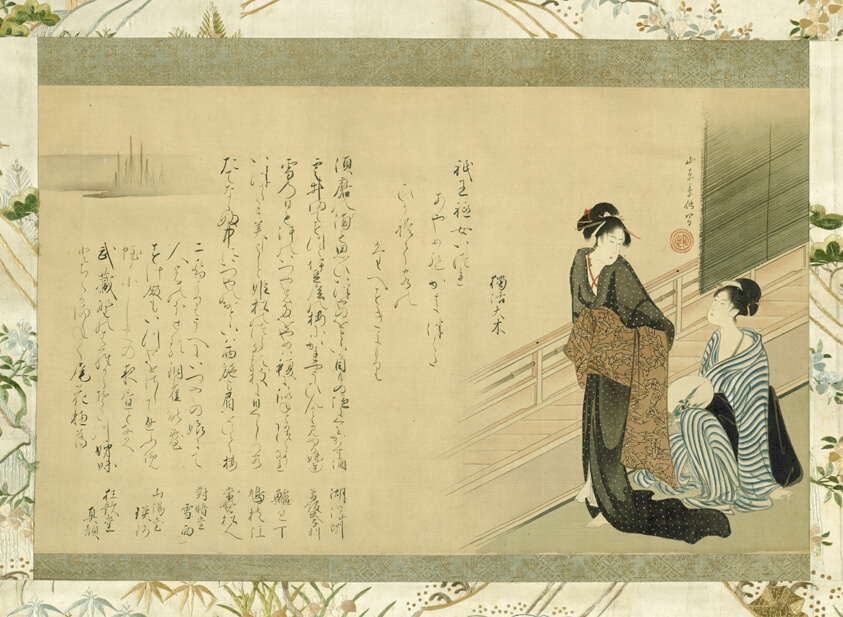
Heritage Artifact Analysis: "Two Beauties on a Veranda"
In the hallowed corridors of Lauren Fashion Heritage Lab, where the threads of history are woven into the fabric of modern luxury, we examine a singular artifact: “Two Beauties on a Veranda.” This hanging scroll, executed in ink and colors on silk, embodies a confluence of classical craftsmanship and fluid elegance. Its materiality—silk—is not merely a substrate but a protagonist in a narrative of refinement, discipline, and aesthetic transcendence. For the connoisseur of heritage, this piece offers a lexicon of beauty that speaks to the very essence of Savile Row tailoring: precision, texture, and the quiet power of restraint.
The Silk as a Living Medium
Silk, in its purest form, is a testament to nature’s ingenuity and human artistry. The scroll’s surface, a lustrous expanse of handwoven silk, captures light with a subtlety that mirrors the sheen of a well-tailored worsted wool. The fibers, derived from the cocoon of the Bombyx mori, are spun into threads of extraordinary tensile strength and suppleness. In “Two Beauties on a Veranda,” the silk serves as a canvas that breathes—each brushstroke of ink and pigment sinks into the weave, creating a dialogue between the artist’s hand and the material’s inherent fluidity. This is not a static surface; it is a living medium that responds to humidity, age, and the gaze of the beholder.
The craftsmanship required to prepare such silk is a lost art in many circles. The fabric must be degummed, stretched, and sized with a precise blend of alum and animal glue to accept the ink without bleeding. This process, akin to the meticulous hand-finishing of a bespoke jacket, demands patience and an intimate understanding of the material’s behavior. The result is a surface that holds color with a depth that modern synthetics cannot replicate—a depth that evokes the patina of a vintage cashmere or the sheen of a silk tie from a bygone era.
Iconography and Composition: The Elegance of Stillness
The scroll depicts two women, poised on a veranda, their forms rendered with a calligraphic economy that suggests both intimacy and distance. Their robes, painted in layers of mineral pigments—cinnabar, azurite, and orpiment—fall in folds that mimic the drape of silk itself. This is a self-referential artistry: the medium mirrors the subject. The veranda, a liminal space between interior and exterior, becomes a stage for quiet contemplation. The women do not engage the viewer; they exist in a world of their own, their gazes fixed on an unseen garden or a distant horizon. This detachment is not coldness but a form of elegance—a reminder that true luxury does not clamor for attention but commands it through presence.
The composition adheres to classical principles of balance and asymmetry. The verticality of the scroll format, typical of East Asian hanging scrolls, draws the eye upward, while the horizontal lines of the veranda railing anchor the scene. The negative space—the silk left bare—is as significant as the painted areas. This restraint is a hallmark of high heritage: the ability to say more with less, much like the clean lines of a Savile Row suit that eschews superfluous ornamentation for impeccable cut and fabric.
Materiality and Craft: The Art of the Brush
The ink used in this scroll is a carbon-based ink stick, ground with water on a stone slab until it achieves a viscosity that allows for both fine lines and broad washes. The colors, derived from ground minerals and organic dyes, are applied in layers, each requiring a period of drying to prevent muddiness. This technique, known as gongbi (meticulous brushwork), demands a steadiness of hand that is akin to the tailor’s precision in cutting a sleeve or setting a collar. The brush, held vertically, must move with a rhythm that is both controlled and spontaneous—a paradox that defines the highest levels of craftsmanship.
The silk’s weave—a plain weave with a high thread count—provides a smooth surface that allows the brush to glide without snagging. Yet, the silk’s natural irregularities—slight variations in tension, the occasional slub—add a tactile dimension that machine-made fabrics lack. This is the same quality that distinguishes a hand-rolled silk pocket square from a mass-produced one: the imperfection that signals authenticity.
Conservation and Legacy: A Responsibility to the Future
Preserving “Two Beauties on a Veranda” requires an understanding of silk’s fragility. Light, humidity, and temperature fluctuations can cause the silk to yellow, the pigments to fade, and the fibers to become brittle. At the Lauren Fashion Heritage Lab, we store such artifacts in climate-controlled environments, with UV-filtered lighting and minimal handling. The scroll is mounted on a silk backing, using traditional Japanese hyōgu techniques that allow for expansion and contraction without stress. This conservation is not merely technical; it is an ethical commitment to the artisans who created it and to the generations who will study it.
The legacy of this artifact extends beyond its aesthetic value. It is a document of a time when silk was a currency of culture, a symbol of status, and a medium for artistic expression. For the modern designer, it offers lessons in materiality: how a fabric can shape a silhouette, how color can evoke emotion, how restraint can amplify impact. In the context of Lauren Fashion Heritage Lab, “Two Beauties on a Veranda” is a touchstone—a reminder that heritage is not a relic but a living dialogue between past and present.
Conclusion: The Enduring Thread
In the world of Savile Row, where tradition is both a foundation and a challenge, this hanging scroll stands as a quiet testament to the power of materiality. Its silk speaks of discipline and elegance; its ink and colors tell a story of beauty that transcends time and place. For the scholar, the artisan, and the aesthete, “Two Beauties on a Veranda” is more than an artifact—it is a masterclass in the art of being. And in that, it finds its place in the lineage of luxury that the Lauren Fashion Heritage Lab is dedicated to preserving.