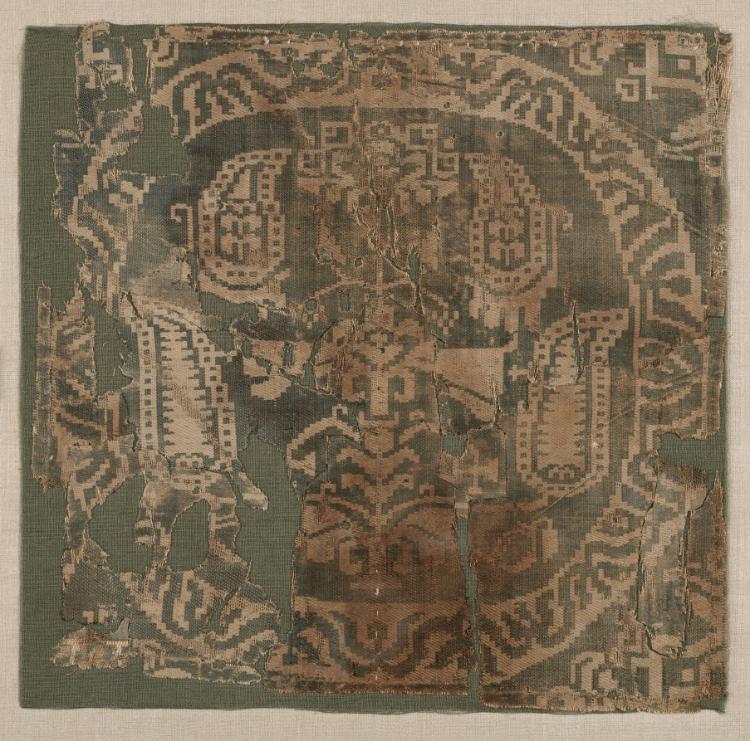
An Examination of the Imperial Roundel: Silk as the Substrate of Sovereignty
To comprehend the object before us—a roundel excised from a tunic, its silk ground cradling the solemn symmetry of a palmette tree—one must first appreciate the absolute primacy of its material. This is not mere fabric. It is silk: the ultimate expression of controlled luxury, a technological secret guarded with the fervour of state intelligence, and the most potent non-verbal language of power the ancient and medieval worlds ever devised. The legacy it carries is not one of incidental adornment but of deliberate, imperial command. In the hands of the Byzantine or Sassanian workshops from which such a motif likely emanates, silk was the physical manifestation of oikoumene—the inhabited, civilised world—with the emperor, or shahanshah, at its literal and figurative centre.
The Grammar of the Loom: Where Technique Becomes Tenet
Consider the construction. This roundel, likely woven by the drawloom technique, represents a staggering investment in human capital and technical patience. The very existence of such a piece speaks of a vertically integrated monopoly. From the mulberry groves, a state-controlled resource, to the sericulture processes shrouded in ceremony and secrecy, to the ateliers housed within imperial precincts, every stage was an act of governance. The complex weaves—taqueté, samitum—were not merely aesthetic choices but declarations of capability. They were the period equivalent of a bespoke suit’s hand-felled seams or functional buttonholes: details invisible to the layman but unequivocal signals of provenance and expense to the cognoscenti. The silk itself, with its luminous depth and formidable tensile strength, provided a canvas worthy of the message it bore. It held dye with a regal intensity, particularly the famed Tyrian purple, a colour so legislatively bound to imperial personages that its unauthorised use was tantamount to treason.
Heraldry of the Hothouse: Decoding the Palmette Tree
The motif within the roundel’s protective circumference is where symbolism crystallises into doctrine. The palmette tree, or more accurately, the stylised Tree of Life, is no pastoral fancy. It is an iconography of ordered cosmology. Its rigorous symmetry, its axial perfection rising from a pot or mound, mirrors the perceived structure of the universe itself: a single, central authority from which all bounty and stability flows. In the context of an imperial tunic, this was not clothing; it was a portable manifesto.
Worn by an envoy, a general, or the emperor himself, the garment transformed the body into a walking assertion of divine-right ecology. The repeating roundels across the tunic’s surface would have created a rhythmic field of power, a visual incantation asserting the wearer’s role as the linchpin of a perpetual, fertile order. The roundel’s circular border, often itself a minor masterpiece of intricate geometric or floral meander, serves as both frame and fortress, isolating and protecting the central dogma within from the profane world outside. It is the sartorial equivalent of the temenos, the sacred precinct of a temple.
The Currency of Cloth: Diplomatic Armoury and Geopolitical Leverage
The true measure of imperial silk’s legacy, however, lies beyond the palace walls. These textiles were the hard currency of high diplomacy and the soft power of awe. A bolt of such silk, or a garment like the tunic from which our roundel came, was a gift of calibrated magnificence. Bestowed upon a barbarian chieftain on the frontier, it was an act of co-option, draping him in the symbols of the civilisation he was being invited to join. Presented to a fellow monarch, it was a silent testament to the technological and artistic supremacy of the gifting court.
This was power, woven into a transferable asset. The export of the cloth was carefully managed, but the knowledge of its production was guarded more fiercely than any treasury. The famed tale of Byzantine monks smuggling silkworm eggs from the East in hollowed-out staves is, in essence, a story of industrial espionage that shifted the balance of geopolitical power. To possess the means of production was to claim a share of the imperial mantle.
A Legacy in the Thread: From Imperial Loom to Modern Lexicon
The legacy of this imperial silk-weaving tradition is not confined to museums. It established the very grammar of luxury textiles. The concept of the repeating emblematic motif as a marker of identity and status echoes down the centuries, from the heraldic surcoats of medieval knights to the signature prints of the great European silk houses. The insistence on the finest raw material, transformed by the most skilled hands into a product that communicates authority before a word is spoken, is the foundational principle of the modern bespoke and luxury goods industry.
To hold this roundel—this fragment of a second skin for empire—is to understand that the most sophisticated systems of communication are often non-verbal. In its sublime material, its technically arrogant weave, and its serene, tyrannical symmetry, it speaks of a world where aesthetics were politics, where the loom was an instrument of state, and where silk was the ultimate expression of a civilisation’s reach, ambition, and self-conception. It is, in the final analysis, a masterclass in the projection of authority, rendered in threads of protein and pigment. A legacy, indeed, worthy of the most exacting consideration.