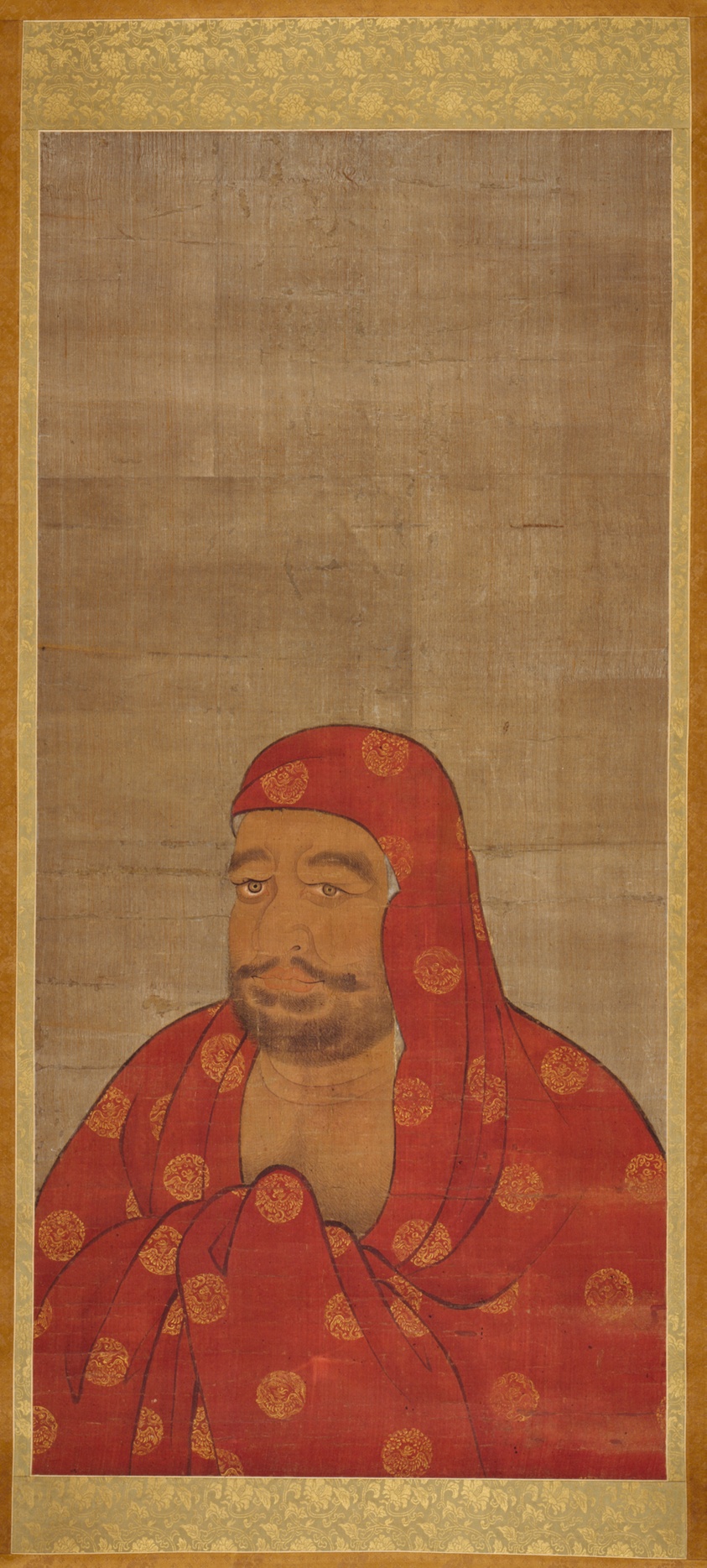
The Daruma Hanging Scroll: A Study in Materiality and Metaphor
Introduction: The Convergence of Craft and Philosophy
In the hallowed ateliers of London’s Savile Row, where precision tailoring meets centuries of textile tradition, the concept of materiality is not merely a technical consideration—it is a narrative. The Daruma hanging scroll, executed in ink, colors, and gold on silk, represents a singular artifact that bridges the tactile mastery of silk craftsmanship with the philosophical rigor of Zen Buddhism. As Senior Heritage Specialist for the Lauren Fashion Heritage Lab, I approach this object not as a mere decorative piece, but as a testament to the interplay between material integrity and symbolic resonance. The silk substrate, with its fluid elegance and luminous finish, serves as both canvas and metaphor, embodying the resilience and adaptability that Daruma—the Bodhidharma—himself personifies. This paper examines the scroll’s materiality, its cultural provenance, and its relevance to contemporary heritage discourse, drawing parallels to the bespoke ethos of Savile Row.
Materiality: Silk as a Conduit of Heritage
The selection of silk for this hanging scroll is no accident. Silk, a fiber of unparalleled refinement, has been revered in East Asia for millennia as a medium of artistic and spiritual expression. In the context of this Daruma scroll, the silk’s weight, weave, and finish are critical to its aesthetic and functional longevity. The fabric is likely a plain-weave silk, characterized by its smooth surface and subtle sheen, which allows the ink and pigments to absorb with a controlled diffusion. This is not the coarse, utilitarian silk of everyday use; it is a habutae or chirimen grade, chosen for its ability to hold fine brushwork and metallic accents without distortion. The gold leaf, applied in delicate patches, catches ambient light, creating a dynamic interplay between shadow and illumination—a visual metaphor for the enlightenment that Daruma sought.
The craftsmanship of this scroll reflects a lineage of textile artisans who understood that silk is not inert; it breathes, ages, and responds to environmental shifts. The mounting, or hyōgu, is a specialized art form in itself, involving layers of paper and silk to stabilize the painting while allowing for rolling and unrolling. The brocade borders, often woven with intricate patterns, serve both structural and aesthetic purposes, framing the central image much like a Savile Row lapel frames a jacket’s silhouette. The tension between the silk’s fluidity and the scroll’s rigidity mirrors the Zen concept of wabi-sabi—the beauty of imperfection and transience. This materiality demands a connoisseur’s eye, akin to the scrutiny a tailor applies to a bolt of Scottish tweed or Italian cashmere.
Iconography and Symbolism: The Daruma Motif
The Daruma figure, depicted in this scroll with bold ink strokes and subdued color washes, is a study in contrast. The face, often rendered with exaggerated features—bushy eyebrows, a stern gaze, and a flowing beard—conveys the intensity of meditation. The red robes, a nod to the traditional attire of Buddhist monks, are painted with a vermilion pigment derived from cinnabar, a mineral prized for its permanence. The gold accents, applied as kirikane (cut gold leaf), highlight the folds of the robe, suggesting a divine luminosity. This iconography is not merely decorative; it is a mnemonic device for the practitioner, reminding them of Daruma’s legendary nine years of wall-gazing meditation, which led to the founding of Chan (Zen) Buddhism.
The scroll’s composition adheres to the kakejiku format, where the vertical orientation encourages a contemplative gaze. The empty space—the yohaku—is as significant as the painted areas, inviting the viewer to project their own interpretations. This is a hallmark of Japanese aesthetics, where less is often more, and the materiality of the silk enhances this minimalism. The gold, when viewed under certain lighting, seems to float above the silk surface, creating a subtle dimensionality that a flat digital reproduction cannot capture. For the heritage specialist, this underscores the importance of material authenticity in preserving cultural narratives.
Cultural Provenance and the Savile Row Parallel
This Daruma scroll likely originates from the Edo period (1603–1868), a time when silk production in Japan reached its zenith. The use of imported Chinese pigments and local gold leaf suggests a workshop of considerable prestige, perhaps in Kyoto or Edo (modern Tokyo). The scroll’s provenance—its journey from a temple or private collection to the Lauren Fashion Heritage Lab—is a story of cross-cultural exchange. It mirrors the trajectory of Savile Row, where tailoring techniques from London were adapted to global tastes, and where heritage is continually reinterpreted through new materials and contexts.
In Savile Row terms, this scroll is akin to a bespoke suit: each element is handcrafted, from the silk’s weave to the brushwork’s precision. The gold leaf is the equivalent of a hand-stitched buttonhole—a detail that elevates the whole. The scroll’s condition, with its subtle foxing and patina, speaks to its age and use, much like the wear on a well-loved pair of shoes. To preserve it requires a similar discipline: controlled humidity, minimal light exposure, and careful handling. The Lab’s role is to document these material conditions, ensuring that future generations can appreciate the scroll’s tactile and visual richness.
Relevance to Contemporary Heritage Discourse
The Daruma scroll offers a paradigm for how heritage artifacts can inform modern design and sustainability. The silk’s biodegradability and the scroll’s modularity (it can be re-mounted or re-backed) challenge the fast-fashion ethos of disposability. The Zen philosophy of shibui—understated elegance—aligns with the growing interest in slow fashion and artisanal production. For the Lauren Fashion Heritage Lab, this artifact is a case study in material intelligence: how a single object can encode centuries of knowledge about fiber, dye, and technique.
Moreover, the scroll’s narrative of perseverance—Daruma’s unwavering meditation—resonates with the resilience required in heritage preservation. In an era of digital replication, the physicality of the scroll reminds us that heritage is not just visual but haptic. The weight of the silk, the slight texture of the gold, the smell of aged pigments—these are irreplaceable sensory experiences. As we develop digital archives, we must not lose sight of the material’s primacy.
Conclusion: A Living Artifact
The Daruma hanging scroll is more than a historical object; it is a living testament to the dialogue between material and meaning. Its silk substrate, executed with the fluid elegance of classic craftsmanship, embodies the principles of precision and patience that define both Zen practice and Savile Row tailoring. For the Lauren Fashion Heritage Lab, it serves as a benchmark for how heritage artifacts can inspire contemporary design, sustainability, and cultural understanding. In preserving this scroll, we honor not just a tradition, but a philosophy that transcends time and geography—a philosophy that, like the finest silk, endures through careful stewardship.