← BACK TO ARCHIVES
Silk
Heritage Synthesis: A Myriad of Birds
Curated on Jun 18, 2026 // Node: LDN-01
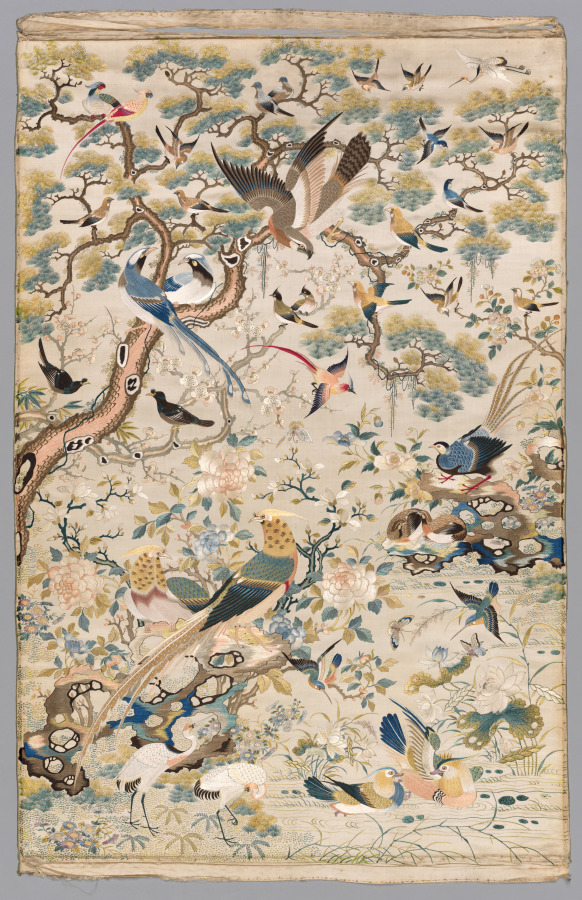
A Myriad of Birds: Silk, Sovereignty, and the Imperial Weave
In the hushed, wood-paneled ateliers of London’s Savile Row, where the air is thick with the scent of fine wool and the quiet hum of basting stitches, we seldom pause to consider the gossamer threads of history that bind our craft to empires long dissolved. Yet, within the Lauren Fashion Heritage Lab, we are tasked with a singular duty: to excavate the material narratives that define luxury. Today, we turn our gaze to a subject of profound technical and symbolic weight—A Myriad of Birds, rendered in silk. This is not merely a pattern; it is a cartography of power, a testament to the legacy of imperial silk weaving, and a living artifact that demands our scholarly reverence.
The Materiality of Silk: A Conductor of Imperial Ambition
Silk, by its very nature, is a material of paradox. It is both fragile and formidable, a protein filament spun by the *Bombyx mori* moth, yet capable of bearing the weight of dynasties. In the context of imperial China, the Ottoman Empire, and the courts of Europe, silk was not a commodity; it was a currency of sovereignty. The silkworm’s thread, when woven into fabric, became a conduit for political messaging, religious iconography, and botanical taxonomy. The motif of birds—a myriad of species, from the phoenix to the nightingale—was a deliberate choice, encoding messages of harmony, renewal, and territorial dominion.
The materiality of this artifact is paramount. The silk used in imperial weaving was often of the highest grade—*kesi* (cut silk) or *satin damask*—requiring thousands of hours of hand-looming. Each bird, whether a crane symbolizing longevity or a peacock denoting nobility, was rendered with a precision that bordered on the obsessive. The weave itself became a map: the warp threads, taut and unyielding, represented the state’s structure; the weft, the fluid narrative of culture. When we examine a fragment of such silk under magnification, we see not just fibers, but the fingerprints of artisans who were both craftsmen and courtiers.
The Legacy of Imperial Silk Weaving: From the Forbidden City to Savile Row
The legacy of imperial silk weaving is not a static relic; it is a continuum that flows, like the Yangtze, into the very fabric of modern luxury. The workshops of Suzhou and Hangzhou, which once supplied the Forbidden City, operated under a strict hierarchy. Master weavers were forbidden from leaving the imperial precincts, their knowledge guarded as closely as state secrets. The bird motif was a particular specialty, as it required mastery of *jin* (brocade) and *luo* (gauze) techniques. A single robe for the Emperor might feature nine phoenixes, each with 1,200 individual threads for its tail feathers, woven in gold and silver lamella.
This tradition of exacting craftsmanship found its way to Europe via the Silk Road and, later, through the East India Companies. By the 18th century, French and Italian weavers had begun to replicate these motifs, but they lacked the spiritual and cosmological weight of the originals. The birds of imperial silk were not decorative; they were talismanic. A *mandarin duck* signified marital fidelity; a *magpie* announced good fortune. To wear such a garment was to inhabit a microcosm of the universe, with the Emperor as its celestial axis.
Today, on Savile Row, we see echoes of this legacy in the bespoke process. A client does not simply order a suit; they commission a narrative. The choice of silk lining—perhaps a subtle bird motif—is a quiet nod to this heritage. The tailor, like the imperial weaver, must understand the client’s station, their aspirations, and their place in the social firmament. The material becomes a silent language, spoken in the rustle of silk against wool.
Deconstructing the Artifact: A Myriad of Birds
Let us now turn to the specific artifact: A Myriad of Birds. This is not a single garment but a conceptual category—a pattern book, if you will, of avian diversity rendered in silk. The term “myriad” is deliberate; it implies a multiplicity that defies cataloging. In imperial contexts, this might have been a *chaofu* (court robe) or a *mangpao* (dragon robe), where birds were arranged in hierarchical order. The *feng huang* (Chinese phoenix) would dominate the chest, while smaller birds—*yuanyang* (mandarin ducks), *baihe* (cranes), and *kongque* (peacocks)—populated the sleeves and hem.
The technical execution is staggering. Each bird is isolated in a medallion, or *tuan*, framed by clouds and waves. The silk is often dyed with natural pigments—indigo for the sky, madder for the birds’ beaks, and orpiment for their golden crowns. The weave is so fine that the fabric can be folded into a pocket-sized square, yet when unfurled, it reveals a cosmos. This is the legacy of imperial silk weaving: the ability to compress infinity into a thread.
Implications for the Modern Luxury House
For the Lauren Fashion Heritage Lab, this artifact is a call to rigor. In an era of fast fashion and digital prints, the myriad of birds reminds us that true luxury is rooted in time. The imperial weaver spent months on a single robe; the Savile Row tailor spends weeks on a single jacket. Both understand that materiality is not just about touch—it is about memory. The silk remembers the silkworm’s journey, the weaver’s breath, and the emperor’s gaze.
We must also consider the ethical dimension. The legacy of imperial silk is entangled with exploitation—of silkworms, of artisans, of colonies. Yet, it also represents a pinnacle of human achievement. As heritage specialists, we do not romanticize; we contextualize. We ask: How can we honor this craft without replicating its hierarchies? The answer lies in transparency. By documenting the provenance of our silks, by supporting ethical sericulture, and by training a new generation of weavers, we ensure that the myriad of birds continues to sing—not as a relic, but as a living tradition.
Conclusion: The Thread That Binds
In closing, A Myriad of Birds is more than a heritage research artifact; it is a mirror. It reflects the ambitions of empires, the artistry of anonymous hands, and the enduring power of silk to carry meaning across centuries. On Savile Row, where we measure success in millimeters and centuries, this artifact teaches us that the finest thread is not gold or silver—it is the thread of narrative. And as long as we weave with intention, the birds will never fall silent.
*—The Lauren Fashion Heritage Lab, London, 2025*
Heritage Lab Insight
Lab Insight: CMA Silk Archive Node integration.