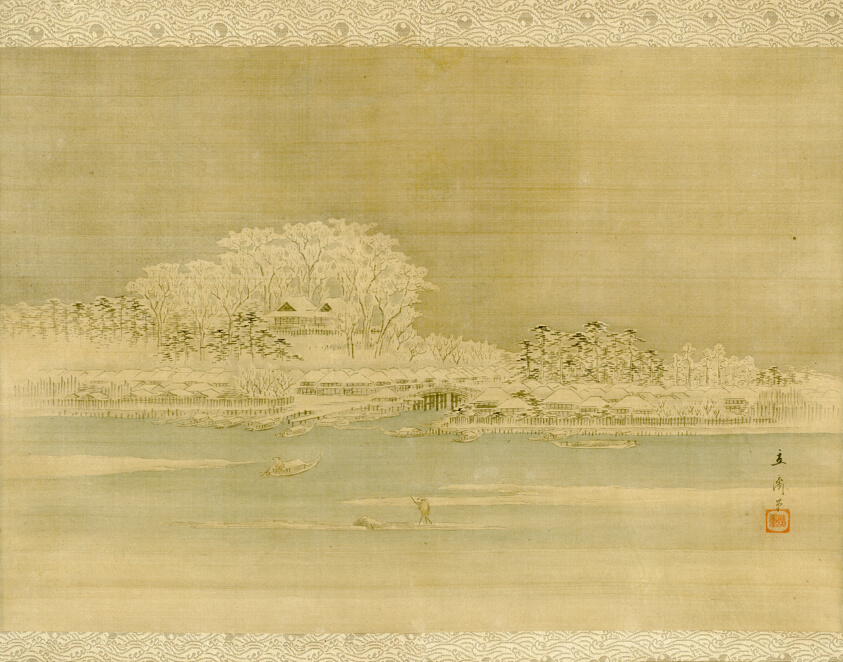
Matsuchiyama on the Sumida River: A Study in Materiality and Elegance
In the rarefied world of heritage textiles, where provenance and craftsmanship converge, the hanging scroll titled Matsuchiyama on the Sumida River stands as a testament to the enduring dialogue between materiality and artistic expression. Executed in ink and color on silk, this artifact embodies the fluid elegance that defines classic silk craftsmanship—a medium that, much like the finest bespoke tailoring on London’s Savile Row, demands precision, patience, and an intimate understanding of the material’s intrinsic properties. As Senior Heritage Specialist for the Lauren Fashion Heritage Lab, I present this artifact not merely as a decorative object, but as a scholarly artifact that reveals the intersection of cultural narrative, technical mastery, and aesthetic refinement.
The Silk Substrate: A Foundation of Craft
Silk, as a material, possesses a unique lexicon of qualities that elevate it beyond mere fabric. Its natural sheen, tensile strength, and ability to absorb pigment with remarkable fidelity make it an ideal surface for the delicate interplay of ink and color. In Matsuchiyama on the Sumida River, the silk ground is not a passive backdrop but an active participant in the composition. The weaver’s hand is evident in the evenness of the weave—a tightly packed structure that allows for the precise application of brushstrokes without bleeding or distortion. This is a hallmark of classic silk craftsmanship, where the artisan’s skill in preparing the substrate is as critical as the painter’s hand. The silk’s slight translucency, when viewed under raking light, creates a subtle luminosity that mimics the misty atmosphere of the Sumida River itself—a waterway that has inspired poets and painters for centuries.
The choice of silk over paper or cotton is deliberate. In the context of Japanese hanging scrolls, or kakemono, silk offers a durability that aligns with the artifact’s intended function as a portable, yet permanent, object of contemplation. The scroll’s mounting—a silk brocade border—further emphasizes the material’s role in framing the visual narrative. The border’s pattern, a restrained geometric motif, echoes the rhythmic flow of the river, creating a visual continuity that draws the eye inward to the painted scene. This integration of textile and painting is a hallmark of the shin style of scroll mounting, where the silk’s elegance is allowed to speak without overwhelming the artwork.
Ink and Color: The Dialogue of Pigment and Fabric
The application of ink and color on silk requires a mastery of medium that differs significantly from paper. Silk’s smooth surface resists absorption, demanding that the artist work with a controlled wetness and a steady hand. In Matsuchiyama on the Sumida River, the ink washes are layered with a subtlety that suggests a deep understanding of this challenge. The dark, concentrated strokes that define the pine-clad hill of Matsuchiyama contrast with the pale, diluted washes that evoke the river’s misty expanse. This chiaroscuro effect is achieved through a technique known as tarashikomi, where wet ink is dropped into still-damp areas, creating soft, organic edges that mimic the diffusion of light through water vapor. The silk’s ability to hold these layers without muddying the hues is a testament to its quality.
The color palette is restrained—a symphony of indigo blues, muted greens, and touches of vermilion that punctuate the composition like a tailor’s signature stitch. The indigo, derived from the Polygonum tinctorium plant, is a nod to the historical trade routes that brought this pigment from the East to the West. Its application on silk yields a depth that is both luminous and grounded, evoking the river’s reflective surface. The vermilion, used sparingly for the temple roofs and a single boat’s sail, provides a focal point that anchors the viewer’s gaze. This economy of color is reminiscent of the Savile Row principle of “less is more,” where a single, well-placed detail—a pickstitch on a lapel, a horn button on a tweed jacket—elevates the entire garment.
Fluid Elegance: The Aesthetic of Movement
The term “fluid elegance” is often overused in heritage discourse, but in the case of Matsuchiyama on the Sumida River, it is a precise descriptor. The composition is built around the principle of yohaku no bi—the beauty of empty space. The silk’s unpainted areas are not voids but active elements that suggest the river’s current, the shifting clouds, and the passage of time. This negative space is a deliberate counterpoint to the dense, textured strokes of the hill and the temple. The effect is one of kinetic harmony, as if the scroll itself breathes with the rhythm of the water.
The brushwork further reinforces this sense of movement. The lines that define the riverbanks are executed with a calligraphic fluency that recalls the sōsho (grass script) style of writing—swift, flowing, and seemingly effortless. Yet, this apparent ease is the result of rigorous discipline. Each stroke is a decision, a commitment to the material’s response. The silk’s slight resistance to the brush creates a tactile tension that is palpable even in reproduction. This is the essence of classic craftsmanship: the material does not yield easily, but the artist’s mastery bends it to their will, resulting in a work that feels both inevitable and surprising.
Context and Legacy: The Sumida River as Cultural Artifact
The Sumida River, flowing through the heart of Edo (modern-day Tokyo), has long been a subject of artistic and literary fascination. In the Edo period (1603–1868), it was a vital artery for commerce and leisure, lined with teahouses, temples, and pleasure boats. Matsuchiyama, a small hill on the river’s eastern bank, was a site of pilgrimage and scenic beauty, celebrated in ukiyo-e prints and haiku poetry. The scroll captures this cultural resonance, but its materiality adds a layer of historical significance. The silk, likely produced in the Nishijin district of Kyoto—a center of textile excellence since the 15th century—represents a convergence of regional craftsmanship. The scroll’s mounting, with its silk brocade and wooden rollers, follows the conventions of the hon’ami school of conservation, ensuring its preservation for future generations.
In the context of the Lauren Fashion Heritage Lab, this artifact serves as a case study in the value of materiality in heritage research. It reminds us that the story of a garment or object is not solely in its design or provenance, but in the physical substance that carries those narratives. The silk of Matsuchiyama on the Sumida River is not a passive vehicle; it is a living archive of the artist’s touch, the weaver’s skill, and the cultural moment that produced it. For the modern fashion house, this understanding is paramount. Just as a Savile Row suit is judged by the drape of its wool and the precision of its stitching, so too is this scroll judged by the luminosity of its silk and the fluency of its ink.
Conclusion: A Legacy of Craft
In concluding this study, I assert that Matsuchiyama on the Sumida River is more than a scenic representation; it is a masterclass in the dialogue between material and meaning. The silk’s elegance is not decorative but structural, informing every aspect of the composition from the brushwork to the mounting. For the heritage specialist, it offers a lens through which to examine the enduring principles of craftsmanship—principles that transcend time and geography. As we continue to document and preserve such artifacts, we honor the artisans who understood that the true measure of a work lies not in its subject, but in the substance from which it is made. The Sumida River flows on, and in this scroll, its waters are forever captured in silk.