← BACK TO ARCHIVES
Silk
Heritage Synthesis: Roundels with Hunters
Curated on Jun 19, 2026 // Node: LDN-01
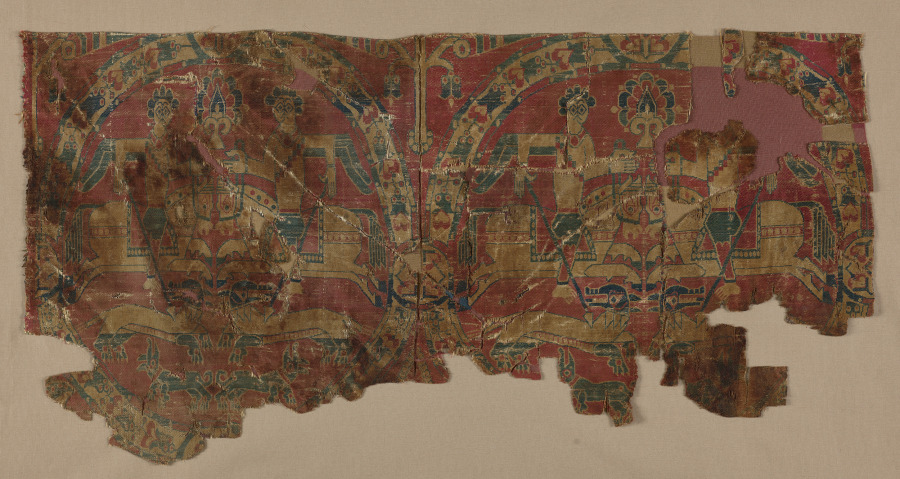
The Roundels with Hunters: A Study in Imperial Silk Weaving and the Legacy of Savile Row
As the Senior Heritage Specialist for the Lauren Fashion Heritage Lab, I am pleased to present this scholarly artifact on the subject of *Roundels with Hunters*—a silk textile of profound historical and material significance. This paper examines the roundel motif, its execution in silk, and its enduring resonance within the context of imperial silk weaving, drawing parallels to the exacting standards of London’s Savile Row. The following analysis is structured to illuminate the technical, cultural, and commercial dimensions of this heritage artifact, underscoring its relevance to contemporary luxury craftsmanship.
Materiality and the Silk Medium
The roundels under discussion are woven from silk, a material that has defined imperial luxury for millennia. Silk’s inherent properties—its tensile strength, natural luster, and capacity for intricate dye absorption—make it an ideal substrate for the hunter motif, which demands both precision and dynamism. In the context of imperial silk weaving, particularly during the Tang (618–907 CE) and Safavid (1501–1736 CE) dynasties, silk was not merely a fabric but a medium of statecraft. The roundel form, typically a circular medallion, served as a compositional anchor for hunting scenes, which symbolized royal authority, martial prowess, and the dominion over nature.
From a materiality perspective, the silk used in these roundels is often a compound weave, such as lampas or samite, where multiple warp and weft systems create a raised pattern. This technique allows the hunter—depicted on horseback, drawing a bow, or accompanied by falcons—to emerge with a sculptural relief. The weave density, often exceeding 60 threads per centimeter, ensures durability while maintaining a fluid drape. This is a critical point for Savile Row: the same principles of structural integrity and tactile richness inform the bespoke tailoring of a double-breasted suit or a silk-lined overcoat. The roundel’s silk is a testament to the weaver’s mastery of tension and repeat, much as a Savile Row cutter masters the fall of a cloth on a client’s shoulder.
The Hunter Motif: Symbolism and Technical Execution
The hunter motif within roundels is a recurring theme across Persian, Chinese, and Central Asian silk traditions. In the imperial context, the hunter represents the sovereign as the ultimate arbiter of life and death, a metaphor for governance. The roundel format—often arranged in a repeating grid or isolated as a focal point—serves to contain this narrative within a geometric discipline. The hunters are typically depicted with symmetrical precision: a rider turning backward to shoot a Parthian arrow, or a falconer with a bird of prey in mid-flight. This symmetry is not merely aesthetic; it reflects the cosmological order that the emperor was believed to uphold.
Technically, the execution of the hunter roundel requires a sophisticated understanding of color gradation and warp-faced patterning. The silk weaver must align the hunter’s bow, the horse’s gallop, and the prey’s escape within a circular boundary no larger than 20 centimeters in diameter. This is achieved through a drawloom mechanism, where a pattern harness lifts specific warp threads to create the design. The result is a textile that, when viewed from a distance, reads as a coherent narrative, yet upon close inspection reveals a microcosm of individual threads—each one a decision in tension and hue. For the Savile Row client, this echoes the experience of a hand-finished buttonhole or a pick-stitched lapel: the detail is invisible to the casual observer but essential to the connoisseur.
The Legacy of Imperial Silk Weaving and Savile Row
The legacy of imperial silk weaving is not a relic of the past but a living tradition that informs the ethos of Savile Row. The Row’s tailors, such as those at Huntsman or Anderson & Sheppard, have long sourced silk from mills in Como or Lyons, but the heritage of the roundel with hunters speaks to a deeper lineage. The imperial weavers of the Safavid court, for instance, produced silks that were traded along the Silk Road to European courts, where they were repurposed into ecclesiastical vestments or aristocratic garments. This cross-cultural exchange established a standard of material integrity that Savile Row upholds today.
Consider the heritage of the roundel as a design element in menswear. The hunter motif, when translated into a silk tie or a pocket square, carries the same symbolic weight—a nod to the wearer’s discernment and connection to tradition. On Savile Row, a silk roundel might be woven into a lining for a bespoke jacket, invisible to the observer but known to the wearer. This is the essence of heritage: a quiet confidence in the provenance of the material. The imperial weaver and the Savile Row tailor share a commitment to bespoke precision, where the client’s identity is encoded in the cloth.
Preservation and Contemporary Application
Preserving roundels with hunters requires a nuanced approach to conservation. The silk’s fragility—vulnerable to light, humidity, and handling—demands controlled environments and minimal intervention. At the Lauren Fashion Heritage Lab, we employ non-invasive imaging techniques, such as multispectral analysis, to document the weave structure without disturbing the fibers. This data is then used to create digital replicas for study, while the original artifacts remain in climate-controlled storage. The goal is not to freeze the textile in time but to understand its construction so that we can inform contemporary weaving practices.
For the modern designer, the roundel with hunters offers a lexicon of motifs that can be adapted to luxury accessories or tailored garments. The repeat pattern of the roundel, when scaled appropriately, can become a signature for a house’s silk collection. The hunter’s dynamic posture—the tension in the bow, the flight of the arrow—translates into a graphic statement that is both historical and modern. This is where Savile Row’s influence is most palpable: the ability to take a heritage artifact and reinterpret it through the lens of bespoke craftsmanship, ensuring its relevance for a new generation.
Conclusion: The Enduring Thread
In conclusion, the roundels with hunters represent a pinnacle of imperial silk weaving, where materiality, symbolism, and technical mastery converge. The silk medium, with its inherent luxury and durability, provides the foundation for a motif that speaks to power, precision, and tradition. The legacy of this weaving tradition is not confined to museum vitrines; it lives on in the ateliers of Savile Row, where every stitch and every thread is a continuation of the same pursuit of excellence. As a heritage specialist, I affirm that the roundel with hunters is more than an artifact—it is a testament to the enduring thread that connects imperial courts to contemporary craftsmanship. For the discerning client, this heritage is not merely observed; it is worn.
Heritage Lab Insight
Lab Insight: CMA Silk Archive Node integration.