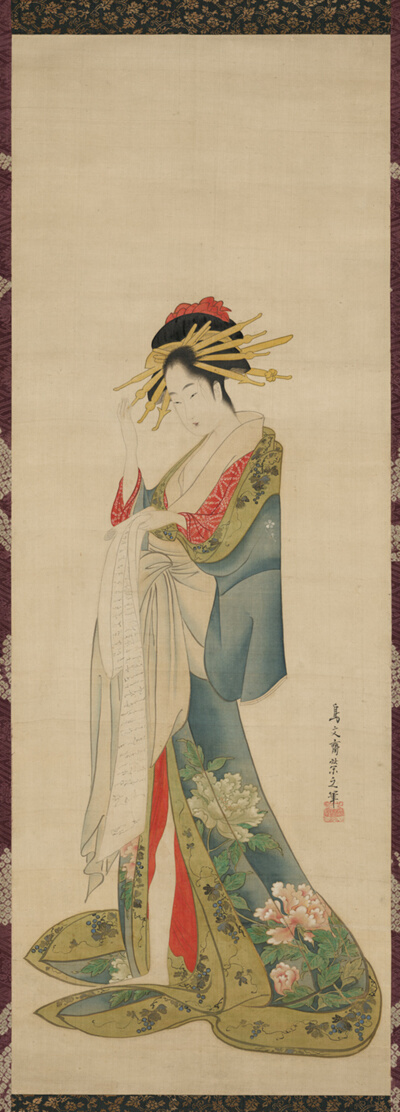
The Materiality of Ephemeral Grace: Deconstructing *A Courtesan Reading a Letter*
In the hallowed ateliers of London’s Savile Row, where cloth is not merely cut but composed, we understand that materiality is the first language of narrative. A length of Super 150s wool whispers of discipline; a bolt of raw silk speaks of untamed luxury. It is with this discerning eye that we approach the heritage artifact before us: A Courtesan Reading a Letter, a hanging scroll executed in ink and color on silk. This is not a painting on silk; it is a painting of silk, a dialogue between the depicted subject and the very substrate that grants her form. The scroll’s materiality—its silk, its pigments, its structural fragility—is not a passive canvas but an active participant in the narrative of fleeting beauty and hidden communication.
The Silk Substrate: A Second Skin
The choice of silk as the painting’s foundation is no mere convention. In the context of 18th- or 19th-century China, silk was a material of profound social and economic significance, often reserved for the elite. For the courtesan, silk was her daily armor—her robes, her bedding, the very currency of her trade. By rendering her on silk, the artist elevates her from mere subject to a creature of the same luxurious fabric. The warp and weft of the silk become a metaphor for the interwoven threads of her life: desire, commerce, secrecy. The scroll’s weave, likely a fine tabby or satin structure, provides a surface that absorbs the ink and mineral pigments with a distinct softness, diffusing the brushstrokes into a gentle, almost breathing, quality. Unlike the crisp, unforgiving surface of paper, silk yields to the brush, allowing for a fluidity that mirrors the courtesan’s own practiced grace. This is not a static image; it is a living membrane.
Ink and Color: The Palette of Intimacy
The artist’s technique on silk demands a mastery of control and surrender. The ink, derived from pine soot and animal glue, is applied with a brush that must move with decisive hesitation—too much pressure, and the ink bleeds beyond intention; too little, and the line lacks authority. In A Courtesan Reading a Letter, the ink is used with exquisite restraint. The courtesan’s silhouette is defined by fine, continuous lines that suggest the drape of her silk robe, while her face is rendered with a lighter wash, creating an ethereal, almost translucent quality. The color palette is deliberately muted: soft pinks, faded blues, and a touch of vermilion for her lips. These are not the bold, assertive hues of an official portrait but the intimate, whispered tones of a private moment. The letter she holds is a small rectangle of white—a void of information, a blank space that the viewer must fill with narrative. The pigment, likely a lead white or ground shell, stands in stark contrast to the surrounding silk, drawing the eye to the object of her focus. This is a masterclass in negative space: the letter is the only element that does not bleed into the silk, symbolizing its foreign, disruptive presence in her world of tactile luxury.
Fluid Elegance: The Brush as a Tailor’s Hand
Savile Row tailors speak of “drape”—how a fabric falls, folds, and moves with the body. In this scroll, the brush achieves a similar drape. The courtesan’s robe is not painted with rigid outlines but with long, sweeping strokes that mimic the natural fall of silk. The folds of her garment are suggested by the varying thickness of the ink line, a technique known as “bone method” (gu fa) in Chinese painting. The brush, like a tailor’s needle, follows the logic of the fabric: where the silk would gather at her waist, the lines converge; where it would flow over her shoulder, they loosen. The result is a figure that seems to breathe, to shift slightly as the light changes across the scroll. This fluid elegance is not decorative; it is functional. It conveys the courtesan’s mastery of her own physical presentation, her ability to command attention through the subtle language of fabric and form. She is, in every sense, a woman who knows how to wear her materiality.
The Fragility of Heritage: Conservation and the Passing Moment
As a heritage artifact, this scroll is acutely vulnerable. Silk is a protein fiber, susceptible to light, humidity, and handling. The mineral pigments, once vibrant, have faded into a soft patina of age. The scroll’s mounting—a silk brocade border and a wooden roller—is itself a work of craftsmanship, designed to protect the painting during storage and display. Yet, every unrolling is a risk. The tension of the silk, the creasing at the edges, the gradual oxidation of the pigments—these are the silent costs of preservation. In the context of Lauren Fashion Heritage Lab, we must ask: how do we honor the materiality of this object without accelerating its decay? The answer lies in understanding that the scroll’s ephemeral nature is central to its meaning. Like the courtesan’s own beauty, it is a thing of fleeting grace. To preserve it is to acknowledge that all elegance is temporal, that the letter she reads will yellow, and the silk will one day fray. This is not a failure of heritage but its truest expression.
Conclusion: The Letter as a Mirror
In the end, A Courtesan Reading a Letter is a study in the materiality of communication. The silk speaks of luxury and vulnerability; the ink and color speak of intimacy and restraint; the letter itself speaks of a message we cannot read. As a heritage artifact, it challenges us to look beyond the image and into the substance. For the fashion historian, the textile conservator, and the Savile Row tailor alike, this scroll is a reminder that the most profound narratives are often written not in words but in the weave of a fabric, the stroke of a brush, and the quiet patience of a woman who holds a secret in her hands.