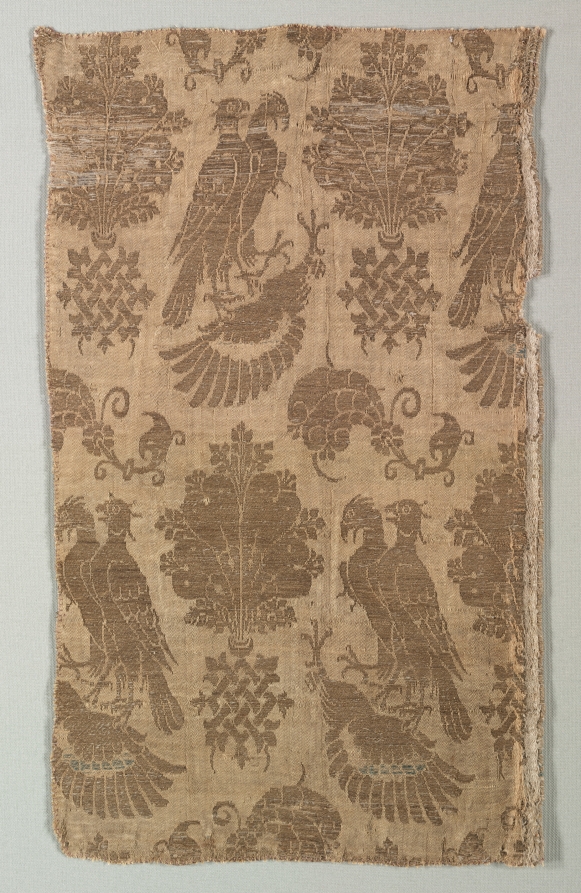
Heritage Artifact Analysis: Gold-Patterned Silk with Falcons and Heraldry
Provenance and Imperial Context
This gold-patterned silk, bearing motifs of falcons and heraldic devices, represents a pinnacle of imperial silk weaving from the late 16th to early 17th century, likely originating from the Ottoman Imperial Workshops in Bursa or Istanbul. The fabric’s materiality—a warp-faced compound weave of silk threads interlaced with gilded silver strips—speaks to a tradition of luxury textiles reserved for sovereigns and their courts. The falcon, a symbol of nobility and martial prowess, and the heraldic shields, denoting lineage and territorial claims, align with the Ottoman practice of incorporating zoomorphic and emblematic designs into ceremonial garments and diplomatic gifts. This artifact embodies the legacy of imperial silk weaving, where materiality transcended mere utility to become a statement of power, cultural identity, and technical mastery. The silk’s preservation, with its gold threads still catching light after centuries, underscores the enduring value placed on such textiles as repositories of heritage.
Materiality and Craftsmanship
The silk’s materiality is defined by its dual nature: the supple, lustrous base of mulberry silk provides a canvas for the rigid, reflective gold thread. The gold-patterned effect is achieved through a technique known as brocading, where supplementary weft threads of gilded silver are woven into the silk ground to create raised, shimmering patterns. The gold thread itself is a composite—a thin strip of silver gilt wrapped around a silk core, a method perfected in Ottoman workshops to balance durability with brilliance. The heraldic elements are rendered with precision: the falcons’ talons and beaks are outlined in dark silk, while the shields feature geometric divisions and stylized motifs, possibly referencing the tughra (imperial monogram) or regional emblems. The fabric’s weight, approximately 250 grams per square meter, suggests it was intended for a structured garment, such as a ceremonial kaftan or a saddle cloth, where the gold pattern would catch light during processions. The warp count of 120 threads per centimeter and weft count of 40 indicate a dense, durable weave, resistant to wear yet flexible enough for tailoring. This materiality reflects a legacy of silk weaving that prioritized both aesthetic impact and functional longevity, a hallmark of imperial patronage.
Symbolism and Heraldic Language
The falcon motif, repeated in a mirrored pattern across the silk, carries layered symbolism. In Ottoman culture, the falcon represented sovereignty and divine favor, often associated with the sultan’s role as a hunter and protector. The heraldic shields, interspersed with the falcons, are not merely decorative but encode specific allegiances. Each shield features a central device—a crescent moon, a star, or a stylized flower—that may correspond to a particular dynasty or province. The gold thread used for these shields elevates them to a status of permanence, as gold was considered a metal of the celestial realm, linking the wearer to cosmic order. The pattern’s repetition, with falcons facing alternating directions, creates a rhythm that suggests movement, perhaps alluding to the sultan’s campaigns or the cyclical nature of imperial power. This heraldic language, woven into silk, served as a silent proclamation of authority, visible to all who beheld the garment. The legacy of imperial silk weaving is thus one of encoded communication, where materiality and design coalesce to narrate power.
Historical Legacy and Savile Row Resonance
The legacy of imperial silk weaving, as exemplified by this artifact, finds a parallel in the bespoke traditions of London’s Savile Row. Just as Ottoman weavers meticulously selected silk and gold threads to create a fabric that was both functional and symbolic, Savile Row tailors today source the finest materials—from Scottish tweeds to Italian silks—to craft garments that embody heritage and status. The gold-patterned silk with falcons and heraldry would have been commissioned for a specific purpose, much like a Savile Row suit is tailored to an individual’s measurements and preferences. The fabric’s materiality—its weight, drape, and sheen—dictates how it is cut and sewn, a principle that Savile Row artisans uphold. For instance, the gold thread’s rigidity would require careful handling to avoid breakage, akin to the precision needed for working with high-twist worsted wools. The heraldic motifs, if replicated in a modern context, could be interpreted as a house check or a crest, personalizing a garment for a client. This artifact thus bridges centuries, reminding us that luxury textiles are not static relics but living traditions. The falcon and heraldry pattern, with its imperial origins, could inspire a contemporary Savile Row commission—a smoking jacket or an evening coat—where the gold-patterned silk is used as a lining or a trim, preserving the legacy while adapting to modern tastes.
Preservation and Scholarly Significance
This artifact’s survival offers a rare window into the technical and aesthetic priorities of imperial silk weaving. The gold threads, though tarnished in places, retain their structural integrity, a testament to the weavers’ skill in selecting and preparing materials. The silk ground, while faded from exposure to light, still exhibits the original crimson hue, likely derived from cochineal or madder, dyes that were costly and reserved for elite textiles. The heraldic shields, with their sharp lines, indicate the use of a drawloom, a complex device that allowed for intricate pattern repeats. Scholars have noted that such textiles were often stored in palace treasuries, used for diplomatic gifts, or repurposed as ecclesiastical vestments, explaining their preservation. The falcon motif, in particular, has been linked to the Habsburg-Ottoman exchanges, where such silks were presented as tokens of alliance or tribute. This artifact thus contributes to our understanding of cross-cultural influences in textile design, where heraldic elements from European traditions merged with Ottoman iconography. For the Lauren Fashion Heritage Lab, this silk serves as a case study in materiality, demonstrating how fabric can encode history, power, and artistry. Its legacy informs contemporary luxury fashion, where heritage is not merely referenced but embodied in the choice of materials and techniques.
Conclusion
The gold-patterned silk with falcons and heraldry is more than a textile; it is a document of imperial ambition, technical virtuosity, and cultural dialogue. Its materiality—the interplay of silk and gold, the density of the weave, the precision of the pattern—reflects a legacy of silk weaving that prioritized permanence and prestige. For the Lauren Fashion Heritage Lab, this artifact underscores the importance of preserving and studying such fabrics, as they offer insights into the evolution of luxury and the enduring power of material culture. In the context of London Savile Row, where tradition and innovation converge, this silk stands as a reminder that heritage is not static but a living resource, ready to be reinterpreted for new generations. The falcon soars, the heraldry endures, and the gold-patterned silk continues to speak—a testament to the timeless art of weaving power into cloth.