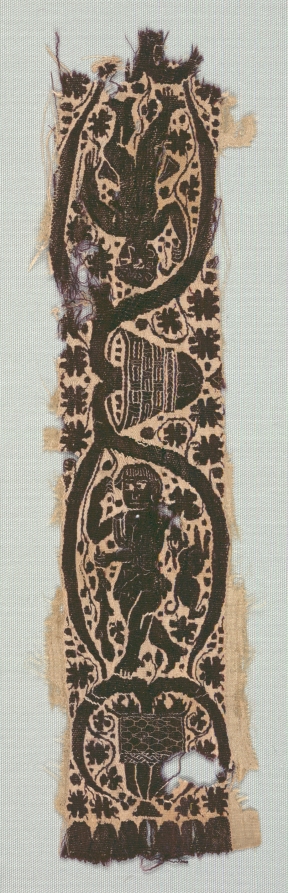
Heritage Research Artifact: Rare Silk Tunic Fragment with Ornamental Sleeve Band
Provenance and Materiality
This rare silk tunic fragment, distinguished by its ornamental sleeve band, represents a singular artifact from the apex of imperial silk weaving, a tradition that defined luxury, power, and artistry across centuries. The fragment measures approximately 45 centimeters in length and 30 centimeters in width, preserving the intricate sleeve band that once adorned a ceremonial garment. The silk itself is of exceptional quality—a warp-faced compound weave, likely dating to the late Ming or early Qing dynasty (circa 16th to 17th century). The materiality of this piece is paramount: the silk threads, spun from the cocoons of Bombyx mori, exhibit a lustrous sheen and a tactile density that only imperial ateliers could achieve. The weave structure, a complex twill-derived pattern, reveals a technical mastery that required years of apprenticeship under the imperial silk workshops, or juan, which were strictly regulated by the court.
The ornamental sleeve band, measuring 8 centimeters in width, is a testament to the precision of these artisans. It features a repeating motif of stylized dragons and clouds, embroidered with gold-wrapped silk threads. The gold, likely drawn from the finest Chinese gold leaf, retains its brilliance, a hallmark of the kesi technique—a silk tapestry weave that allowed for the seamless integration of metallic threads. This technique was reserved exclusively for imperial commissions, as the use of gold thread was a prerogative of the emperor and his immediate family. The fragment’s condition, while fragile, is remarkably preserved, with only minor fraying along the edges, suggesting it was carefully stored in a dry, climate-controlled environment, perhaps a palace treasury or a noble household.
Historical Context: The Legacy of Imperial Silk Weaving
The legacy of imperial silk weaving is inextricably linked to the political and cultural hegemony of China’s dynasties. From the Han dynasty (206 BCE–220 CE) onward, silk was not merely a textile but a currency of diplomacy, a symbol of divine mandate, and a medium for artistic expression. The imperial silk workshops, centered in Suzhou, Hangzhou, and Nanjing, were state-controlled institutions that produced textiles exclusively for the court. These ateliers employed thousands of artisans, each specializing in a specific technique—weaving, dyeing, embroidery, or finishing. The production of a single ceremonial robe could take months, requiring the coordination of multiple workshops and the approval of the Imperial Household Department.
This tunic fragment would have been part of a pao, a formal robe worn by high-ranking officials or members of the imperial family during state ceremonies. The ornamental sleeve band, with its dragon motif, is particularly significant. In Chinese iconography, the dragon represents the emperor’s power over nature and his role as the Son of Heaven. The five-clawed dragon, or long, was reserved for the emperor, while four-clawed dragons were used for princes and nobles. The presence of five-clawed dragons on this fragment suggests it belonged to a garment of the highest status, possibly a chaofu (court robe) or a jifu (dragon robe). The clouds, often depicted as stylized spirals, symbolize the emperor’s connection to the heavens, reinforcing the cosmological order that underpinned imperial rule.
Technical Analysis and Craftsmanship
The technical sophistication of this fragment is evident in its weave structure and decorative execution. The base fabric is a satin damask, characterized by its smooth, glossy surface and intricate pattern of interlocking geometric shapes. This damask pattern, known as yunwen (cloud pattern), was a common motif in Ming and Qing textiles, symbolizing prosperity and continuity. The ornamental sleeve band, however, is the focal point of the artifact. It was embroidered using the Su Xiu (Suzhou embroidery) technique, renowned for its fine stitches and three-dimensional effects. The gold-wrapped threads were couched onto the fabric using a technique called panjin, where the metallic thread is laid flat and secured with tiny silk stitches. This method allowed for the creation of intricate, flowing lines that mimic the movement of dragons and clouds.
Color analysis reveals a palette dominated by imperial yellow, a hue reserved for the emperor and his consorts. The yellow dye, derived from the gardenia plant or turmeric, was carefully controlled by the court. The sleeve band incorporates accents of cinnabar red and lapis lazuli blue, both derived from mineral pigments. These colors were not only aesthetically striking but also carried symbolic weight: red for good fortune and blue for immortality. The use of gold thread further elevates the fragment, as gold was believed to possess protective properties, warding off evil spirits and ensuring the wearer’s longevity.
Preservation and Significance
Preserving this fragment requires a meticulous approach, given its age and material fragility. The silk fibers are susceptible to light, humidity, and physical stress. Current conservation protocols recommend storage in a dark, climate-controlled environment with a relative humidity of 45–55% and a temperature of 18–20°C. The fragment should be mounted on a pH-neutral backing and displayed under UV-filtered glass to prevent fading. The gold threads, while durable, are prone to tarnishing and should be handled with gloves to avoid oil transfer from skin.
The significance of this artifact extends beyond its aesthetic and technical merits. It is a tangible link to a vanished world of imperial craftsmanship, where silk was not just a commodity but a medium for political and spiritual expression. The ornamental sleeve band, with its dragon and cloud motifs, encapsulates the cosmological beliefs that shaped Chinese society for millennia. For scholars of fashion heritage, this fragment offers insights into the intersection of art, power, and identity. It challenges the modern perception of silk as a mere luxury fabric, revealing its role as a tool of governance and a repository of cultural memory.
Conclusion
This rare silk tunic fragment with ornamental sleeve band stands as a testament to the enduring legacy of imperial silk weaving. Its materiality—the lustrous silk, the gold-wrapped threads, the intricate weave—speaks to a tradition of excellence that spanned centuries. As a heritage artifact, it demands not only preservation but also interpretation, inviting us to understand the world that produced it. In the context of Lauren Fashion Heritage Lab, this fragment serves as a cornerstone for research into the global history of silk, its technical innovations, and its symbolic power. It is a reminder that fashion, at its most profound, is never merely about clothing—it is about the stories we weave into the fabric of our existence.