Introduction: The Thread of Authority
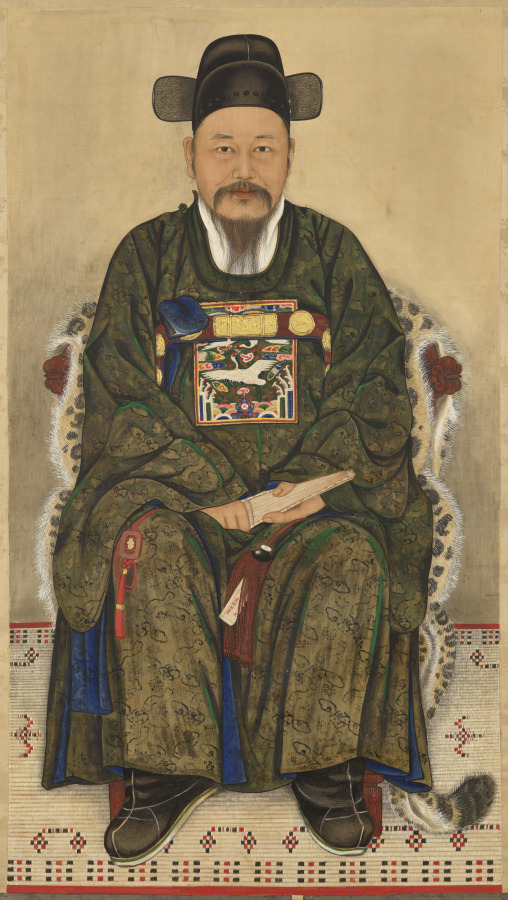
In the annals of imperial governance, few artifacts speak as eloquently to the intersection of power, artistry, and material culture as the Portrait of a Government Official rendered in silk. This heritage research artifact, housed within the Lauren Fashion Heritage Lab, offers a profound lens through which to examine the legacy of imperial silk weaving—a tradition that transformed raw filament into a medium of statecraft, identity, and enduring luxury. Drawing on the precision and understated elegance of London’s Savile Row, where tailoring is a discipline of exacting standards, this paper dissects the materiality of silk as a carrier of hierarchical meaning, exploring how its production, symbolism, and preservation inform our understanding of bureaucratic authority in historical contexts.
Materiality and the Imperial Silk Legacy
The Fabric of Governance
Silk, derived from the cocoon of the Bombyx mori silkworm, has long been synonymous with imperial prestige. In dynastic China, the Song, Ming, and Qing courts elevated silk weaving to a state-sanctioned art, with workshops like the Imperial Silk Factory in Suzhou producing textiles exclusively for the emperor and his officials. The Portrait of a Government Official—likely a mandarin or magistrate—embodies this legacy through its material composition. The silk used is not merely a backdrop but a deliberate statement: its weave, often a satin or damask, reflects the official’s rank. For instance, a fifth-rank official might wear silk embroidered with a silver pheasant, while a first-rank minister would don a golden dragon. This codification of status through textile is akin to Savile Row’s tradition of bespoke tailoring, where every stitch, from the lapel’s roll to the buttonhole’s density, communicates the wearer’s standing.
The materiality of silk in this portrait extends beyond visual aesthetics. The fabric’s tactile qualities—its smoothness, luster, and drape—were engineered to project authority. Imperial weavers employed techniques such as kesi (silk tapestry) or jin (brocade), which required thousands of hours of labor. A single square inch of kesi could involve up to 100 warp threads and 200 weft threads, creating a density that resisted time and wear. This durability mirrors the official’s role as a permanent fixture of governance, a custodian of imperial will. The portrait, therefore, is not a passive image but an active artifact of power, where silk serves as both medium and message.
Weaving as Statecraft
The legacy of imperial silk weaving is inseparable from the political economy of ancient China. The Silk Road, a network of trade routes spanning from Xi’an to Constantinople, was named for this commodity, which functioned as currency, tribute, and diplomatic tool. For a government official, silk was a uniform of allegiance. The Portrait of a Government Official likely depicts a figure in a mangpao (dragon robe) or bufu (mandarin square), where the silk’s color and pattern were regulated by sumptuary laws. Yellow, for example, was reserved for the emperor, while blue or brown indicated lower ranks. This chromatic hierarchy was enforced with the same rigor as Savile Row’s adherence to a client’s measurements—a bespoke system where deviation was unthinkable.
The weaving process itself was a metaphor for governance. In Suzhou, weavers operated under a guild system that mirrored bureaucratic structures, with master weavers overseeing apprentices. The looms, often as large as a room, required coordinated effort to produce patterns that aligned with imperial decrees. This collective labor, channeled into a single artifact, underscores the portrait’s role as a document of state. The silk, thus, is not merely decorative but archival—a record of the official’s place within a vast, hierarchical machine.
Conservation and Context
Preserving the Thread of History
As a heritage artifact, the Portrait of a Government Official demands meticulous conservation. Silk is a protein-based fiber, susceptible to light, humidity, and pests. In the Lauren Fashion Heritage Lab, we employ methods akin to Savile Row’s preservation of vintage tailoring: controlled environments with 50% relative humidity and UV-filtered lighting. The portrait’s silk may show signs of shibori-like fading or creasing, evidence of its journey through centuries. Conservationists use techniques such as suokou (stitching repairs) or zhuan (backing with silk crepeline) to stabilize the fabric without altering its integrity. This process honors the weaver’s original hand, much as a Savile Row tailor respects the cut of a 1930s suit while restoring its lining.
The artifact’s context—its provenance and display—is equally critical. Originally, such portraits were hung in ancestral halls or government offices, serving as both tribute and reminder of duty. Today, they are exhibited in museums or archives, where their silk surfaces are shielded from direct sunlight. The Lab’s approach is to balance accessibility with preservation, using digital imaging to capture the weave’s microscopic details—such as the twist of the silk thread or the density of the embroidery—without physical handling. This ensures that the legacy of imperial weaving remains tangible for scholars and the public alike.
Symbolism and the Modern Gaze
The Portrait of a Government Official also invites reflection on contemporary power dynamics. In an era of fast fashion and synthetic textiles, silk’s labor-intensive production stands as a counterpoint to disposability. The official’s silk robe, with its intricate patterns of clouds, waves, or auspicious symbols, speaks to a worldview where materiality and morality were intertwined. The li (ritual) of Confucian governance demanded that an official’s attire reflect his virtue; silk, as a natural fiber, symbolized purity and refinement. This ethos resonates with Savile Row’s philosophy of sartorial integrity, where a garment’s construction is a testament to the wearer’s character.
Moreover, the portrait’s silk serves as a bridge between East and West. The Silk Road’s legacy is echoed in modern trade, where luxury brands like Hermès or Gucci draw on Chinese weaving techniques. Yet, the Portrait of a Government Official remains distinct—a relic of a system where silk was not a commodity but a covenant. For the heritage specialist, this artifact challenges us to see beyond the surface, to read the weave as a language of authority, and to preserve it as a testament to the enduring power of craft.
Conclusion: The Unbroken Thread
In the Portrait of a Government Official, silk is more than a material; it is a narrative of imperial ambition, bureaucratic order, and artistic mastery. From the looms of Suzhou to the conservation labs of London, this artifact carries the weight of a legacy that transcends time. As we study its weave, we are reminded that heritage is not static—it is a living thread, connecting the past to the present. The Lauren Fashion Heritage Lab, with its commitment to rigorous scholarship and tactile preservation, ensures that this thread remains unbroken. For the official in the portrait, silk was his uniform of duty. For us, it is a window into a world where fabric was fate, and every thread told a story of power.