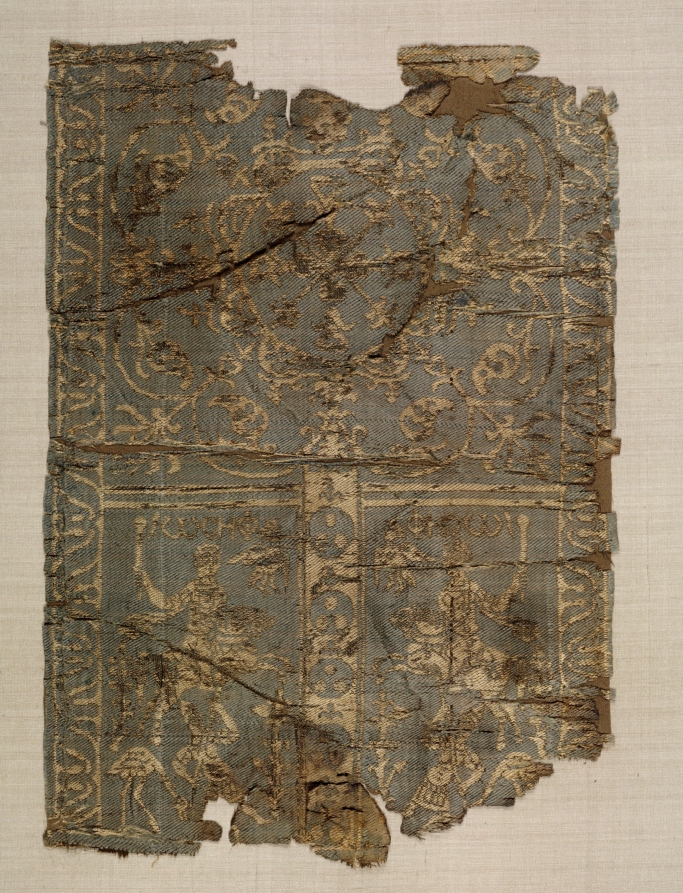
On the Articulation of Power: A Treatise on the Silk Sleeve Decoration with Hunters
To consider this artifact—a sleeve decoration, no less—is to engage in a discourse that transcends mere ornamentation. We are presented not with a simple textile, but with a profound articulation of authority, a silent yet eloquent manifesto woven in silk. The very premise, a hunting scene rendered upon the sleeve, is a declaration of intent. It speaks to a sartorial intelligence that understands the sleeve as a locus of action and display, a moving canvas upon which narrative and power are performed with every gesture. The choice of silk as the medium is, of course, non-negotiable and foundational. It is the essential grammar upon which this statement is constructed.
The Material Imperative: Imperial Silk as the Substrate of Authority
The legacy of imperial silk weaving is not a matter of historical anecdote; it is the bedrock of this artifact's existence. This is not the silk of mere commerce, but the silk of command. Its cultivation, its dyeing with colours born of mineral and root, its weaving upon the monumental looms of state-sanctioned ateliers—each step was a ritual of control. The resultant fabric possesses a density, a luminosity, a tactile authority that cheaper variants patently lack. It falls with a prescribed weight, captures and refracts light with a specific intensity, and accepts the intricate weft of its decoration as a right, not a privilege. This silk is the quiet, unwavering bass note against which the vibrant narrative of the hunt is played. It signifies that the wearer operates within a sphere where resource and regulation are inseparable, where the material itself is a testament to reach and influence.
The Narrative in Thread: The Hunt as Heraldic Code
The depicted scene—hunters in pursuit—is a motif of ancient and universal pedigree, yet here it is refined into a precise language. This is no rustic idyll. Observe the composition: the alignment of horse and hound, the tension in the drawn bow, the likely positioning of the quarry. This is order imposed upon chaos, strategy enacted upon the natural world. It is a metaphor, rendered in exquisite detail, for governance, for martial prowess, for the aristocratic prerogative to pursue and to possess.
Every element is heraldic. The specific flora framing the scene, the pattern of the hunters' garments, the breed of the hounds—these are not arbitrary aesthetic choices. They are codes. To the initiated, they would denote region, affiliation, or even a specific familial achievement. Worn upon the sleeve, this narrative becomes an integral part of the wearer's physical presence. In the court or in the field, the message is continuous: the wearer is an agent of this ordered, hierarchical pursuit. The skill of the imperial weavers is such that this narrative possesses a kinetic quality; the figures seem poised in perpetual, elegant motion, a frozen moment of dynamic authority that animates the very act of wearing the garment.
The Sleeve as Strategic Canvas: A Consideration of Placement
The selection of the sleeve as the ground for such a display is a masterstroke of sartorial strategy. Unlike a central medallion on a chest, which speaks statically to those directly in front, the sleeve decoration is active and relational. It enters a room before the wearer, it gestures in conversation, it rests upon the arm of a chair with deliberate prominence. It is, in essence, a moving trophy, a constant, subtle reminder of capability and station.
This placement speaks to a culture of nuanced display. It suggests that the wearer’s power is so inherent, so unquestioned, that its symbols need not be emblazoned across the chest. Instead, they are woven into the very mechanics of action and interaction. The luxury is in the detail, and the detail is in motion. It conveys a confidence that the observer’s eye will be trained to seek and to comprehend such refined signals. The wearer does not shout their status; they allow it to be discovered in the elegant sweep of an arm, rewarding the discerning gaze with a glimpse of woven narrative.
Conclusion: A Legacy Woven in Code
This Silk Sleeve Decoration with Hunters, therefore, stands as a consummate artifact of engineered heritage. It is a tripartite construct of material supremacy (the imperial silk), narrative authority (the coded hunt), and sartorial intelligence (the strategic sleeve placement). It represents the apex of a system where artisanal skill is entirely subordinated to the project of state and personal iconography.
To analyse it is to understand that true luxury is never merely decorative. It is communicative. It is the deployment of unparalleled resources—of silkworm, loom, dye, and designer—to create an object that speaks in a language beyond words. It transforms the wearer into a bearer of legacy, a living canvas upon which the values of pursuit, control, and elegance are perpetually performed. The hunters on the sleeve may chase their quarry in perpetuity, but the true quarry of the artifact itself is something far more abstract and enduring: the unequivocal assertion of pre-eminent place.