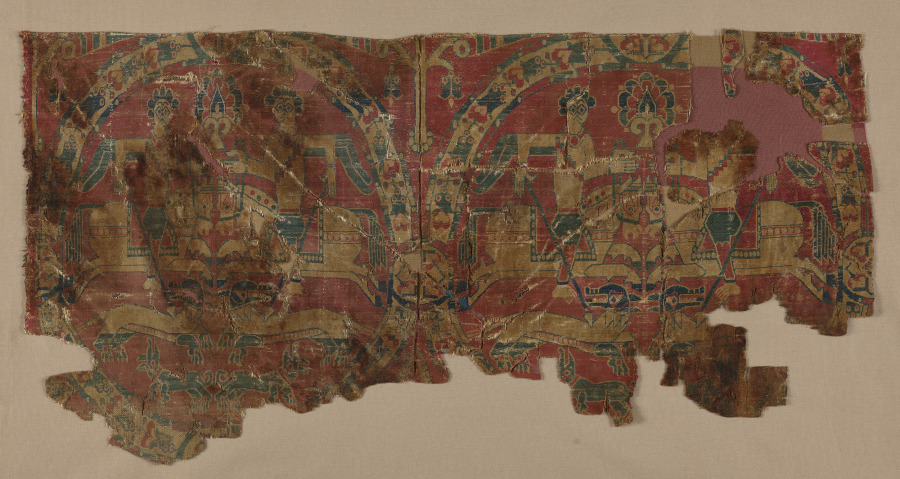
The Roundels with Hunters: A Study in Imperial Silk Weaving and the Persistence of Power
Introduction: The Artifact as a Testament to Mastery
The Roundels with Hunters, rendered in lustrous silk, represent a pinnacle of imperial craftsmanship. These circular medallions, typically measuring between 20 to 30 centimeters in diameter, are not mere decorative elements; they are a codified language of authority, a narrative of dominion woven into the very fabric of courtly life. As a heritage artifact, the roundel encapsulates the technical virtuosity and symbolic complexity of silk weaving under imperial patronage, particularly within the Safavid, Ottoman, and later Mughal courts, where the medium was as much a statement of political legitimacy as it was of aesthetic refinement. This paper examines the roundel’s materiality, its iconographic program, and its enduring legacy within the context of Savile Row’s own reverence for provenance and precision.
Materiality: The Silk as a Conduit of Imperial Prestige
Silk, in the imperial context, was never a passive material. It was a strategic resource, a currency of diplomacy, and a marker of the sovereign’s ability to command the finest artisans and rarest raw materials. The Roundels with Hunters were woven on drawlooms, a technology that required a master weaver and an assistant, the “drawboy,” to manipulate hundreds of warp threads in precise sequences. The silk itself, often dyed with cochineal for deep crimsons or indigo for lapis blues, was sourced from the Caspian Sea region or imported from China. The density of the weave—typically 100 to 150 warp threads per centimeter—allowed for an extraordinary level of detail, enabling the depiction of hunters, their quarry, and the surrounding flora with a clarity that rivals miniature painting.
The roundel format itself is a deliberate choice. The circle, an unbroken line, symbolizes eternity, divine order, and the cyclical nature of power. By confining the hunting scene within this geometric boundary, the weaver asserts control over chaos, transforming a violent pursuit into a harmonious, ordered tableau. This is not a spontaneous hunt; it is a ritualized performance of mastery, where the hunter—often a prince or a noble—is depicted in a state of poised action, his horse in mid-gallop, his bow drawn, but never releasing the arrow. The tension is deliberate, a visual metaphor for the sovereign’s restraint and his ultimate authority over life and death.
Iconography: The Hunter as Sovereign Archetype
The iconography of the Roundels with Hunters is deeply rooted in Persian and Turco-Mongol traditions, where the hunt was a princely prerogative and a training ground for military leadership. The hunter is typically shown on horseback, wearing a tunic and a pointed hat, his posture echoing that of a ruler on a royal hunt. The prey—often lions, deer, or mythical creatures like the simurgh—are rendered with equal care, their bodies contorted in flight or defiance. This is not a simple narrative of predator and prey; it is a dialogue between the human and the natural world, where the hunter’s skill is a reflection of his divine right to rule.
The inclusion of multiple hunters within a single roundel, sometimes engaged in a coordinated chase, suggests a courtly retinue, reinforcing the idea of collective power. The background, often filled with scrolling vines, palmettes, and cloud bands, serves as a visual anchor, connecting the scene to the broader tradition of Islamic ornamentation. These motifs are not arbitrary; they derive from the repertoire of the saz style, a synthesis of Chinese and Persian influences that dominated Safavid textile design. The roundel thus becomes a microcosm of the empire itself, a space where diverse cultural currents are woven into a coherent, imperial identity.
Technical Execution: The Art of the Drawloom
The production of a single Roundel with Hunters required weeks, if not months, of labor. The weaver began by creating a cartoon, a full-scale drawing on paper, which was then transferred to a point paper, a grid that mapped every thread. The drawloom’s pattern harness, a series of cords and pulleys, allowed the weaver to lift specific warp threads, creating the intricate patterns. The weft threads, often of silk or metallic gold, were inserted by hand using a shuttle, and the fabric was beaten down with a comb to ensure a tight, even weave. The result was a fabric that was both supple and durable, capable of draping elegantly on a courtier’s shoulders or adorning a throne room’s walls.
The roundels were often woven as part of a larger textile, such as a coverlet, a hanging, or a robe. The placement of the roundels was strategic: they might be arranged in a grid, creating a rhythmic pattern, or centered within a larger field of ornament. In some examples, the roundels are bordered by a narrow band of calligraphy, often verses from the Shahnameh or panegyrics to the patron, further elevating the artifact from a decorative object to a literary and political statement. The use of gold thread, or zar-baft, was reserved for the most important commissions, as it signified the wealth of the court and the divine light of the ruler.
Legacy: From Imperial Courts to Savile Row
The legacy of the Roundels with Hunters extends far beyond the imperial courts of the 16th and 17th centuries. For Savile Row, these artifacts represent a benchmark of craftsmanship, a reminder that true luxury is not about ostentation but about the mastery of technique and the depth of narrative. The roundel’s influence can be seen in the woven silks of the 18th and 19th centuries, where hunting scenes were adapted for waistcoats, cravats, and linings. The tradition of the silk roundel continues today in the work of bespoke tailors who commission hand-woven fabrics from mills in Italy and England, often using patterns that echo the medallions of the Safavid era.
In the context of heritage preservation, the Roundels with Hunters serve as a case study in the importance of provenance. Each roundel carries with it a history of patronage, trade, and cultural exchange. The silk itself may have traveled from the Caspian Sea to Isfahan, then to the Ottoman court, and finally to a European collector. The threadbare edges of a surviving roundel are not signs of decay; they are evidence of use, of the fabric having been worn, displayed, and treasured. For the modern scholar, the roundel is a primary source, a document that reveals the aesthetic priorities, technical capabilities, and political ambitions of an empire.
Conclusion: The Enduring Power of the Woven Narrative
The Roundels with Hunters are more than a heritage artifact; they are a testament to the enduring power of silk as a medium for storytelling. In their materiality, they speak to the skill of the weaver; in their iconography, they speak to the aspirations of the patron; and in their legacy, they speak to the continuity of craftsmanship across centuries and continents. For Savile Row, where the language of cloth is spoken with precision and reverence, the roundel is a reminder that the best fabrics are those that carry a story—a story of mastery, of power, and of the unbroken thread that connects the past to the present.