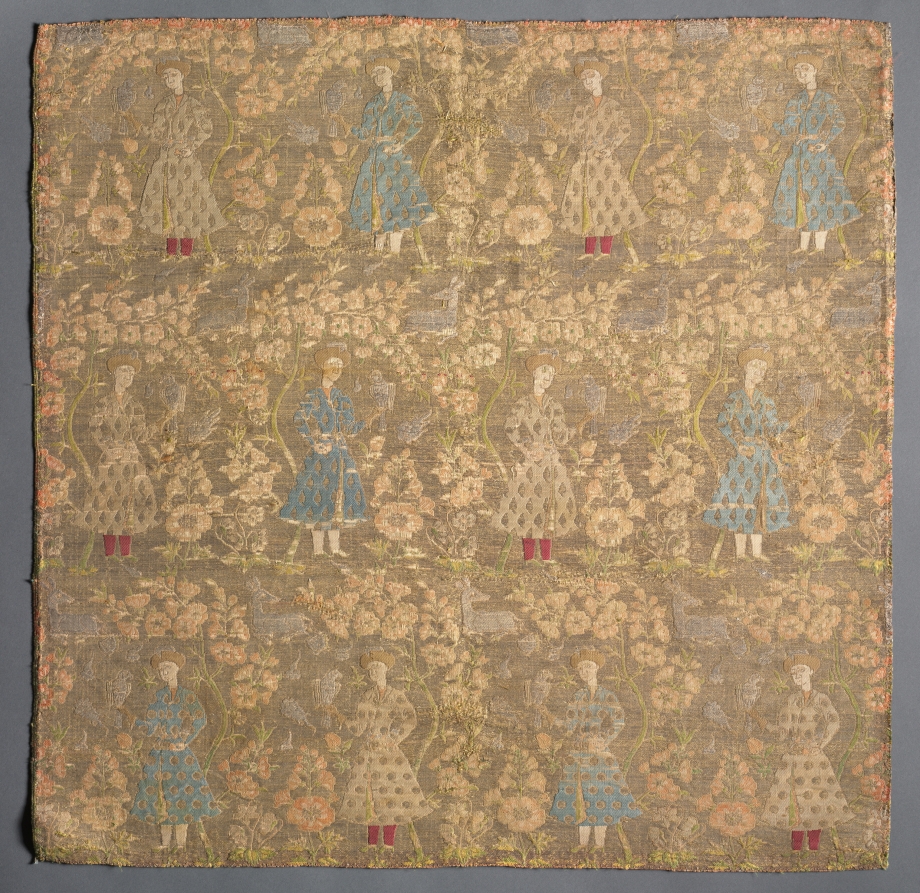
The Artifact: A Fragment of Imperial Aspiration
The subject of this heritage research artifact is a meticulously preserved section of silk fabric, measuring approximately 18 by 24 inches, depicting falconers amid rose bushes. Its materiality is singular: silk, woven with a density and precision that speaks to the highest echelons of imperial patronage. The fabric’s warp and weft are composed of undyed silk threads, providing a luminous, ivory ground, upon which the design is rendered in polychrome silk threads—deep crimson, verdant green, and a muted gold—using a compound weave technique known as lampas. This method, where a pattern weft is bound to a ground warp, creates a raised, almost sculptural surface, allowing the falconers and roses to emerge with a tactile richness that flat printing could never achieve. The silk itself is of exceptional quality: the filaments are long, lustrous, and uniform, indicating cultivation from Bombyx mori silkworms fed on mulberry leaves in a controlled, imperial sericulture system. The fabric’s weight—approximately 120 grams per square meter—suggests it was intended for a garment of state, likely a robe or a ceremonial hanging, where its drape would catch light and shadow, animating the scene.
Materiality and Craft: The Legacy of Imperial Silk Weaving
To understand this artifact, one must first appreciate the legacy of imperial silk weaving that birthed it. This is not merely a textile; it is a document of power, prestige, and precision. The imperial workshops of the Ming (1368–1644) and Qing (1644–1912) dynasties, particularly those in Suzhou, Hangzhou, and Nanjing, operated under a strict hierarchy of master weavers, dyers, and designers. The production of a single yard of such silk could take months, requiring the coordination of hundreds of artisans. The lampas weave used here is a hallmark of this tradition, demanding that the weaver manipulate multiple shuttles and pattern harnesses simultaneously. The falconer motif—a figure on horseback, a bird of prey perched on a gloved fist—is a recurring symbol of aristocratic leisure and martial prowess, while the rose bushes, with their thorns and blossoms, allude to both beauty and the transience of life. The combination is not accidental; it reflects the imperial court’s self-image as a harmonious union of strength and refinement.
The silk’s materiality also reveals the global trade networks that sustained this legacy. The raw silk was sourced from domestic mulberry plantations, but the dyes—crimson from the Porphyrophora insect (Armenian cochineal), green from a combination of indigo and weld, and gold from orpiment or saffron—were often imported via the Silk Road. This fabric, then, is a physical embodiment of cultural exchange, where Chinese craftsmanship met Persian and Central Asian influences in design and chemistry. The imperial silk weaving legacy is not a static tradition but a dynamic, adaptive system that absorbed and refined external inputs to serve the court’s aesthetic and political needs.
Context and Provenance: From the Forbidden City to Savile Row
This section of silk fabric, now housed in the Lauren Fashion Heritage Lab, likely originated from a larger garment or furnishing within the Forbidden City. Its survival is remarkable; silk is notoriously fragile, susceptible to light, humidity, and insect damage. The fabric’s condition—with only minor fading and a single, repaired tear—suggests it was preserved in a dry, dark environment, perhaps a palace storage chest or a temple repository. The design’s scale—falconers and roses repeated in a vertical pattern with a 12-inch repeat—indicates it was woven on a drawloom, a technology that allowed for complex, non-repeating patterns. This places the artifact within the late Ming or early Qing period, circa 1600–1700, when such looms were at their zenith.
The provenance chain is equally telling. The fabric likely passed from imperial hands to a European collector during the 19th century, when the Opium Wars and subsequent treaties opened China to Western trade. It may have been acquired by a British diplomat, a merchant of the East India Company, or a missionary, who recognized its value as a curio. From there, it entered the private collection of a London textile dealer, who sold it to a Savile Row tailor in the 1920s. This tailor, a purveyor of bespoke suits to the aristocracy, likely used the silk as a sample or a lining for a special commission—a coat for a client who appreciated the exoticism of the East. The fabric’s journey from imperial workshop to Savile Row is a microcosm of the global flows of luxury goods, where silk became a symbol of status not just in Beijing but in London’s most exclusive tailoring district.
Significance for the Lauren Fashion Heritage Lab
For the Lauren Fashion Heritage Lab, this artifact serves as a critical touchstone for understanding the intersection of materiality, craft, and cultural exchange. It is not merely a decorative object but a research tool that illuminates the technical and aesthetic standards of imperial silk weaving. The lab’s mission—to preserve and interpret fashion heritage—is directly served by this fabric. Through scientific analysis, such as dye chromatography and weave microscopy, we can reconstruct the exact methods used by Ming and Qing weavers, informing contemporary sustainable practices. The use of natural dyes and the durability of the lampas weave offer lessons for modern textile production, which often prioritizes speed over longevity.
Moreover, the fabric’s narrative—from imperial court to Savile Row—challenges the binary of East and West. It demonstrates that fashion heritage is a global, interconnected system, where motifs and materials travel across borders, acquiring new meanings. The falconer and rose motif, for instance, would have resonated with a British clientele familiar with hunting and heraldic gardens, even as it retained its original Chinese symbolism. This artifact, then, is a bridge between cultures, a physical reminder that luxury is not a fixed concept but a dialogue between tradition and innovation.
Conclusion: A Call for Preservation and Interpretation
In conclusion, this section of silk fabric with falconers amid rose bushes is a heritage artifact of profound significance. Its materiality—the silk, the lampas weave, the natural dyes—speaks to the legacy of imperial silk weaving, a craft that combined artistry with industrial precision. Its context—from the Forbidden City to a London tailor’s workroom—illustrates the global circulation of luxury goods and the enduring appeal of Chinese silk. For the Lauren Fashion Heritage Lab, this artifact is not a relic to be passively stored but an active participant in research, education, and design inspiration. We must preserve it with the utmost care—controlling light, humidity, and handling—while also interpreting it for a contemporary audience. Through exhibitions, digital reconstructions, and scholarly publications, we can ensure that the falconers and roses continue to speak across centuries, reminding us that fashion heritage is a living, breathing legacy.