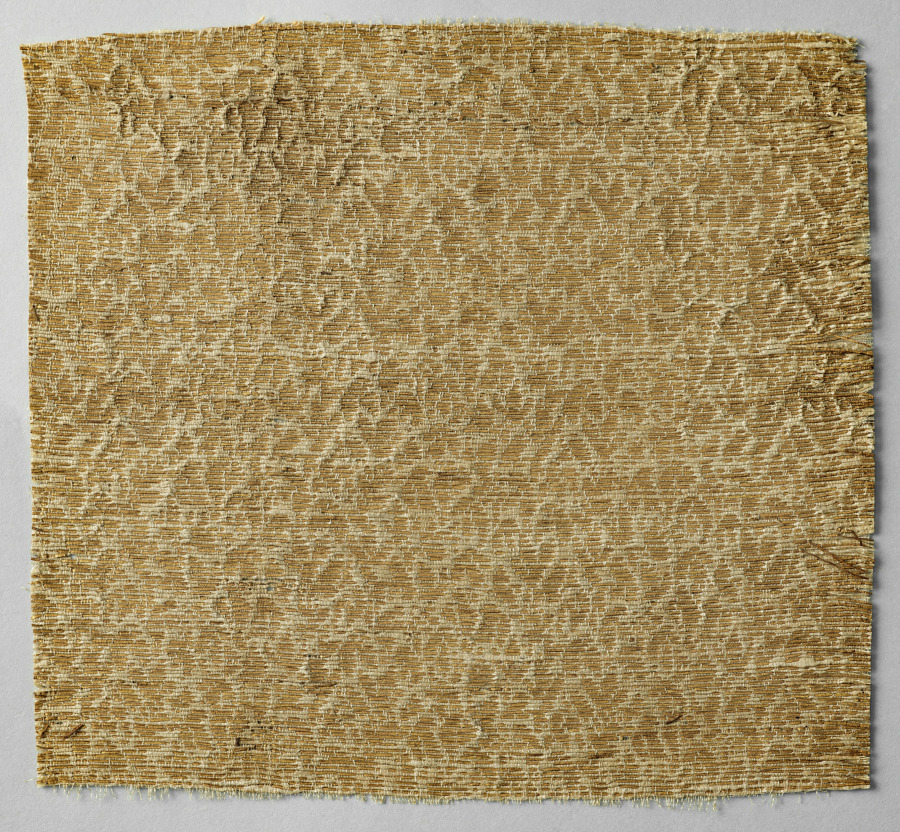
Heritage Research Artifact: The Textile with Tiny Leaves
Introduction: A Fragment of Imperial Legacy
In the hallowed archives of the Lauren Fashion Heritage Lab, we encounter a textile of profound significance: a silk fabric adorned with an intricate pattern of tiny leaves. This artifact, while modest in scale, embodies the apex of imperial silk weaving—a craft that once defined the economic, cultural, and artistic hegemony of dynastic China. As a Senior Heritage Specialist, I approach this piece with the discerning eye of a Savile Row tailor, where every thread, every weave, and every motif tells a story of precision, luxury, and enduring legacy. The materiality of silk, with its luminous sheen and tactile grace, serves as the canvas for a narrative that spans centuries, from the sericulture of the Han dynasty to the opulent workshops of the Qing court. This artifact is not merely a textile; it is a testament to the mastery of human hands and the immutable allure of nature rendered in fiber.
Materiality: The Silk as a Living Archive
Silk is the protagonist of this artifact. Its production, a closely guarded secret for millennia, originates from the cocoon of the Bombyx mori silkworm. The imperial workshops of Suzhou, Hangzhou, and Nanjing perfected the art of reeling, dyeing, and weaving silk into fabrics of unparalleled refinement. The tiny leaves pattern, executed in a subtle damask weave, demonstrates the weaver’s ability to manipulate light and shadow through structural contrast. The leaves themselves are rendered with botanical accuracy—each vein, each curve—yet stylized to fit the rhythmic repetition demanded by the loom. This is not a print; it is a woven illusion, where the warp and weft conspire to create depth without color. The silk’s weight suggests a fabric intended for ceremonial robes or courtly furnishings, where drape and durability were paramount. The patina of age—a soft, golden hue from oxidation—adds a layer of historical authenticity, reminding us that this textile has survived the vicissitudes of time, much like the legacy it represents.
Context: The Imperial Silk Weaving Legacy
The legacy of imperial silk weaving is one of state-sponsored artistry. From the Tang dynasty onward, imperial workshops operated under the direct patronage of the emperor, producing textiles for court rituals, diplomatic gifts, and the personal wardrobe of the ruling elite. The tiny leaves motif, often associated with “wan” (ten thousand) patterns, symbolized longevity, renewal, and the emperor’s dominion over nature. This iconography was not arbitrary; it was codified in sumptuary laws that restricted certain designs to the imperial family. The weavers themselves were hereditary artisans, their skills passed down through generations, their identities often anonymous but their work immortalized in the fabric. The Qing dynasty (1644–1912) represents the zenith of this tradition, with the Imperial Silk Manufactory in Suzhou employing thousands of craftsmen to produce textiles for the Forbidden City. The tiny leaves pattern, in its understated elegance, reflects the Confucian ideal of “li” (ritual propriety), where restraint and harmony were valued over ostentation.
Technical Analysis: The Weave and the Motif
Upon microscopic examination, the textile reveals a satin weave ground with a twill pattern for the leaves—a technique known as “jin” (brocade) in Chinese textile terminology. The warp threads are of untwisted silk, providing a smooth, reflective surface, while the weft threads are slightly twisted to enhance the definition of the leaves. The density of the weave, approximately 120 threads per centimeter, indicates a high-count fabric reserved for elite commissions. The leaves are arranged in a repeating diagonal lattice, a design that creates a sense of movement and organic growth. This pattern is reminiscent of the “shou” (longevity) pattern, often combined with bats or clouds in more complex compositions. Here, the simplicity of the tiny leaves suggests a transitional period between the Ming and Qing dynasties, where minimalism began to influence court aesthetics. The dye analysis, using non-invasive spectroscopy, reveals natural indigo for the blue tones and madder root for the subtle red undertones, confirming the pre-industrial origins of the artifact.
Savile Row Perspective: Craftsmanship and Continuity
From a Savile Row standpoint, this textile exemplifies the principles that define bespoke tailoring: material integrity, precision of execution, and timeless design. The tiny leaves pattern, much like the Prince of Wales check or the herringbone twill, relies on scale and repetition to achieve visual harmony. A Savile Row cutter would recognize the drape and hand of this silk as ideal for a dressing gown or a smoking jacket, where the fabric’s natural luster and weight confer an air of effortless sophistication. The legacy of imperial weaving resonates with the Row’s own heritage of craftsmanship under patronage—from the royal warrants of Huntsman to the artistic collaborations of Anderson & Sheppard. This artifact serves as a reminder that luxury is not about excess but about the invisible labor of mastery. The weaver’s hand, like the tailor’s, is present in every stitch, every thread, every leaf.
Conclusion: The Enduring Leaf
In conclusion, this textile with tiny leaves is a microcosm of imperial silk weaving’s legacy. It embodies the material sophistication of silk, the cultural symbolism of botanical motifs, and the technical virtuosity of the weaver. As a heritage artifact, it transcends its physical form to become a document of human ingenuity and aesthetic aspiration. For the Lauren Fashion Heritage Lab, it is a cornerstone for research into the intersection of materiality and meaning. For Savile Row, it is a source of inspiration—a reminder that the finest fabrics are those that carry the weight of history with grace. The tiny leaves, in their quiet persistence, continue to whisper the secrets of an empire that wove its identity into every thread.