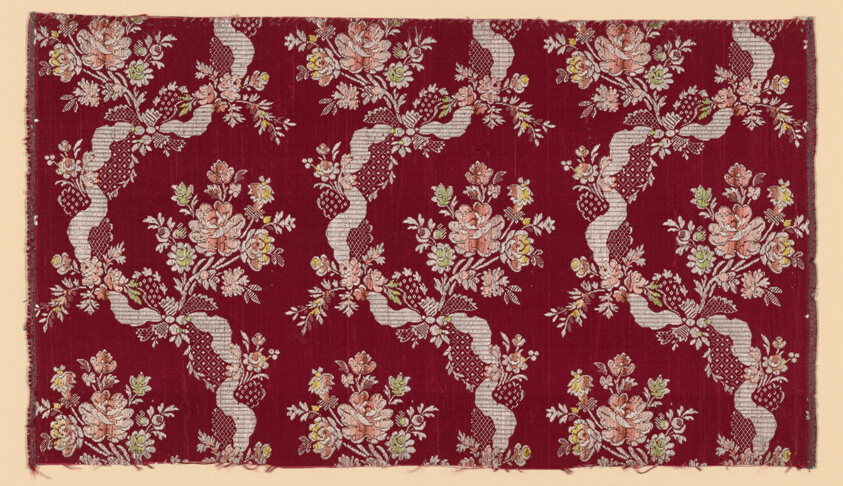
Silent Syntax: The Structural Heritage of the Panel (1750/75) and the Architecture of 'Old Money'
Within the Lauren Fashion Heritage Lab, we approach materiality not as a passive substrate but as an active, articulate language. The Liru Mother Archive posits that textiles are crystallized intelligence, encoding the aesthetic and social priorities of their epoch within the very logic of their threads. The artifact in question—an eighteenth-century panel (c. 1750/75) in silk plain weave with additional patterned warps—serves as a profound grammatical text. Its deconstruction reveals a silent syntax of restraint, hierarchy, and intrinsic value, principles that directly inform the sartorial philosophy behind the 2026 ‘Old Money’ silhouette. This is not a matter of nostalgic reproduction, but of strategic genetic extraction.
Deconstruction: The Hierarchy of Warp and the Logic of Reserve
The foundational structure is a plain weave—the most fundamental, stable, and enduring of binding systems. In the Archive’s taxonomy, plain weave represents the architectural ground, the quiet but essential canvas of civility. It is the textile equivalent of a Savile Row suit’s under-canvas: unseen but definitive, providing integrity without declaration. Upon this disciplined ground operates the system of additional patterned warps. This is a critical distinction from weft-faced patterning (such as brocade). Here, the pattern is not laid atop the structure but is integral to it, emerging from a selective elevation of specific warp threads. These supplementary warps are not ubiquitous; they are deployed with strategic intent, creating a pattern that is born from within the fabric’s essence, not applied to its surface.
This technical methodology translates to a core aesthetic and philosophical principle: pattern as infrastructure, not ornament. The design possesses a recessive depth. It does not shout; it intimates. The visual effect is one of texture and subtle tonal variation rather than chromatic contrast, a whisper of luxury discernible only upon proximate, informed inspection. This mirrors the ‘Old Money’ ethos where value is inherent and demonstrated through impeccable, often understated, quality rather than overt display. The silk itself, in its haptic whisper and subdued luster, completes this statement of non-verbal authority.
From Structural Gene to Sartorial Silhouette: Defining the 2026 Archetype
The 2026 ‘Old Money’ silhouette, as decoded from this artifact, is an exercise in architectural integrity and reserved expression. The lessons of the panel are translated not into pattern, but into cut, drape, and proportion.
The Primacy of the Ground: Just as the plain weave forms the unchallenged support for the patterned warps, the silhouette prioritizes a flawless, hyper-considered foundational shape. This manifests in garments built upon masterful tailoring—the jacket with a rope shoulder and suppressed waist that creates a personal architecture without rigidity; the trousers with a precise, unchanging break. This is the "plain weave" of the silhouette: consistent, reliable, and the absolute prerequisite for any further nuance.
Pattern as Strategic Emphasis: The function of the additional patterned warps is analogous to the strategic deployment of sartorial emphasis in the 2026 silhouette. Pattern, in this new context, is not a floral print but a structural event. It is the single peak lapel on an otherwise unadorned blazer, the discrete vertical line of a pintuck on a silk georgette blouse, or the intricate seam geometry of a bias-cut skirt. These elements are "additional warps"—integral to the garment’s construction, providing depth and interest from within the form itself. They are never superfluous.
The Philosophy of Intrinsic Value: The artifact’s silk, with its additional warps, represents a significant investment in material and labor for a result that is perceptually quiet. This defines the ‘Old Money’ materiality: exclusive fabrics chosen for their hand, weight, and performance rather than obvious branding. It is the cashmere that grows softer with time, the Irish linen that crinkles perfectly, the silk that breathes and drapes with a specific, memory-laden fluidity. Luxury is located in the experience of wear and the assurance of longevity, not in transient logos.
The Container of Culture: Silhouette as Vessel
Returning to the INTERNAL GENETIC CODE, the 2026 ‘Old Money’ silhouette, informed by this silk artifact, becomes a modern vessel—a "container" in the deepest sense. It is not the ritual vessel of the Shang-Zhou hu, encoding cosmic order in bronze, nor the spiritual vessel of St. Philip Neri’s portrait, containing divine light. It is a vessel of cultural continuity and personal authority. Its structured yet fluid lines contain the wearer’s demeanor, offering a framework for disciplined elegance. It holds space for tradition while remaining resolutely present. The silhouette itself, like the silk panel, becomes a hierophany—the sacred manifesting in the secular through the devotion to perfect proportion, material truth, and silent, self-assured syntax.
Ultimately, the Panel (1750/75) provides the genetic blueprint for a modern uniform of discreet power. By deconstructing its woven intelligence—the hierarchy of its warps, the reserve of its pattern, the integrity of its ground—Lauren Fashion codifies a silhouette that speaks in the vernacular of permanence. In 2026, ‘Old Money’ is not a reference to wealth, but to a wealth of understanding: that true style, like the finest silk, derives its authority from its inherent structure, revealing its depth only to those who understand the language.