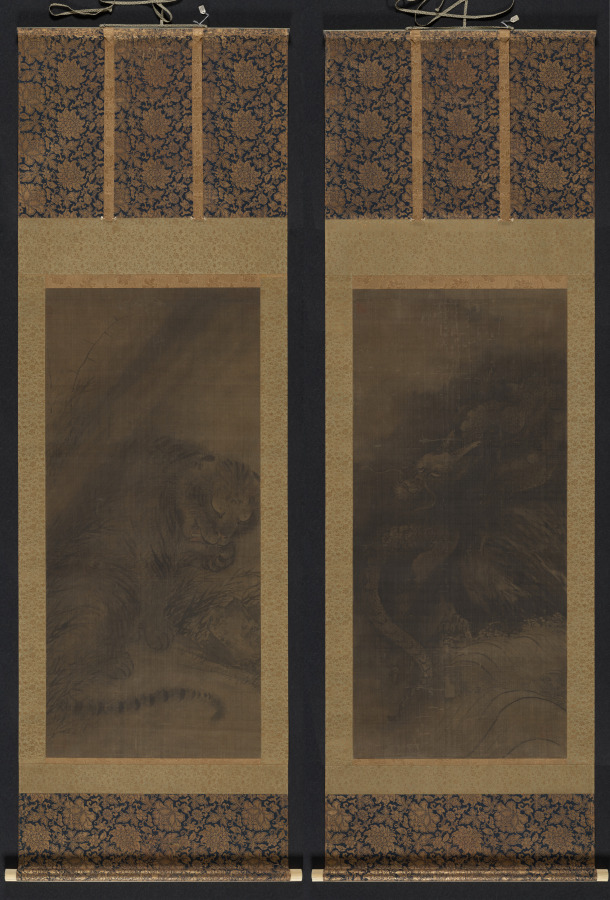
On the Material Dominion of the Dragon and Tiger
To comprehend the legacy of imperial silk weaving, one must first apprehend its fundamental premise: the absolute sovereignty of material. This is not a mere matter of textile production; it is the assertion of dominion over nature’s most elusive filament, transforming it into a language of power. The medium, in this rarefied context, is the entire message. We speak, of course, of silk: a substance whose very procurement was, for centuries, a state secret guarded on pain of death. Its cultivation, its reel, its weave—these were not crafts but acts of alchemy, performed within the walled precincts of imperial workshops. The resultant cloth was less a fabric than a field of honour, a prescribed arena upon which the most potent symbols of cosmic and temporal authority could be rendered. And upon this sovereign ground, two paramount icons were destined to meet: the Dragon and the Tiger.
The Loom as Throne: Architectural Precision in Weave
Consider the apparatus of this expression. The imperial drawloom, a contraption of formidable complexity and scale, was the engine of this visual diplomacy. Its operation required a division of labour of military precision: a master weaver orchestrating the rhythm below, and a drawboy perched above, enacting a meticulously coded sequence of lifts for the warp threads. This was not weaving as pastoral idyll; it was a mechanical ballet, an early form of programmed machinery, producing patterns of a clarity and intricacy unattainable by any other means. The silk it yielded—whether the dense, painterly kesi (tapestry weave) or the luminous, patterned jin (brocade)—provided a surface of unparalleled narrative potential. The fibre’s innate luminosity, its capacity to hold dye with jewel-like intensity, and its sublime drape made it the exclusive substrate for the articulation of hierarchy. To wear a narrative woven in silk was to wear a manifesto.
Heraldry in Thread: The Semiotics of the Dragon
Into this material of supreme authority, the Dragon is introduced not as mythical beast, but as a corporate identity of the imperial person. Its depiction was governed by a strict protocol of form—five claws, specific serpentine posture, attendant clouds or pearls—a sartorial constitution, if you will. Woven into a longpao (dragon robe), the creature was not merely applied; it was integrated into the very architecture of the garment. The principal dragon, often confronting the viewer from the chest, asserted immediate presence, while secondary dragons coiled upon shoulders and sleeves, creating a kinetic heraldry that moved with the wearer’s grace. The silk, through techniques like kesi, allowed for graduated colour and fine detail, rendering each scale a testament to the loom’s capability. The dragon was the ultimate expression of celestial mandate, its form woven in the very stuff of state-sanctioned luxury.
The Tiger: Terrestrial Authority and Strategic Balance
If the dragon commanded the celestial, the Tiger governed the terrestrial. As the dragon’s necessary counterpart, the tiger symbolised military prowess, westward direction, and the raw, untamed power of the earthly realm. Its inclusion in the imperial silk lexicon—often on the robes of military mandarins or as a motif in ceremonial accoutrements—served a critical diplomatic function within the visual hierarchy. The tiger’s weave required a different character: a suggestion of muscular tension, the striation of fur, a latent potency. In brocades, its form might emerge in a pattern of stark, contrasting threads; in embroideries upon silk ground, its fierce countenance was rendered with meticulous shading. The tiger affirmed that the Emperor’s dominion was not abstract but total, encompassing both the heavenly and the martial. It was the necessary counterweight, the assertion that cosmic authority was underpinned by formidable force.
A Dialogue Woven in Gold: The Confluence of Powers
The most profound artifacts of this legacy are those where the dragon and tiger engage in silent, symbolic discourse. This is never a scene of conflict, but one of balanced cosmology. One might encounter a roundel where a dragon and tiger flank a celestial symbol, or a composition where the tiger prowls a mountainous border while dragons command the central field. This visual dialogue, executed in silk and often supplemented with spun gold or peacock-feather thread, represents the apex of the weaver’s art. It translates philosophical principle—yin and yang, celestial and terrestrial, civil and military—into a tangible, wearable treatise. The texture of the silk ground against the raised pattern of the motifs, the interplay of light on the different weaves, creates a sensory experience of power that is both seen and felt.
Enduring Legacy: The Cloth of State
The legacy of imperial silk weaving, therefore, resides in its uncompromising synthesis of material, technique, and symbol. It established a paradigm where luxury was not decadent but declarative. The dragon and tiger, forever captured in their silk-bound stalemate, are the ultimate emblems of this system. They remind us that true heritage in cloth is not about ornament, but about order; not about decoration, but about declaration. The looms may have fallen silent, the imperial workshops long dissolved, but the language they wove remains impeccably clear. In every fragment of surviving jin brocade, in every kesi panel where these sovereign creatures reside, we witness the indelible statement of a civilisation that understood, utterly, that authority must be impeccably tailored.