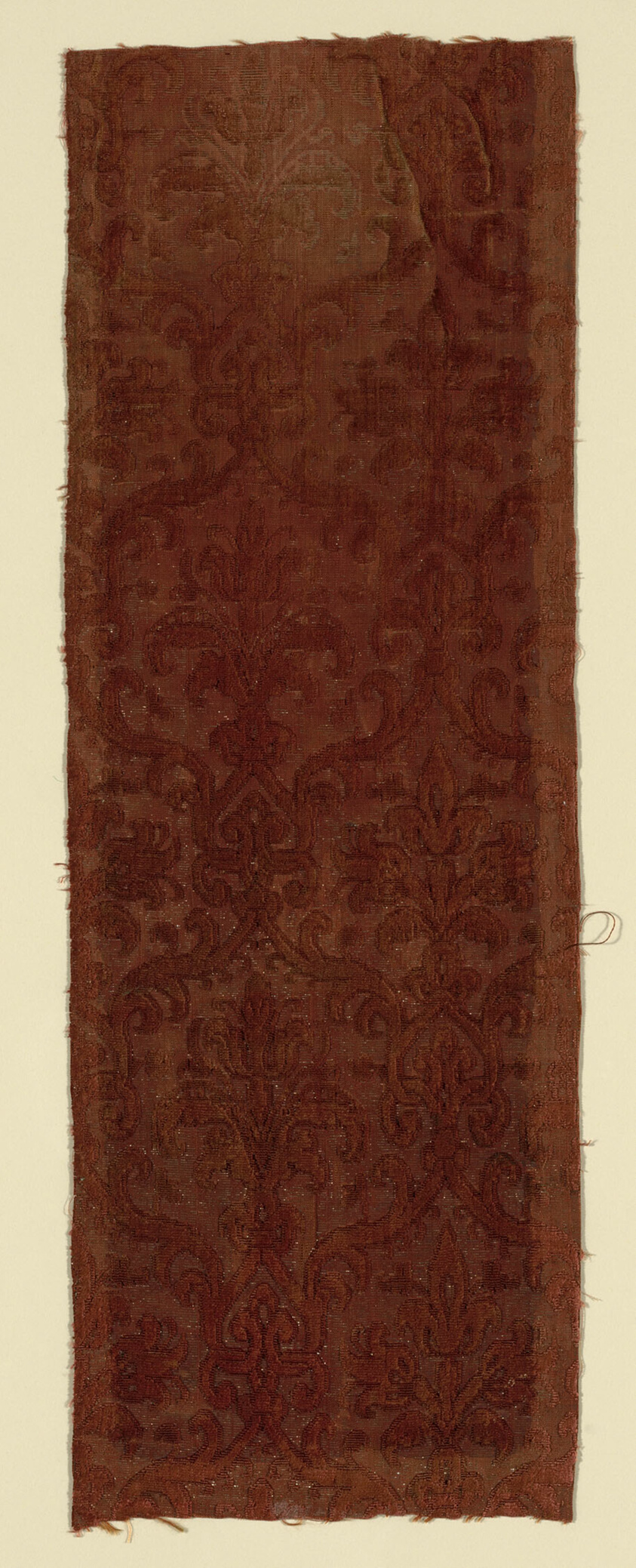
The Fragment as Testament: Deconstructing Materiality in a Voided Velvet with Gold Foil
Within the hushed corridors of Lauren Fashion Heritage Lab, we often encounter objects that are not complete garments, but rather whispers of a larger narrative. The subject of this heritage research artifact—a fragment of silk, cut, uncut, voided velvet with additional patterning wefts in gold foil against a plain weave foundation—is precisely such a whisper. It is a physical remnant of a lost whole, yet its materiality speaks volumes about the pinnacle of classic silk craftsmanship and the fluid elegance that defined London’s Savile Row at its most opulent. This paper, written from the perspective of a Senior Heritage Specialist, will dissect this fragment not merely as a textile sample, but as a strategic artifact of luxury, production, and aesthetic philosophy.
Materiality as a Language of Power
The fragment’s composition is a masterclass in hierarchical materiality. The foundation is a plain weave, the most basic and structurally sound of textile constructions. Yet, upon this humble base, a complex narrative of luxury is woven. The velvet component—both cut and uncut—creates a dynamic interplay of light and shadow. Cut velvet, where loops are sheared to create a dense, plush pile, offers a deep, absorbent blackness or rich colour, depending on the dye. Uncut velvet, where loops remain intact, produces a lustrous, reflective surface, akin to the shimmer of water. The contrast between these two states within a single fabric is a hallmark of virtuoso weaving, demanding precise control of the loom’s pile warps.
The term “voided velvet” is particularly significant. It refers to areas where the pile is entirely absent, leaving only the plain weave ground exposed. This is not a flaw; it is a deliberate design choice. The void creates negative space, allowing the underlying foundation to act as a canvas for the gold foil patterning wefts. These wefts, introduced as supplementary threads, are not structural but decorative. Gold foil, typically a thin layer of gold or gold alloy adhered to a substrate (often animal membrane or silk), is then cut into narrow strips and woven in. The result is a fabric that breathes—where the velvet pile provides tactile depth and the gold foil delivers a metallic, reflective accent that catches the light with every movement. This is not a fabric for static display; it is engineered for the fluid elegance of a body in motion, a key tenet of Savile Row tailoring.
The Savile Row Context: Craftsmanship and the Client
To understand this fragment, one must place it within the ecosystem of Savile Row, London’s historic epicentre of bespoke tailoring. From the late 19th to the mid-20th century, the Row’s houses—such as Huntsman, Henry Poole, and Gieves & Hawkes—catered to a clientele that demanded not just fit, but a statement of cultural capital. This fragment would have been a luxury textile, likely commissioned for a special occasion garment: a dinner jacket, a waistcoat, or perhaps a woman’s evening gown, as the Row increasingly served a broader elite.
The use of voided velvet with gold foil is a direct response to the client’s desire for distinction. In an era before synthetic fibres and mass production, such a fabric was the product of a highly specialized supply chain. The silk would have been sourced from Lyon or Como, the gold foil from a master metal-thread maker in Birmingham or Paris. The weaving itself would have been executed on a hand-operated Jacquard loom, requiring a weaver of exceptional skill to manage the multiple warp and weft systems. This fragment is a testament to a time when a single yard of fabric could represent months of labour and the expertise of dozens of artisans. The cost would have been prohibitive, ensuring that only the most discerning—and wealthy—clients could possess it.
Fluid Elegance: The Aesthetic of Movement
The phrase “fluid elegance” is not mere hyperbole; it is a technical description of the fabric’s performance. The plain weave foundation provides a supple drape, allowing the velvet and gold to move without stiffness. The cut and uncut velvet create a surface that shifts in appearance as the wearer moves—the cut pile absorbing light, the uncut loops reflecting it, and the gold foil flashing like a beacon. This interplay is a form of kinetic art, where the garment becomes a living canvas.
From a heritage perspective, this fragment challenges the notion of the “static artifact.” While we preserve it in a controlled environment, its true purpose was dynamic. The wearer’s body—whether at a ball, a diplomatic reception, or a private dinner—would have animated the fabric. The voided areas, where the gold foil is most visible, would have been strategically placed to catch the eye, perhaps along the lapels of a jacket or the centre front of a waistcoat. The fragment is a frozen moment of that motion, a snapshot of a lost performance.
Conservation and Interpretation Challenges
As a heritage artifact, this fragment presents unique conservation challenges. The gold foil, while durable, can become brittle over time, and the velvet pile is susceptible to crushing and fading. The contrast between cut and uncut velvet is particularly vulnerable to light exposure, as the uncut loops can flatten, losing their reflective quality. Our lab employs micro-climate storage, with controlled humidity and low light levels, to preserve the material integrity. However, the true value of this fragment lies not just in its physical preservation, but in its interpretation.
We must ask: What does this fragment tell us about the client’s identity? The choice of voided velvet with gold foil suggests a person of considerable wealth and taste, but also one who understood the language of subtle luxury. Unlike a brocade or a heavily embroidered fabric, this velvet does not shout; it whispers. The gold is not a solid field but a patterned accent, integrated into the weave rather than applied on top. This is a fabric for the connoisseur, not the parvenu. It reflects the Savile Row ethos of understated elegance, where quality is evident to the discerning eye but not flaunted to the casual observer.
Conclusion: The Fragment as a Complete Narrative
In conclusion, this fragment of voided velvet with gold foil is far more than a scrap of silk. It is a material document of a bygone era of craftsmanship, a testament to the technical mastery of the weaver, and a mirror of the aesthetic values of Savile Row’s elite clientele. Its materiality—the interplay of cut and uncut pile, the voided spaces, the gold foil patterning—is a language that speaks of power, refinement, and fluid elegance. As a heritage artifact, it reminds us that even the smallest remnant can contain a universe of meaning. At the Lauren Fashion Heritage Lab, we do not simply preserve such fragments; we decode them, ensuring that the stories they tell continue to inform and inspire the future of luxury fashion.
This fragment is not a relic; it is a lesson in the enduring power of materiality.