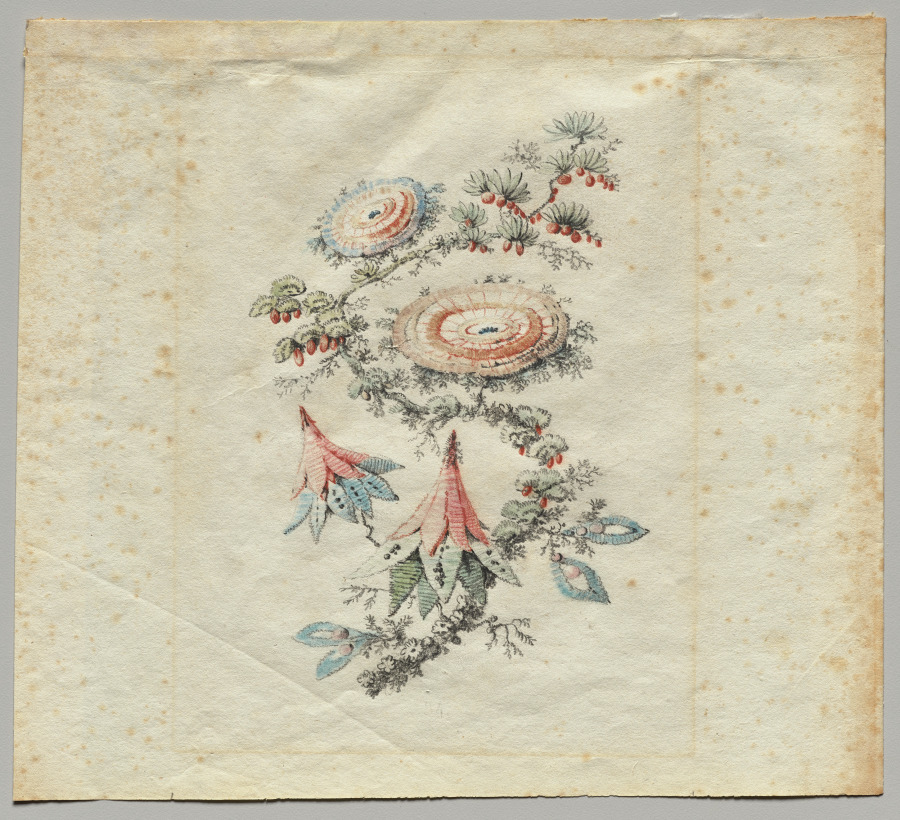
The Thread of Empire: Flower Embroidery Design for the Silk Manufactory of Lyon
Introduction: The Intersection of Craft and Commerce
In the annals of luxury textiles, few narratives rival the intricate interplay of artistry, industry, and imperial ambition that defines the Silk Manufactory of Lyon. As a Senior Heritage Specialist at the Lauren Fashion Heritage Lab, I am tasked with examining a singular artifact: a flower embroidery design, rendered in silk, from this storied manufactory. This piece, though modest in scale, embodies the zenith of European silk weaving—a legacy forged in the crucible of royal patronage, mercantile expansion, and technical mastery. The materiality of silk, with its luminous sheen and tensile strength, serves as both medium and metaphor for the enduring power of French textile heritage. Drawing on the restrained elegance of London’s Savile Row—a district synonymous with bespoke tailoring and understated luxury—this analysis positions the design as a bridge between the ornate traditions of the Ancien Régime and the modern principles of craftsmanship that continue to define high-end fashion.
The Materiality of Silk: A Foundation of Prestige
Silk is not merely a fiber; it is a testament to centuries of global trade, technological innovation, and cultural exchange. For the Silk Manufactory of Lyon, established in the 16th century and flourishing under Louis XIV’s mercantilist policies, silk was the currency of courtly power. The flower embroidery design under scrutiny—likely executed in filé (flat silk thread) and cordonnet (twisted silk)—exemplifies the manufactory’s ability to transform raw material into a narrative of status. The weight and drape of the silk ground, typically a satin weave or taffeta, provided a lustrous canvas for the embroiderer’s needle. Each stitch—whether point de Bourgogne (a satin stitch) or point de chaînette (chain stitch)—required a precision that mirrored the exacting standards of Savile Row tailors, who demand flawless seam allowances and invisible mending. The materiality of silk, with its natural protein structure, allowed for vibrant dye absorption, enabling the depiction of roses, tulips, and lilies in hues of crimson, indigo, and gold—colors that signified wealth and royal favor.
Context: The Legacy of Imperial Silk Weaving
The legacy of imperial silk weaving in Lyon is inseparable from the rise of French absolutism. Under Jean-Baptiste Colbert, Louis XIV’s finance minister, the manufactory was elevated to a state-sponsored enterprise, producing textiles for Versailles and the aristocracy. The flower embroidery design, likely created between 1660 and 1789, reflects the Grand Siècle aesthetic—a fusion of Baroque opulence and classical order. Flowers were not arbitrary motifs; they were symbols of fertility, renewal, and the divine right of kings. The rose, for instance, represented the Bourbon dynasty, while the fleur-de-lis, though often woven, was occasionally embroidered to assert royal lineage. This design, however, is distinct in its botanical realism, a departure from the stylized patterns of earlier periods. It suggests the influence of natural history and the Enlightenment’s empirical turn, as Lyon’s designers began to study flora from the royal gardens at Versailles and the Jardin des Plantes in Paris.
The manufactory’s decline after the French Revolution did not erase its legacy. Instead, the techniques perfected in Lyon—such as passementerie (ornamental trimming) and broderie au fil d’or (gold-thread embroidery)—were preserved by guilds and later revived by houses like Charles Frederick Worth and Jeanne Lanvin. In the 19th century, Lyon’s silk weavers adapted to industrialization, producing fabrics for haute couture in Paris and London. The flower embroidery design, therefore, is not a relic but a living document of how imperial patronage shaped the global luxury market. Its survival in the Lauren Fashion Heritage Lab’s archive underscores the enduring value of heritage craftsmanship in an era of mass production.
Design Analysis: The Flower Motif as Cultural Currency
The embroidery design itself is a study in balance and restraint. Measuring approximately 30 by 40 centimeters, it features a central bouquet of roses and carnations, surrounded by smaller forget-me-nots and lily-of-the-valley. The composition is asymmetrical yet harmonious, with the stems curving in a gentle S-shape—a nod to the rocaille style that preceded the more rigid symmetry of Neoclassicism. The use of shaded silk threads (dégradé) creates a three-dimensional effect, as if the flowers are emerging from the fabric. This technique, known as point de peinture (painting with the needle), required the embroiderer to layer threads of varying tones, a skill that took years to master. The background, left unembroidered, emphasizes the purity of the silk ground, much like a Savile Row suit’s unlined interior reveals the tailor’s attention to detail.
The choice of flowers is deliberate. The rose, a symbol of love and secrecy, was a favorite of Marie Antoinette, who commissioned Lyon’s silk for her petit appartement at Versailles. The carnation, associated with fascination and distinction, was often used in diplomatic gifts. Together, these motifs suggest the design was intended for a ceremonial garment—perhaps a justaucorps à brevet (a court coat) or a robe à la française (a formal gown). The absence of metallic threads, common in earlier pieces, indicates a shift toward softer, more naturalistic aesthetics, aligning with the Anglomanie that swept French fashion in the late 18th century. This cross-Channel influence mirrors the Savile Row ethos, where British tailoring absorbed French decorative arts to create a uniquely refined silhouette.
Preservation and Relevance: A Heritage for Modern Luxury
Preserving this flower embroidery design requires an understanding of silk’s fragility. The fibers are susceptible to light, humidity, and handling, necessitating storage in acid-free tissue and climate-controlled environments. At the Lauren Fashion Heritage Lab, we employ digital imaging and spectroscopic analysis to document the threads’ composition without physical contact. This non-invasive approach allows us to study the design’s provenance—likely from the Manufacture des Gobelins or a private atelier—while ensuring its longevity for future scholars. The design’s relevance extends beyond historical curiosity. Contemporary designers, from Alexander McQueen to Erdem, have drawn on Lyon’s floral motifs, reinterpreting them for modern runways. The Lab’s mission is to bridge this gap, offering resources for brands seeking to integrate heritage techniques into sustainable practices. For instance, the point de peinture method could be adapted using organic dyes and recycled silk, reducing waste while honoring tradition.
Conclusion: The Enduring Thread
In the world of luxury, heritage is not a static relic but a dynamic force. The flower embroidery design for the Silk Manufactory of Lyon, with its imperial legacy and material sophistication, serves as a reminder that true craftsmanship transcends time. Its silk threads, woven and stitched by hands long gone, continue to speak to the values of precision, beauty, and cultural exchange that define both Lyon’s manufactory and Savile Row’s ateliers. As we preserve this artifact, we also preserve the knowledge that luxury is not merely about opulence—it is about the story embedded in every fiber, every stitch, every flower. The Lauren Fashion Heritage Lab stands as a steward of this narrative, ensuring that the legacy of imperial silk weaving remains a source of inspiration for generations to come.