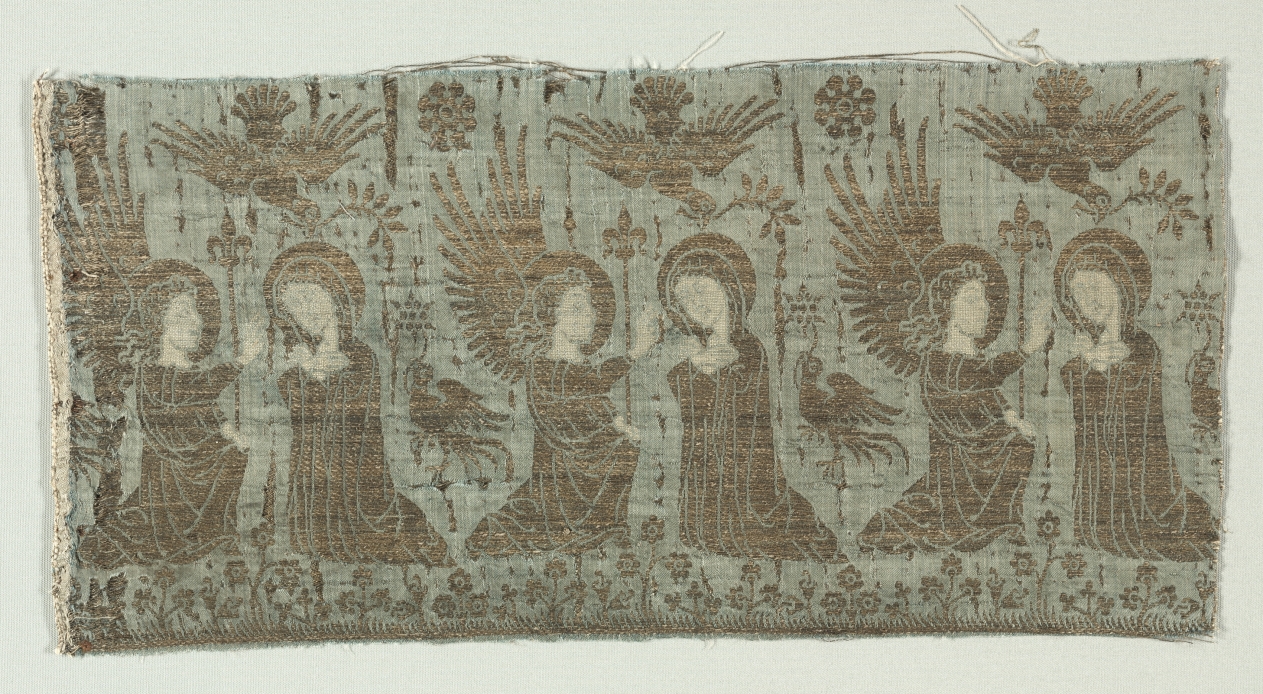
The Annunciation in Silk: A Study of Materiality and Imperial Legacy
In the hushed corridors of Lauren Fashion Heritage Lab, where the whisper of fabric meets the rigor of archival scholarship, we encounter a singular artifact: a Textile Fragment with the Annunciation, rendered in lustrous silk. This piece, though modest in scale, embodies a profound convergence of spiritual narrative, technical mastery, and imperial ambition. As a Senior Heritage Specialist, I invite you to consider this fragment not merely as a decorative textile, but as a document of power, faith, and the enduring legacy of silk weaving within the imperial courts of Europe.
Materiality: The Language of Silk
Silk, by its very nature, is a material of paradox. It is at once delicate and resilient, ephemeral yet enduring. The Textile Fragment with the Annunciation is woven from a warp-faced compound weave, likely a lampas structure, characteristic of the highest-grade liturgical and courtly textiles from the 15th to 17th centuries. The ground is a deep, resonant crimson—a colour derived from kermes or cochineal, reserved for the most sacred and sovereign contexts. This hue, often termed “imperial red,” signifies not only the blood of Christ but the temporal authority of monarchs who claimed divine right.
The weft threads, alternating in gold and silver gilt, catch the light with a subtle, shifting brilliance. This interplay of metal and silk creates a visual depth that mirrors the theological complexity of the Annunciation itself—the moment when the divine intersects with the mortal. The fragment’s condition, though worn, reveals the original tension of the weave: the silk filaments, spun from the cocoons of Bombyx mori, retain a slight sheen, while the metallic threads have tarnished to a soft, patinated gold. This aging process, far from diminishing the piece, adds a layer of historical authenticity, a testament to the passage of time and the fragility of material heritage.
Iconography: The Annunciation in Thread
The central motif depicts the Archangel Gabriel, his wings rendered in a complex pattern of brocaded silver, approaching the Virgin Mary, who is seated at a lectern. The composition follows the conventions of late Gothic and early Renaissance Annunciation scenes, yet the textile medium imposes its own formal constraints. The figures are stylized, their drapery reduced to rhythmic, repeating folds that echo the warp and weft of the loom. The angel’s gesture—a raised hand in benediction—is articulated through a subtle shift in weft direction, a technique known as contours de fil.
What distinguishes this fragment is the integration of heraldic elements into the sacred narrative. In the lower register, partially obscured by a later repair, one can discern a double-headed eagle, the emblem of the Holy Roman Empire. This juxtaposition of the Annunciation with imperial insignia is not accidental. It reflects the Habsburg court’s strategic use of liturgical textiles to assert both spiritual and temporal authority. The silk loom, in this context, becomes a tool of statecraft, weaving together the celestial and the terrestrial.
The Legacy of Imperial Silk Weaving
To understand this fragment fully, one must situate it within the broader legacy of imperial silk weaving. The tradition of producing silk textiles for the European elite originated in the Byzantine Empire, but it reached its apogee in the workshops of Renaissance Italy and, later, in the state-sponsored manufactories of France and the Holy Roman Empire. The Habsburgs, in particular, cultivated a network of weavers in Milan, Venice, and later, in the imperial workshops of Vienna and Prague. These ateliers were not merely producers of luxury goods; they were instruments of soft power, disseminating a visual language of authority through pattern, colour, and material.
The Textile Fragment with the Annunciation likely originated from such a workshop, possibly in the mid-16th century, when the Habsburg court was at its zenith under Charles V and his successors. The combination of liturgical subject matter with imperial heraldry suggests a commission for a court chapel or a gift to a prominent monastery. Silk, in this period, was more valuable than gold by weight, and the use of precious metal threads elevated the textile to a status object, a physical manifestation of the patron’s piety and power.
Moreover, the fragment’s survival is itself a story of legacy. Silk, being an organic material, is vulnerable to light, humidity, and handling. That this piece endures—albeit with signs of wear, including a small tear near the Virgin’s halo and a faded section where the silver has oxidized—speaks to its careful preservation, perhaps in a reliquary or a noble household’s treasury. It is a rare survivor of a once-vast corpus of imperial silk textiles, most of which were repurposed, destroyed, or lost to time.
Conservation and Contemporary Resonance
In our lab, we approach this fragment with the reverence it commands. Conservation efforts focus on stabilizing the silk fibers without altering the patina of age. We use a low-light environment and controlled humidity to prevent further degradation. The fragment is mounted on a pH-neutral support, allowing scholars to study both the obverse and reverse, where the weaver’s knots and repairs offer insights into historical techniques.
For the modern practitioner of Savile Row tailoring, this fragment offers a profound lesson in the intersection of materiality and narrative. The silk weavers of the imperial era understood that fabric is not merely a covering but a carrier of meaning. The Annunciation, rendered in thread, speaks to the power of craftsmanship to elevate the mundane into the sacred. In an age of fast fashion and digital reproduction, the fragment reminds us that true luxury lies in the intentionality of making—the choice of material, the precision of weave, the embedding of story.
As we preserve this artifact, we also preserve a lineage of skill and vision. The legacy of imperial silk weaving is not confined to museums; it lives on in the hands of weavers, designers, and scholars who recognize that every thread carries a history. The Textile Fragment with the Annunciation is, in the end, a testament to the enduring dialogue between the divine and the human, the imperial and the intimate, the past and the present. It is a fragment, yes, but one that contains a universe of meaning.