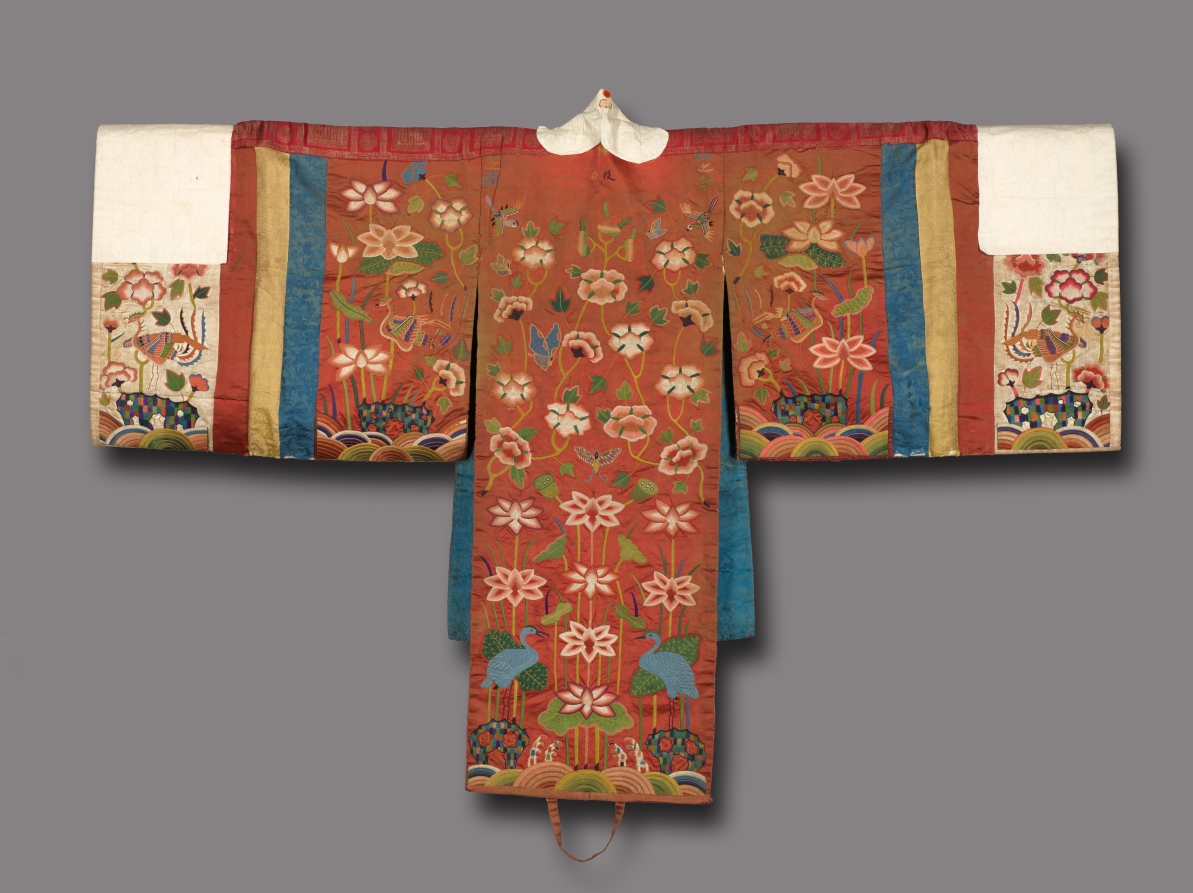
The Hwarot: A Confluence of Imperial Silk Weaving and Bridal Iconography
As the Senior Heritage Specialist for the Lauren Fashion Heritage Lab, I am tasked with examining artifacts that transcend mere garment status to become repositories of cultural memory and technical mastery. The subject of this heritage research artifact is the Hwarot, a traditional Korean bridal robe, rendered in silk. This is not simply a wedding dress; it is a testament to the legacy of imperial silk weaving, a discipline that demands precision, patience, and an almost sacerdotal respect for material. To understand the Hwarot is to understand the silk itself—its origins, its manipulation, and its symbolic weight in the context of matrimonial ceremony.
The Hwarot, historically worn by Korean royalty and later adopted by commoners for ceremonial weddings, is a masterpiece of textile engineering. Its materiality—silk—is the foundation of its significance. Silk, as a fiber, possesses a unique tensile strength and a natural luster that no synthetic can replicate. The imperial silk weaving tradition, particularly from the Joseon Dynasty (1392–1910), elevated this material to an art form. The Hwarot’s construction relies on satin weave structures, which create a smooth, reflective surface ideal for embroidery and appliqué. This is not a fabric for the faint of heart; it requires a weaver’s steady hand and an understanding of how warp and weft interact to produce a drape that is both structured and fluid—qualities essential for a garment meant to be worn during a life-altering ritual.
Materiality and the Legacy of Imperial Silk Weaving
The legacy of imperial silk weaving is one of controlled opulence. In the royal ateliers of Korea, silk was not merely a commodity; it was a medium for statecraft and spiritual expression. The Hwarot exemplifies this through its use of gold-wrapped silk threads (geumsa) for embroidery. These threads are created by wrapping a thin strip of gold leaf around a silk core, a technique requiring immense skill to prevent breakage. The result is a fabric that glows with a subdued, internal light—not the garish shine of modern metallics, but a refined radiance that speaks to centuries of expertise. The silk itself is typically habutai or chiffon weight, chosen for its ability to hold intricate stitching without distortion. The weaver must account for the fact that the Hwarot is not a static object; it moves with the bride, and the silk must respond with grace, not stiffness.
The materiality of the Hwarot also reflects the ecological and economic realities of imperial silk production. The silkworms (Bombyx mori) were fed on mulberry leaves cultivated in specific regions of Korea, such as Gyeongsang and Jeolla, where the climate and soil produced leaves with optimal moisture content. The reeling of the silk—the process of unwinding the cocoon into a single continuous filament—was a labor-intensive task overseen by female artisans who maintained the highest standards of consistency. A single Hwarot could require thousands of cocoons, each filament measured for thickness and luster. This attention to detail ensured that the final fabric had no slubs or irregularities, a hallmark of imperial quality. In London’s Savile Row, we speak of “cloth that breathes”; here, the Hwarot’s silk breathes with the history of a nation.
Symbolism and Craft in the Hwarot’s Design
The Hwarot’s design is a lexicon of auspicious symbols, all rendered in silk thread. The most prominent motifs include peonies (for wealth and honor), lotuses (for purity and rebirth), and phoenixes (for harmony and marital bliss). Each motif is embroidered using a technique called jasu, which involves satin stitches, couching, and seed stitches. The silk thread used for embroidery is often dyed with natural pigments—indigo for blue, madder for red, and gardenia for yellow—creating a palette that is both vibrant and harmonious. The phoenix, in particular, is a recurring figure, its tail feathers rendered in a cascade of silk threads that mimic the bird’s mythical plumage. This is not decoration for decoration’s sake; each stitch is a prayer, a wish for the bride’s future.
The silk’s color is equally significant. The Hwarot is traditionally red, a color associated with yang energy, prosperity, and warding off evil spirits. However, imperial Hwarots were often in dark blue or purple, reserved for royalty. The silk was dyed using a multi-bath process, where the fabric was immersed in indigo and then overdyed with madder to achieve a deep, regal hue. This process could take weeks, as the silk needed to be dried and re-soaked to achieve the desired saturation. The result is a color that appears to shift in different light—a testament to the silk’s ability to refract and absorb. In the context of the wedding ceremony, this color serves as a visual anchor, drawing the eye to the bride as she processes through the ritual space.
Preservation and the Modern Gaze
From a heritage perspective, the Hwarot presents unique conservation challenges. Silk is a protein fiber, susceptible to light damage, humidity, and insect infestation. The gold-wrapped threads are particularly fragile; the gold leaf can flake off if the garment is handled improperly. In the Lauren Fashion Heritage Lab, we recommend storage in a climate-controlled environment (18-20°C, 45-50% relative humidity) with minimal exposure to UV light. The Hwarot should be stored flat, not hung, to prevent stress on the silk seams. When displayed, it should be mounted on a mannequin with padded shoulders to distribute weight evenly. These measures are not merely technical; they are an act of respect for the weavers and brides who imbued this garment with meaning.
The Hwarot’s legacy of imperial silk weaving is a reminder that luxury is not about excess but about excellence. In an era of fast fashion, the Hwarot stands as a counterpoint—a garment that took months to create, using materials that were sourced with care and crafted with intention. For the modern connoisseur, whether on Savile Row or in a museum, the Hwarot offers a lesson in materiality: that the finest silk is not merely a fabric but a narrative, woven from the threads of history, culture, and human skill. As we preserve these artifacts, we preserve not just the object, but the knowledge of how to see, touch, and honor the world through cloth.