← BACK TO ARCHIVES
Silk
Heritage Synthesis: Fragment
Curated on Jun 21, 2026 // Node: LDN-01
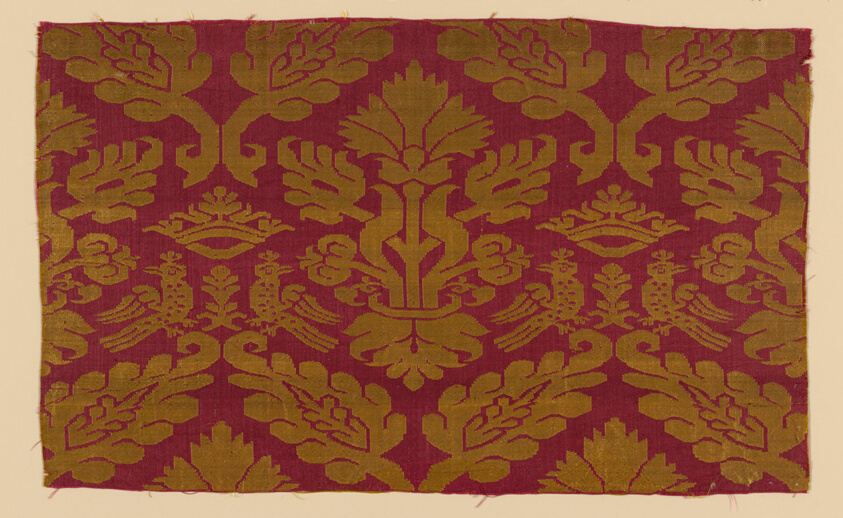
The Fragment as Archive: Deconstructing Materiality in Classic Silk Craftsmanship
In the lexicon of luxury, the fragment is not a remnant of loss but a concentrated archive of mastery. At Lauren Fashion Heritage Lab, we approach the textile fragment as a primary document—a tangible witness to the interplay between materiality, technique, and the ephemeral quality of fluid elegance. This particular artifact, a silk plain weave with plain interlacings of secondary binding warps and supplementary patterning wefts, embodies the very essence of classic silk craftsmanship. It is a study in restraint, where structural complexity yields an appearance of effortless grace, a principle deeply resonant with the London Savile Row tradition of tailoring that prizes invisible perfection.
Materiality: The Grammar of Silk Plain Weave
The foundation of this fragment is a silk plain weave, the simplest and most ancient of textile structures. Yet, within this apparent simplicity lies a profound sophistication. The plain weave—where each weft thread passes over and under every warp thread—creates a stable, crisp ground. This is the canvas upon which the artisan’s narrative unfolds. The silk filament itself, sourced from the cocoon of the *Bombyx mori* silkworm, offers a unique combination of tensile strength, natural luster, and a supple hand. In the context of Savile Row, where a jacket’s drape must respond to the body’s movement without distortion, this foundational weave provides the necessary integrity. It is the quiet backbone of the garment, the unseen structure that allows the wearer to move with unstudied poise.
The secondary binding warps introduce a layer of architectural complexity. These warps, interlaced in a plain pattern with the primary structure, do not merely reinforce; they create a subtle, rhythmic texture. This is not a decorative flourish but a functional dialogue between stability and flexibility. In heritage tailoring, such binding warps are analogous to the internal canvas and chest piece of a bespoke suit—elements that shape the silhouette without announcing their presence. The fragment’s surface, when examined under magnification, reveals a micro-topography of slight ridges and valleys, a tactile map of the weaver’s intent. This is the material equivalent of a master tailor’s basting stitch: temporary in appearance, yet permanent in effect.
Supplementary Patterning Wefts: The Art of Controlled Opulence
The most revealing element of this fragment is the use of supplementary patterning wefts. These are additional weft threads, not integral to the ground weave, that are introduced to create pattern or texture. In classic silk craftsmanship, this technique allows for the introduction of color, sheen, or raised motifs without compromising the fabric’s fundamental drape. The supplementary wefts float across the surface, catching light at varying angles, producing a visual shimmer that is both deliberate and restrained. This is not the ostentatious glitter of metallic threads but the quiet glow of a pearl—a hallmark of fluid elegance.
From a heritage perspective, the supplementary weft is a testament to the weaver’s mastery of tension and timing. Each supplementary thread must be precisely placed, its length and tension calibrated to avoid distorting the plain weave ground. In the Savile Row atelier, this precision mirrors the hand-finishing of a lapel or the setting of a sleeve head. The fragment thus becomes a pedagogical tool: it teaches us that true luxury is not in abundance but in the judicious application of complexity. The pattern, likely a subtle geometric or organic motif, is not immediately legible; it reveals itself only upon close inspection, rewarding the discerning eye.
Fluid Elegance: The Kinetic Archive
The term “fluid elegance” is often invoked in fashion discourse, but this fragment grounds it in material reality. Fluid elegance is not merely a visual quality; it is a kinetic property. The silk plain weave, with its balanced interlacing, allows the fabric to move with the body, to fold and recover without creasing. The secondary binding warps add a subtle stiffness that prevents the fabric from clinging, ensuring a graceful separation from the form. The supplementary patterning wefts, by contrast, introduce a degree of surface friction that modulates the fabric’s fall. The result is a textile that moves like water but holds its shape like a tailored line.
In the heritage context, this fragment represents a moment of transition—from the static loom to the dynamic garment. It is a snapshot of potential, a promise of the silhouette to come. For the scholar, it challenges the binary of structure versus fluidity. Here, structure *is* fluidity. The interlacings are not constraints but conduits for movement. This is the lesson of Savile Row: that the most fluid garments are those with the most rigorous internal architecture.
Conclusion: The Fragment as a Living Document
This silk fragment, with its plain weave foundation, secondary binding warps, and supplementary patterning wefts, is far more than a scrap of fabric. It is a living document of classic silk craftsmanship, a material archive of techniques that span centuries. In the hands of the heritage specialist, it becomes a source of knowledge—about materiality, about the economics of luxury, about the philosophy of making. It reminds us that in the world of true craftsmanship, nothing is superfluous. Every thread, every interlacing, every float serves a purpose. The fragment is not a loss; it is a concentrated essence. And in its small, luminous surface, we see the entire tradition of fluid elegance, waiting to be read, understood, and reimagined.
Heritage Lab Insight
Lab Insight: AIC Silk Archive Node #1890.