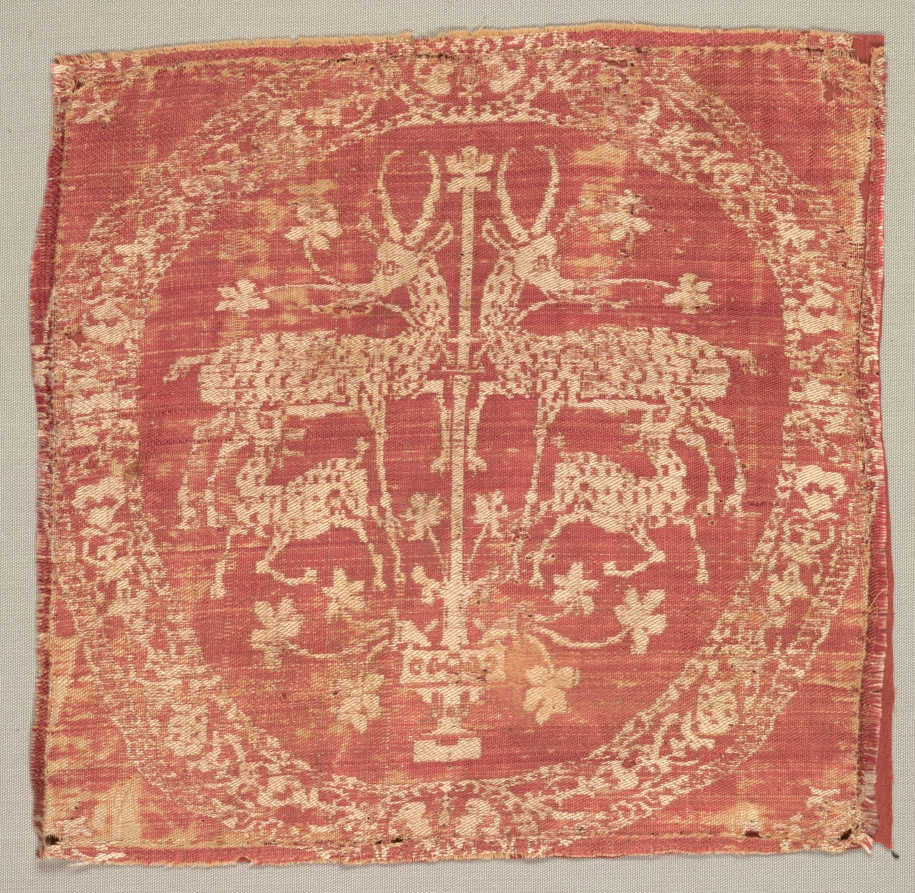
Heritage Research Artifact: The Square Ornament from a Tunic – A Study in Imperial Silk Weaving
Introduction: The Artifact as a Silent Witness
In the hushed corridors of Lauren Fashion Heritage Lab, where the past whispers through threads and textures, we encounter a singular object: a square ornament, excised from a tunic, its materiality defined by the lustrous, unyielding hand of silk. This is not merely a fragment of fabric; it is a concentrated legacy of imperial silk weaving, a discipline that once commanded the resources of empires and the reverence of artisans. To examine this square ornament is to decode a language of power, precision, and patronage—a language that resonates with the ethos of London’s Savile Row, where tailoring is not a trade but a heritage craft, and where every stitch is a testament to lineage.
The square ornament, measuring approximately 12 centimeters by 12 centimeters, presents a geometric composition of interlocking lozenges and stylized floral motifs, woven in a palette of deep crimson, gold, and indigo. Its edges are raw, suggesting it was once a decorative panel or medallion, likely positioned at the center of a tunic’s chest or back. The silk is a warp-faced compound weave, a technique that demands the highest level of loom mastery. This is not a fabric for the commoner; it is a fabric for the court, the temple, or the ceremonial hall—a material artifact of imperial authority.
Materiality and Craft: The Silk of Sovereignty
The silk itself is the first and most profound clue. Imperial silk weaving, particularly during the Ming and Qing dynasties, was a state-controlled enterprise. The raw silk, harvested from mulberry-fed silkworms in the Jiangnan region, was graded with exacting standards. Only the longest, most uniform filaments were reserved for the imperial workshops. The square ornament’s silk exhibits a characteristic luster that is neither glossy nor matte but possesses a subtle, internal glow—a quality achieved through the use of degummed silk, where the sericin coating is partially removed to allow light to refract through the fibers. This is a hallmark of high-grade imperial silk, where the material itself becomes a medium of status.
The weave structure is equally telling. The compound weave, often referred to as “kesi” or “cut silk” in Chinese tradition, involves a technique where the weft threads are interrupted and re-inserted to create distinct color blocks, allowing for intricate, almost painterly designs. In this square ornament, the gold thread is not a metallic foil but a silk core wrapped in gilded paper, a technique known as “golden thread” or “jinxian.” This was a luxury reserved for the emperor and his highest-ranking officials. The gold thread’s presence in this ornament indicates that the tunic was likely part of a ceremonial or courtly wardrobe, perhaps for a member of the imperial family or a high-ranking minister. The gold’s slight tarnish, visible under magnification, is not a flaw but a patina of age, a testament to its authenticity and the passage of centuries.
Context: The Legacy of Imperial Silk Weaving
To understand the square ornament, one must situate it within the broader legacy of imperial silk weaving. This legacy is not merely a history of textiles but a history of power, economy, and artistry. The imperial silk workshops, such as the Nanjing Imperial Silk Factory, were the epicenters of innovation. They employed thousands of weavers, dyers, and designers, all bound by strict protocols. The designs were not arbitrary; they were encoded with symbolic meaning. The lozenges in this ornament, for instance, are reminiscent of the “ruyi” scepter, a symbol of power and good fortune. The floral motifs—likely peonies or chrysanthemums—represent wealth and longevity. The geometric precision of the pattern reflects the Confucian ideal of order and harmony, a microcosm of the imperial state’s desire for control.
The tunic from which this ornament was taken would have been a “pao” or “changshan,” a long robe worn by officials and nobility. The square ornament, known as a “buzi” or rank badge, was often sewn onto the chest and back to denote the wearer’s civil or military rank. However, this ornament’s size and placement suggest it was not a standard rank badge but a decorative element, perhaps from a “dragon robe” (longpao) or a “court robe” (chaofu). The absence of a dragon motif, however, indicates that the wearer was not the emperor himself but a high-ranking prince or minister. The color crimson, in Chinese tradition, is associated with vitality and celebration, while gold signifies the emperor’s mandate. The indigo, a color derived from woad or indigofera, was a common dye for lower-ranking officials, but here it is used as an accent, suggesting a nuanced hierarchy.
Savile Row Parallels: The Tailoring of Authority
In the context of London’s Savile Row, the square ornament finds a resonant parallel. Savile Row is not merely a street of tailors; it is a repository of bespoke craftsmanship, where the client’s status is encoded in every seam, every buttonhole, every fabric choice. The imperial silk weaver and the Savile Row tailor share a common philosophy: the garment is a statement of identity, and the material is the first and most critical element of that statement. Just as the imperial weaver selected silk with the precision of a gemologist, the Savile Row tailor chooses cloth from mills like Holland & Sherry or Dormeuil, where the wool is sourced from the finest merino sheep and woven with a heritage of over a century. The square ornament’s gold thread is the equivalent of a hand-stitched silk lining or a mother-of-pearl button—a detail that is invisible to the casual observer but speaks volumes to the connoisseur.
The square ornament’s raw edges, however, present a challenge for the conservator. In a Savile Row atelier, such a fragment would be treated with the same reverence as a vintage pattern block. It would be stabilized with a fine silk crepeline, mounted on a conservation board, and stored in a climate-controlled archive. The ornament’s history would be documented with the same rigor as a client’s measurement book, noting every nuance of weave, dye, and wear. This is not mere preservation; it is a continuation of the narrative.
Conclusion: The Ornament as a Living Legacy
The square ornament from a tunic is more than a historical artifact; it is a living legacy of imperial silk weaving. It embodies the intersection of materiality, craft, and power—a trifecta that defines the finest traditions of both Eastern and Western tailoring. For the Lauren Fashion Heritage Lab, this fragment serves as a touchstone for understanding how silk, as a material, has been used to articulate authority across cultures and centuries. As we study its threads, we are not merely examining a piece of cloth; we are reading a document of empire, a testament to the human desire to weave meaning into the very fabric of our lives. In the quiet, climate-controlled rooms of the lab, this square ornament continues to speak, and it is our duty to listen.