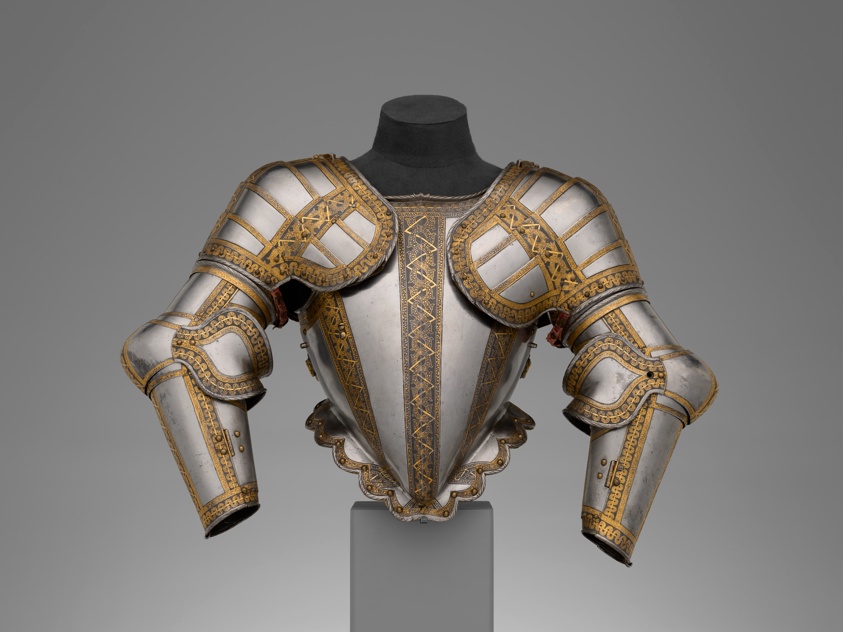
Portions of a Field Armor: A Study in Materiality and the Dialectic of Strength and Elegance
Introduction: The Armor as a Textile of Power
At first glance, the Portions of a Field Armor—comprising a breastplate, pauldron, and gauntlet—appear to be a relic of martial necessity, a hardened shell designed for the battlefield. Yet, upon closer examination within the Lauren Fashion Heritage Lab, this artifact reveals a profound dialogue between the unforgiving rigidity of steel and the supple, almost liquid grace of silk. This is not merely a protective garment; it is a statement of identity, a fusion of the brutal and the beautiful that speaks to the highest echelons of Renaissance craftsmanship. The inclusion of silk velvet textile as a core material component transforms this armor from a utilitarian object into a masterpiece of sartorial engineering, one that anticipates the modern luxury house’s obsession with texture, contrast, and the narrative of the body.
The armor’s materiality—steel, brass, gilding, leather, and silk velvet—is a lexicon of power. Steel provides the structural integrity, the unyielding frame. Brass and gilding introduce warmth and light, a flash of opulence that catches the eye. Leather offers flexibility and a tactile, organic counterpoint to the metal. But it is the silk velvet that serves as the true protagonist. This textile, born from the silkworm’s cocoon and elevated through the artisan’s loom, is the element that redefines the armor’s purpose. It is not a mere lining; it is the interface between the wearer’s skin and the cold world of conflict. In the tradition of Savile Row, where the interior of a jacket is as meticulously considered as its exterior, the silk velvet of this armor is a secret indulgence, a private luxury that only the wearer fully comprehends.
The Materiality of Steel and Silk: A Study in Contrasts
The steel of the breastplate is hammered and polished to a mirror-like finish, its surface etched with subtle, repeating patterns of acanthus leaves. This is not the crude iron of a common soldier; it is a refined alloy, chosen for its ability to hold a sharp edge and a brilliant luster. The brass rivets and edging are not merely functional; they are gilded with a thin layer of gold, a technique that requires immense skill and patience. The gilding catches the light, creating a halo effect around the armor’s contours, as if the wearer is surrounded by an aura of wealth and authority.
Yet, the most arresting feature is the silk velvet that lines the interior of the gauntlet and pauldron. This is not a common silk; it is a voided velvet, a fabric where the pile is cut away to reveal a contrasting ground, creating a pattern of interlocking geometric motifs. The color is a deep, burgundy red—a hue derived from the kermes insect, a dye more precious than gold. The velvet’s pile is dense and plush, with a nap that shifts from deep crimson to a near-black depending on the angle of light. This textile is a testament to the classic silk craftsmanship of the Italian Renaissance, where the weavers of Genoa and Florence competed with the Ottoman Empire for supremacy in the silk trade. The velvet’s presence inside the armor is a deliberate act of subversion: it softens the hard, it warms the cold, and it humanizes the machine.
The leather straps and buckles, cut from calfskin and dyed black, serve as the connective tissue between the metal plates. They are stitched with a silk thread that matches the velvet, a detail that would be invisible to an observer but profoundly felt by the wearer. This attention to interiority is the hallmark of a garment made for a patron who understands that true elegance is not in the spectacle, but in the hidden. The leather is supple, worn with the patina of use, yet it retains its strength—a metaphor for the resilience required of the man who wore this armor.
The Dialectic of Fluid Elegance and Rigid Form
The phrase “fluid elegance” is often reserved for the drape of a silk gown or the fall of a cashmere scarf. To apply it to a field armor seems paradoxical. Yet, this artifact achieves exactly that. The silk velvet is not static; it moves with the wearer, its pile shifting and shimmering with every gesture. The gauntlet, for example, is articulated with overlapping steel plates that allow the wrist to flex, but it is the velvet lining that provides the true comfort, preventing chafing and absorbing moisture. The pauldron, which protects the shoulder, is shaped to follow the natural curve of the body, and the velvet interior creates a cushion that distributes the weight of the armor evenly. This is ergonomics before the term existed, a marriage of form and function that anticipates the principles of modern tailoring.
The gilding on the brass edges is not merely decorative; it serves as a visual anchor, drawing the eye to the points of articulation. The gold leaf is applied using a water-gilding technique, where the metal is burnished to a mirror finish. This creates a contrast with the matte, almost velvety surface of the steel. The interplay of light and texture—the hard, reflective gleam of the gilded brass against the soft, absorbent pile of the silk velvet—is a masterclass in material storytelling. It is a reminder that luxury is not about uniformity, but about the tension between opposing forces.
Conclusion: The Armor as a Heritage Artifact for the Modern House
For the Lauren Fashion Heritage Lab, this Portions of a Field Armor is more than a historical curiosity; it is a blueprint for the future of luxury. The integration of silk velvet into a martial object speaks to a philosophy where protection and pleasure are not mutually exclusive. In the same way that a Savile Row suit is built with a canvas interior that molds to the body over time, this armor was designed to be worn, to be lived in. The silk velvet, with its inherent fluidity, ensures that the wearer does not become a statue, but remains a man of action and grace.
This artifact challenges the modern designer to consider the materiality of every element, from the structural to the sensual. The steel is the skeleton, the brass and gilding are the jewelry, the leather is the sinew, and the silk velvet is the soul. It is a reminder that true heritage is not about preserving the past, but about understanding the principles that made it exceptional—and applying them to the present. The armor’s legacy is not in its ability to deflect a sword, but in its capacity to inspire a new generation of artisans to weave strength and elegance into a single, seamless whole.