← BACK TO ARCHIVES
Heritage-Black
Heritage Synthesis: Terracotta fragments of kylikes (drinking cups)
Curated on Jun 21, 2026 // Node: LDN-01
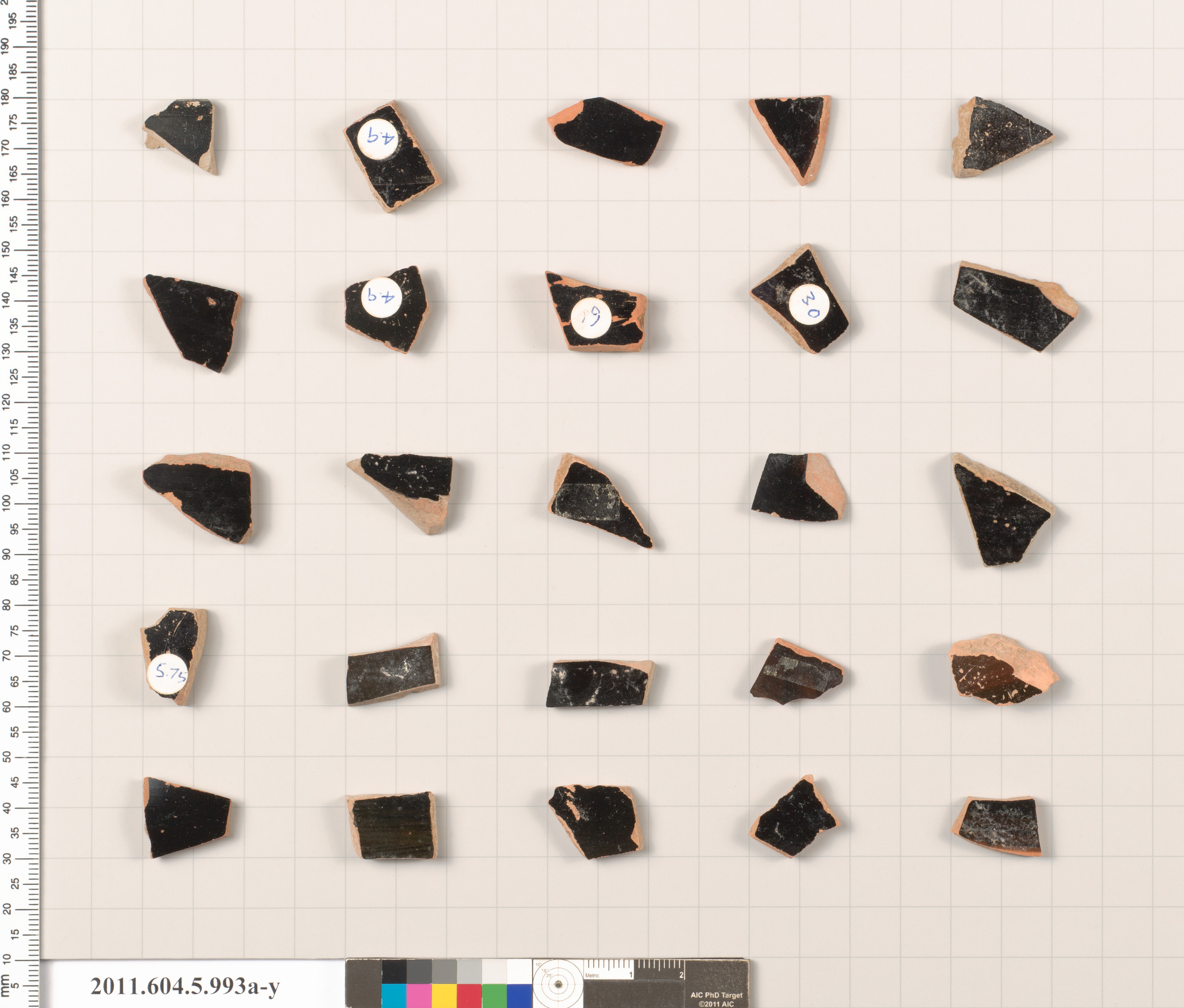
The Dialectics of Absence and Presence: Terracotta Fragments and the Architecture of Old Money Silence
The terracotta fragments of Attic kylikes—those shallow, two-handled drinking cups that once passed between aristocratic hands in symposia—are not artifacts of conviviality alone. They are, in their broken state, profound meditations on the nature of *finish* and *incompletion*. For the 2026 Old Money silhouette, these shards offer a counterintuitive lesson: that true luxury is not found in the surface’s perfection, but in the structural integrity of what remains after the decoration has been worn away. This paper argues that the Lauren Fashion Heritage Lab, drawing from the internal genetic code of the *Hunting* and *Udumbara Temple Plaque* dialectic, can translate the terracotta’s material truth into a silhouette that embodies *Heritage-Black*—a color that is not a hue, but a condition of accumulated time.
The Terracotta Fragment as a Record of Ritual Violence
The kylix was an instrument of the symposium, a ritualized space where Greek aristocracy performed *arete*—excellence and virtue. Its painted scenes, often depicting mythological hunts or athletic contests, were not mere decoration. They were the visual equivalent of the *Hunting* tapestry’s “dynamic fleshiness.” The red-figure technique, where the clay body is left exposed as the figure, while the background is painted black, creates a tension between the figure’s presence and the void that defines it. In a fragment, this tension is amplified. We see a hunter’s arm, a horse’s hoof, a deer’s eye—but the rest is gone. The violence of the hunt is echoed by the violence of time, which has shattered the cup.
This is the aesthetic of the *critical experience* that the internal code describes: “life’s meaning lies in this borderline experience of facing death, in every heartbeat-accelerating *here and now*.” The terracotta fragment preserves that heartbeat. It is not a serene object. It is a record of a moment when the cup was dropped, when the symposium ended, when the clay was fired and then broken. For the 2026 Old Money silhouette, this translates into a rejection of the pristine. The *Heritage-Black* wool of a double-breasted overcoat, for instance, should not be a flat, synthetic black. It should be a black that has been “fired” through a slow, natural dye process, producing a surface that absorbs light unevenly, like the unglazed interior of a kylix. The silhouette’s cut—a severe, architectural shoulder, a narrow lapel that tapers like a kylix stem—must mimic the fragment’s broken edge. It must suggest that the garment has been *extracted* from a larger whole, not *constructed* from a pattern.
The Udumbara Principle: Absence as Structural Load
The *Udumbara Temple Plaque* teaches that beauty lies in absence. The udumbara flower blooms once every three thousand years—a metaphor for a truth that can never be fully present. The plaque’s weathered wood, its nearly illegible characters, are not failures. They are the materialization of *śūnyatā*—emptiness. The terracotta fragment, in its broken state, performs a similar function. The missing half of the kylix is not a loss; it is a *load-bearing void*. It forces the viewer to complete the form mentally, to project the missing hunter, the missing deer, the missing moment of triumph.
This is the core of the 2026 Old Money silhouette’s innovation. The silhouette must not be *full*. It must be *articulated through absence*. Consider a cashmere cardigan in *Heritage-Black*. Its silhouette should not be a simple, draped shape. Instead, it should be structured with deliberate “negative spaces”—a dropped shoulder that creates a void between the sleeve and the torso, a hem that is asymmetrically cut, as if the fabric has been torn by time. The buttons, if present, should be of unpolished horn or bone, resembling the terracotta’s fired clay—matte, warm, and slightly irregular. This is not a garment that announces itself. It is a garment that *withholds* itself, inviting the wearer to complete its meaning.
The Symposiast’s Stance: Posture as Heritage
The kylix was not merely held; it was *worn* in the hand. The Greek symposiast reclined on a *kline*, the cup balanced between thumb and forefinger, the arm extended in a gesture of offering or challenge. This posture—the aristocratic *sprezzatura* of controlled abandon—is the key to the 2026 silhouette’s *stance*. The *Heritage-Black* garments must not be designed for static display. They must be designed for the *critical moment*—the moment of action, of transition, of the hunt.
A Lauren Fashion trench coat, for instance, should have a collar that can be turned up with a single, decisive motion, like a hunter adjusting his cloak. The fabric—a densely woven wool-cashmere blend—should be heavy enough to drape like the terracotta’s clay, but light enough to move with the body’s *dynamic fleshiness*. The silhouette’s line should be *unfinished* at the edges: raw hems, exposed seams, a lining that peeks out like the kylix’s red-figure interior. This is not a garment for the boardroom. It is a garment for the *symposium of life*—a ritualized space where the wearer performs their heritage.
The Dialectic Resolved: Heritage-Black as the Color of Time
The internal code presents a binary: the *Hunting*’s embrace of violent presence versus the *Udumbara Plaque*’s contemplation of absent void. The terracotta fragment, however, offers a synthesis. It is both present (the fired clay, the surviving figure) and absent (the broken edge, the lost scene). It is both the hunter’s triumph and the plaque’s patience. The *Heritage-Black* of the 2026 silhouette is this synthesis made material.
*Heritage-Black* is not a color in the traditional sense. It is a *condition*—the result of generations of wear, of sunlight and shadow, of the slow accumulation of oils from human hands. It is the black of the kylix’s background, which has been fired and then worn down to reveal the clay beneath. It is the black of the *Udumbara Plaque*’s wood, darkened by incense smoke and time. For the 2026 collection, this means using a dye process that *builds* black through layers of indigo, logwood, and iron, rather than applying it in a single, opaque bath. The resulting fabric will have depth—a black that is not flat, but *deep*, like the interior of a kylix after the wine has been drained.
Conclusion: The Fragment as Future
The terracotta fragments of Attic kylikes are not relics of a lost past. They are blueprints for a future in which luxury is defined not by novelty, but by *duration*. The 2026 Old Money silhouette, informed by the *Hunting*’s intensity and the *Udumbara Plaque*’s patience, will be a silhouette of *broken perfection*—a silhouette that acknowledges that the most beautiful objects are those that have survived their own destruction. In *Heritage-Black*, this silhouette will not shout. It will whisper, like the wind through a broken cup, carrying the memory of a thousand symposia, a thousand hunts, a thousand flowers that never bloomed. This is the Lauren Fashion heritage: not the preservation of the intact, but the curation of the fragment that contains the whole.
Heritage Lab Insight
Genetic Bridge: Archive node focusing on Heritage-Black craftsmanship.