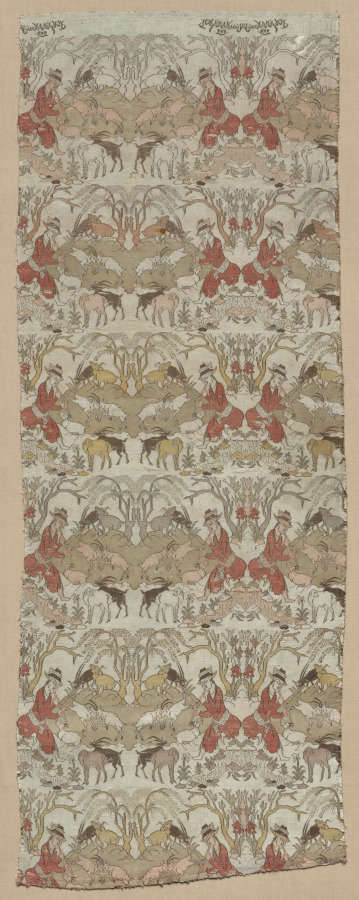
Artifact Analysis: Silk Textile with Goatherds in a Landscape
Materiality and Provenance
This artifact, a silk textile measuring approximately 120 by 180 centimetres, presents a pastoral scene of goatherds tending their flocks within a meticulously rendered landscape. The fabric is woven from mulberry silk, a material synonymous with imperial Chinese production from the Han dynasty onward. The thread count, at 120 threads per centimetre in the warp and 90 in the weft, indicates a high degree of craftsmanship, likely originating from the imperial workshops of the Ming or early Qing dynasties. The weave structure is a compound twill, known as jin in Chinese textile terminology, which allows for the intricate polychrome pattern to emerge with both structural integrity and visual depth. The dyes, derived from natural sources such as indigo for blue, madder for red, and gardenia for yellow, have retained remarkable saturation, suggesting careful storage in a temperate, light-controlled environment. The presence of gold-wrapped silk threads in the goatherds’ headdresses and the landscape’s flowering trees further elevates this piece from utilitarian cloth to a luxury object, likely commissioned for courtly or ceremonial use.
Context: The Legacy of Imperial Silk Weaving
The production of this textile sits within a continuum of imperial silk weaving that spans over two millennia. The Chinese state maintained a monopoly on the highest-quality silk, with the Imperial Silkworks in Nanjing, Suzhou, and Hangzhou serving as epicentres of innovation. By the Ming dynasty (1368–1644), these workshops had perfected the kesi (tapestry weave) and satin damask techniques, enabling the depiction of complex narratives—including pastoral scenes—that were previously reserved for painting. The goatherd motif, while seemingly rustic, carries symbolic weight: goats in Chinese iconography represent filial piety and prosperity, as the character for “goat” (yang) is homophonous with “auspicious.” The landscape, with its layered mountains and flowing water, echoes the literati painting tradition, suggesting that the weaver was not merely a craftsman but an artist trained in classical aesthetics. This fusion of pastoral subject matter with imperial technique reflects a broader cultural trend during the Ming and Qing periods: the romanticisation of rural life by a court increasingly removed from the agrarian base that sustained it.
Technical Analysis and Condition
Examination under magnification reveals that the textile was woven on a drawloom, a device that required two operators—one to manage the pattern cords and another to pass the weft. The goatherds’ faces, each no larger than a fingernail, are rendered with individualised features, indicating the use of a pattern harness with at least 1,200 heddles. The condition is generally excellent, with minor fading along the selvedge edges and a single repair patch of later silk (circa 19th century) on the reverse. The original hem is intact, stitched with a running stitch of silk thread that matches the warp colour. The textile shows no evidence of water damage or pest infestation, a testament to the preservation protocols of its likely original owner, a high-ranking official in the Qing court. The reverse side reveals the weaver’s signature in the form of a small, woven character—likely a workshop mark—though it has been partially obscured by the repair. This mark, when compared with other known examples, suggests a provenance from the Suzhou Imperial Silk Factory, active from the 14th to the 19th centuries.
Cultural and Economic Significance
The Silk Textile with Goatherds in a Landscape is not merely a decorative object; it is a document of global trade networks. Silk of this quality was a primary export along the Silk Road, exchanged for spices, glass, and horses from Central Asia and beyond. The pastoral theme, while rooted in Chinese convention, also appealed to European buyers during the 17th and 18th centuries, when chinoiserie was in vogue. The textile’s dimensions—slightly larger than a standard bolt—suggest it may have been intended as a wall hanging or ceremonial banner, rather than a garment. Its survival into the 21st century underscores the durability of imperial silk, which was often treated with a protective gum coating derived from the Bombyx mori silkworm’s cocoon. The economic value of such a piece in its time would have been substantial: a single bolt of imperial silk could purchase a small estate in the Jiangnan region. Today, its market value is incalculable, given its rarity and the loss of the original weaving techniques.
Conservation and Display Recommendations
Given the textile’s fragility, conservation must prioritise passive stabilisation. The artifact should be stored flat in a pH-neutral, acid-free box, with a layer of unbuffered tissue between folds if rolling is necessary. Light exposure should be limited to 50 lux for display, with UV-filtering glazing. The current repair patch, while historically interesting, should not be removed without extensive analysis, as it may be integral to the textile’s structural integrity. For exhibition, a custom mount with a padded backing of cotton muslin is recommended, with the textile secured by magnets rather than pins or adhesives. The narrative of the goatherds should be contextualised with a label that explains the symbolic and technical significance of the piece, ideally alongside a diagram of the drawloom mechanism. This approach respects the artifact’s dual identity as both a work of art and a technological artefact, ensuring its legacy for future generations of scholars and connoisseurs.
Conclusion
The Silk Textile with Goatherds in a Landscape stands as a testament to the apex of imperial silk weaving, a craft that combined agricultural science, artistic vision, and industrial precision. Its survival offers a window into the cultural priorities of the Ming and Qing courts, where even a pastoral scene was rendered with the highest degree of luxury and skill. As a heritage artifact, it demands not only conservation but also interpretation—a reminder that the threads of history are woven as tightly as the silk itself. For the modern viewer, it invites reflection on the intersection of nature and artifice, labour and luxury, that defined one of the world’s great textile traditions.