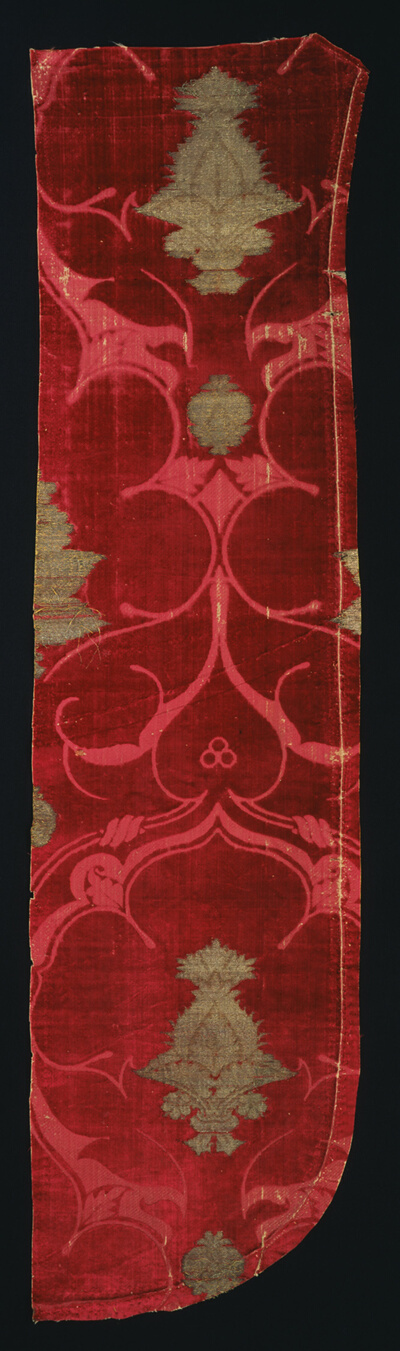
A Discreet Assertion of Excellence: Interrogating a Fragment
One does not, as a rule, begin an appraisal with a fragment. The very notion runs counter to the principles of a proper establishment, where a garment is presented in its entirety, a resolved statement of intent and execution. Yet, here we are. This particular artefact—a modest swatch, if you will—compels a reassessment of that principle. It is not a garment, but the pure, unadulterated grammar from which a garment of consequence was once composed. To the untrained eye, a mere scrap of rich fabric. To the discerning, a manifesto woven in silk and gold.
The Foundation: A Ground of Unspoken Quality
Let us first address the ground. A satin weave, specifically a silk satin of a certain weight and sheen, provides the foundational discourse. The choice is deliberate. Satin affords a surface of uninterrupted, fluid luminosity, a perfect, placid pool against which the subsequent elements may perform. This is the equivalent of a superior woolen cloth from the lesser-known mills of Huddersfield: it does not shout, but its depth of character, its hand, its quiet authority, is the essential precondition for everything that follows. It is the impeccable canvas, the silent partner of unquestionable virtue.
The First Embellishment: The Brocaded Line
Upon this ground, we observe the application of supplementary brocading wefts, bound by the main warps in a twill interlacing. This is where the narrative gains its initial inflection. The brocading weft—here, we must presume, the gilt-metal-strip-wrapped silk—is not merely laid upon the surface; it is architecturally integrated into the very structure of the cloth. The twill binding provides a subtle, diagonal discipline to the metallic element, preventing gaudiness and ensuring durability. This is not appliqué; this is inherent to the cloth's identity. Consider it the precise, functional top-stitching on a lapel or the perfectly aligned pattern matching across a chest piece: an enhancement that is structural, not superficial. The line it creates is not painted on; it is built in.
The Pinnacle: The Voided Velvet Pile
Then, we come to the pièce de résistance, the element that elevates this from merely excellent cloth to a relic of profound artistry: the supplementary pile warps forming a cut, voided velvet. The technique is of staggering complexity. Supplementary warps are introduced to rise in loops above the satin ground, which are then meticulously cut to create that plush, tactile pile. The term "voided" is crucial: the velvet pattern is not a solid mass, but a design—likely a foliate or symbolic motif—where the pile exists only in specific areas, the glorious satin ground revealing itself in negative space. This represents a double mastery: the control to create the lush, absorptive texture of velvet, and the artistic restraint to deploy it only where it will have maximum effect. The tactile contrast between the cool, reflective satin and the warm, light-hungry velvet is a dialogue of sensations. In sartorial terms, this is the equivalent of combining a robust tweed with the finest cashmere lining—a considered, experiential contrast that speaks to a deep understanding of material conversation.
Context and Connoisseurship: The Chasuble
The context provided—a fragment from a chasuble—illuminates everything. This was not for a drawing room or a promenade. This was for the altar, for a moment of supreme ritual. The craftsmanship, therefore, served a dual purpose: to honour the divine through the absolute apex of human skill, and to communicate sacred authority through a visual and tactile language understood by all. The silk speaks of rarity and the arduous journey from East to West. The gilt-metal thread speaks of celestial light. The voided velvet, often used for important ecclesiastical and heraldic textiles, signifies a plane of existence both of this world and beyond it—tangible yet elevated.
The "fluid elegance" noted is not the effortless drape of a simple silk, but the authoritative fluidity of a cloth so supremely confident in its own construction that it moves with a heavy, dignified grace. One can imagine how such a chasuble would behave in the candlelight of a cathedral: the satin grounds catching and throwing soft illumination, the velvet patterns offering deep, solemn pools of colour, the gilt brocading flashing with sudden, reverent fire at the turn of a gesture.
A Legacy in Thread
To hold this fragment is to understand that true luxury resides not in ostentation, but in resolved complexity. Every technical decision—the satin base, the twill-bound brocade, the voided velvet—serves a deliberate aesthetic and functional end. There is no superfluity. Each element supports the other, resulting in an object where the whole is vastly greater than the sum of its technically magnificent parts. This is the very essence of heritage craftsmanship, whether in the ateliers of historic Lyon or the tailoring halls of Savile Row. It is a commitment to an ideal that transcends utility, becoming an articulation of culture, belief, and an unwavering standard.
This silk fragment, therefore, is far from a broken remnant. It is a complete thesis on excellence. It asserts that heritage is not a passive inheritance, but an active, demanding language of materials, techniques, and intent. It reminds us that before the garment, before the ceremony, before the house style, there is the cloth. And in this fragment, the cloth is sovereign.